development of the syntactic system in middle english and early new english

PPTX 20 sahifa 849,9 KB Bepul yuklash

Sahifa ko'rinishi (5 sahifa)

Pastga aylantiring 👇
1 / 20
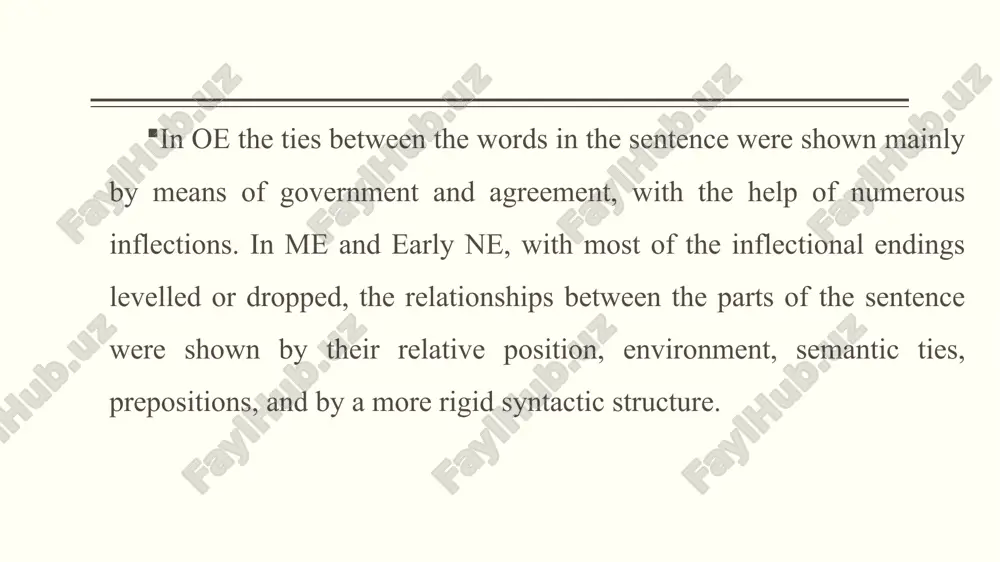
development of the syntactic system in middle english and early new english development of the syntactic system in middle english and early new english primechanie. chtobi izmenit izobrajenie na etom slayde, viberite risunok i udalite ego. zatem najmite znachok «risunki» v zapolnitele, chtobi vstavit izobrajenie. 1 outline general remarks the sentence structure word order the phrase: noun, adjective and verb patterns 2 general remarks the most obvious difference between oe syntax and the syntax of the me and ne periods is that the word order became more strict and the use of prepositions more extensive. the growth of the literary forms of the language, the literary flourishing in late me and especially in the age of the renaissance, the differentiation of literary styles and the efforts made by 18th c. scholars to develop a logical, elegant style – all contributed to the improvement and perfection of english syntax. in oe …
2 / 20
.’ the use of the verb-substitute do, as well as the use of auxiliary and modal verbs without the notional verb proves that the position of the predicate could not be vacant either. this can be seen in the following examples with the notional verb left out, e.g.: helpeth me now, as i dyde yow whileer. (chaucer) ‘help me now as i did (help) you formerly.’ as compared with oe the subject of the sentence became more varied in meaning, as well as in the forms of expression. due to the growth of new verb forms the subject could now denote not only the agent or a thing characterized by a certain property, but also the recipient of an action or the “passive” subject of a state and feeling. the predicate had likewise become more varied in form and meaning. the simple predicate could be expressed by compound forms which …
3 / 20
e bring nat every man into thyn hous. (chaucer) ‘don’t bring every man into your house.’ in shakespeare’s time the use of negations is variable: the sentence could contain one or more means of expressing negation. cf.: so it is not with me as with that muse… good madam, hear me speak, and let no quarrel, nor no brawl to come… (shakespeare) gradually multiple negation went out of use. in the age of correctness – the normalizing 18th c. – when the scholars tried to improve and perfect the language, multiple negation was banned as illogical. these logical restrictions on the use of negations became a strict rule of english grammar. word order. in me and early ne the order of words in the sentence underwent noticeable changes: it had become fixed and direct: subject plus predicate plus object (s+p+o) or subject plus the notional part of the predicate (used …
4 / 20
rose.” (shakespeare) the phrase: noun, adjective and verb patterns in oe the dependent components of noun patterns agreed with the noun in case, number and gender, if they were expressed by adjectives, adjective-pronouns or participles. if expressed by nouns, they either agreed with the head noun in case and number (nouns in apposition) or had the form of the genitive case. by late me agreement in noun patterns had practically disappeared, except for some instances of agreement in number. formal markers of number had been preserved in nouns, demonstrative pronouns and some survivals of the strong declension of adjectives; most adjectives and adjectivised participles had lost number inflections by the age of chaucer; cf. a few phrases from chaucer: sg.:… this holy maiden… that requeste pl.: these wodes eek recoveren grene. ‘these woods become green again’. sg.: a good man was ther of religioun. ‘there was a good man, a …
5 / 20
‘s-genitive was less restricted than in mod e, so that inanimate nouns commonly occurred as inflectional genitive in a noun pattern: fadres sone ‘father’s son’, every shires ende ‘end of every shire’. yet the use of prepositions had become more extensive: the sergeaunts of the toun of rome ‘the officials of the town of rome’. in the age of literary renaissance, the noun patterns became fixed syntactic frames in which every position had a specific functional significance. the attribute in pre-position was enclosed between the determiner and the head-word; hence every word occupying this position was an attribute. the position of the head-noun could not be left vacant – it was at that time that the indefinite pronoun one and the demonstrative that began to be used as the so-called “prop-words”, e.g. a barren-spirited fellow, one that feeds on abject orts and imitations… (shakespeare) with the growth of the written …

Ko'proq o'qimoqchimisiz?

Barcha 20 sahifani Telegram orqali bepul yuklab oling.

To'liq faylni yuklab olish

"development of the syntactic system in middle english and early new english" haqida

development of the syntactic system in middle english and early new english development of the syntactic system in middle english and early new english primechanie. chtobi izmenit izobrajenie na etom slayde, viberite risunok i udalite ego. zatem najmite znachok «risunki» v zapolnitele, chtobi vstavit izobrajenie. 1 outline general remarks the sentence structure word order the phrase: noun, adjective and verb patterns 2 general remarks the most obvious difference between oe syntax and the syntax of the me and ne periods is that the word order became more strict and the use of prepositions more extensive. the growth of the literary forms of the language, the literary flourishing in late me and especially in the age of the renaissance, the differentiation …

Bu fayl PPTX formatida 20 sahifadan iborat (849,9 KB). "development of the syntactic system in middle english and early new english"ni yuklab olish uchun chap tomondagi Telegram tugmasini bosing.

Teglar: development of the syntactic sy… PPTX 20 sahifa Bepul yuklash Telegram