developing effective speaking activities

DOCX 5 pages 39.7 KB Free download

Page preview (5 pages)

Scroll down 👇
1 / 5
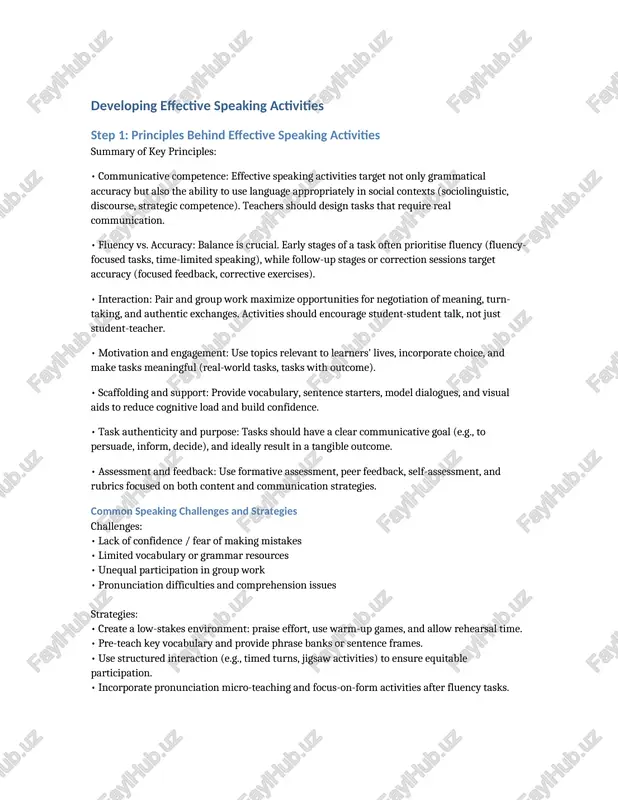
developing effective speaking activities step 1: principles behind effective speaking activities summary of key principles: • communicative competence: effective speaking activities target not only grammatical accuracy but also the ability to use language appropriately in social contexts (sociolinguistic, discourse, strategic competence). teachers should design tasks that require real communication. • fluency vs. accuracy: balance is crucial. early stages of a task often prioritise fluency (fluency-focused tasks, time-limited speaking), while follow-up stages or correction sessions target accuracy (focused feedback, corrective exercises). • interaction: pair and group work maximize opportunities for negotiation of meaning, turn-taking, and authentic exchanges. activities should encourage student-student talk, not just student-teacher. • motivation and engagement: use topics relevant to learners' lives, incorporate choice, and make tasks meaningful (real-world tasks, tasks with outcome). • scaffolding and support: provide vocabulary, sentence starters, model dialogues, and visual aids to reduce cognitive load and build confidence. • task authenticity and purpose: …
2 / 5
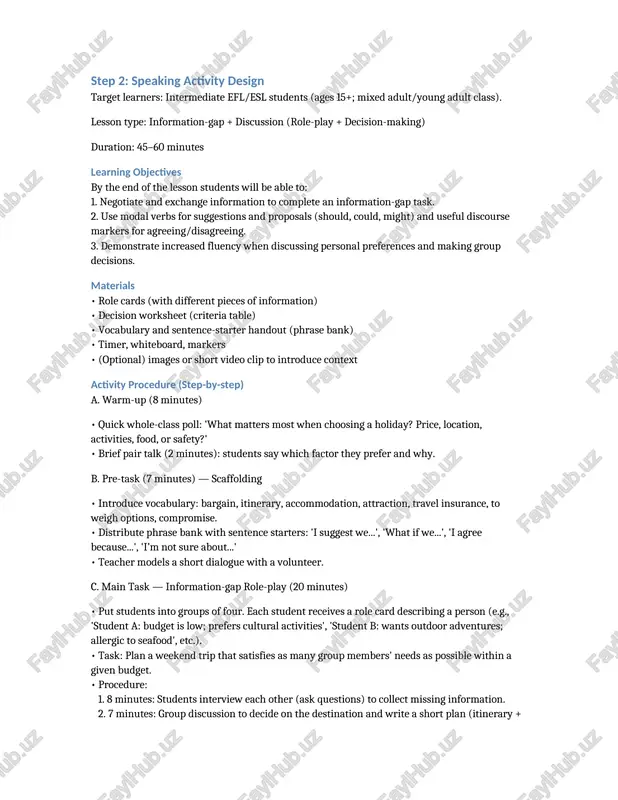
micro-teaching and focus-on-form activities after fluency tasks. step 2: speaking activity design target learners: intermediate efl/esl students (ages 15+; mixed adult/young adult class). lesson type: information-gap + discussion (role-play + decision-making) duration: 45–60 minutes learning objectives by the end of the lesson students will be able to: 1. negotiate and exchange information to complete an information-gap task. 2. use modal verbs for suggestions and proposals (should, could, might) and useful discourse markers for agreeing/disagreeing. 3. demonstrate increased fluency when discussing personal preferences and making group decisions. materials • role cards (with different pieces of information) • decision worksheet (criteria table) • vocabulary and sentence-starter handout (phrase bank) • timer, whiteboard, markers • (optional) images or short video clip to introduce context activity procedure (step-by-step) a. warm-up (8 minutes) • quick whole-class poll: 'what matters most when choosing a holiday? price, location, activities, food, or safety?' • brief pair talk (2 …
3 / 5
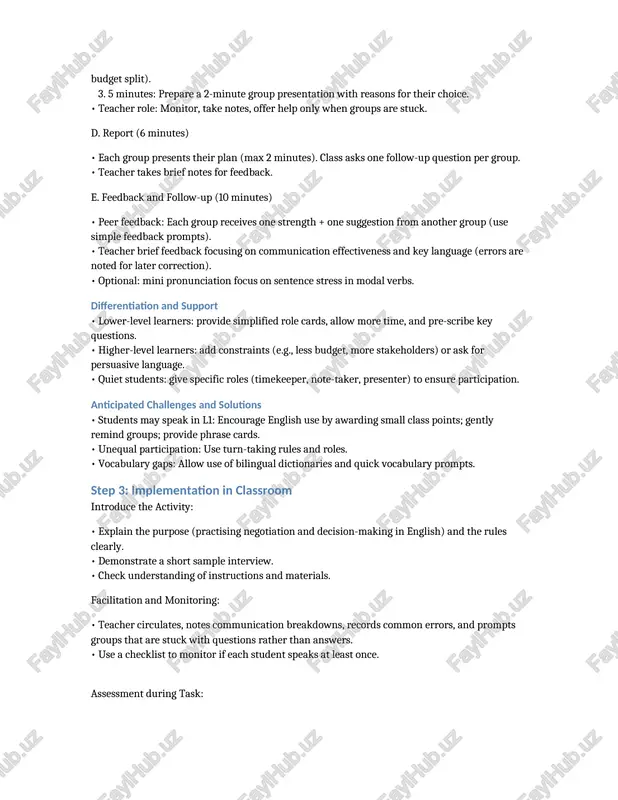
discussion to decide on the destination and write a short plan (itinerary + budget split). 3. 5 minutes: prepare a 2-minute group presentation with reasons for their choice. • teacher role: monitor, take notes, offer help only when groups are stuck. d. report (6 minutes) • each group presents their plan (max 2 minutes). class asks one follow-up question per group. • teacher takes brief notes for feedback. e. feedback and follow-up (10 minutes) • peer feedback: each group receives one strength + one suggestion from another group (use simple feedback prompts). • teacher brief feedback focusing on communication effectiveness and key language (errors are noted for later correction). • optional: mini pronunciation focus on sentence stress in modal verbs. differentiation and support • lower-level learners: provide simplified role cards, allow more time, and pre-scribe key questions. • higher-level learners: add constraints (e.g., less budget, more stakeholders) or ask for …
4 / 5
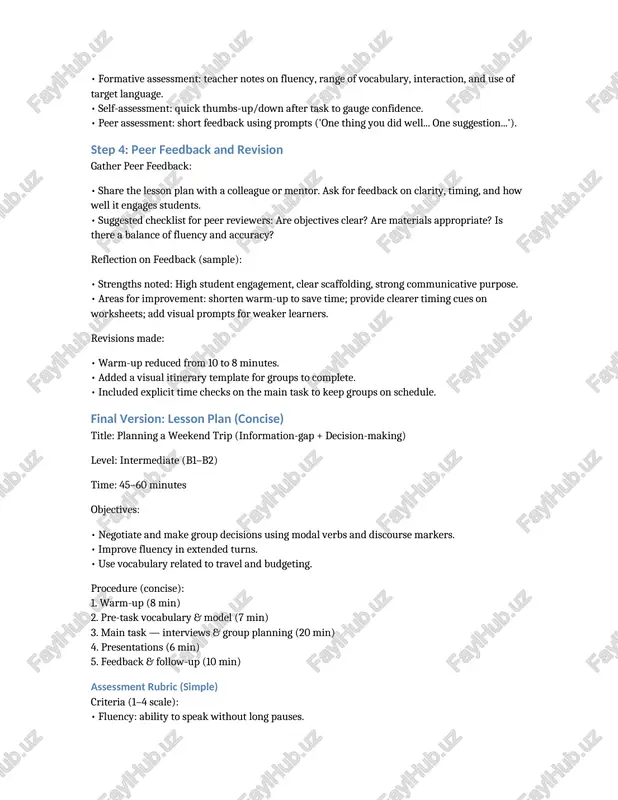
interaction, and use of target language. • self-assessment: quick thumbs-up/down after task to gauge confidence. • peer assessment: short feedback using prompts ('one thing you did well... one suggestion...'). step 4: peer feedback and revision gather peer feedback: • share the lesson plan with a colleague or mentor. ask for feedback on clarity, timing, and how well it engages students. • suggested checklist for peer reviewers: are objectives clear? are materials appropriate? is there a balance of fluency and accuracy? reflection on feedback (sample): • strengths noted: high student engagement, clear scaffolding, strong communicative purpose. • areas for improvement: shorten warm-up to save time; provide clearer timing cues on worksheets; add visual prompts for weaker learners. revisions made: • warm-up reduced from 10 to 8 minutes. • added a visual itinerary template for groups to complete. • included explicit time checks on the main task to keep groups on schedule. …
5 / 5
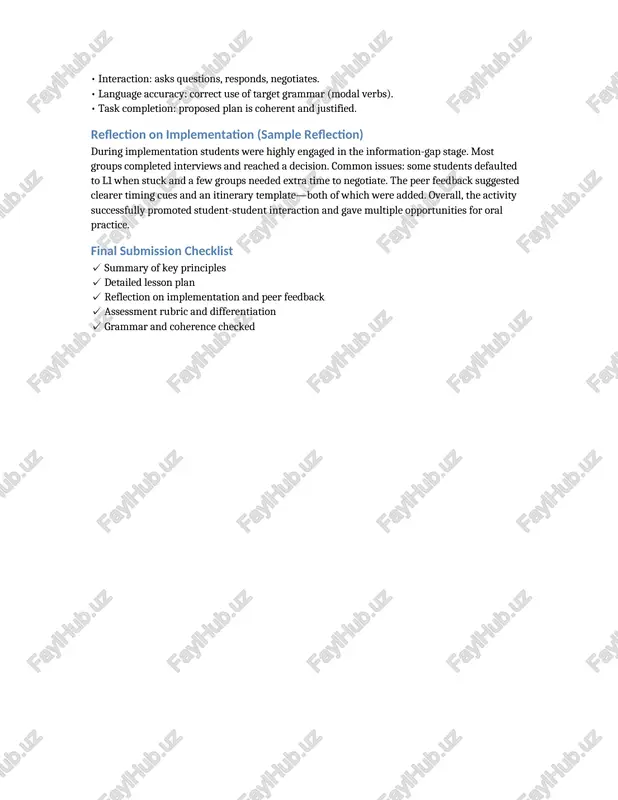
ed to l1 when stuck and a few groups needed extra time to negotiate. the peer feedback suggested clearer timing cues and an itinerary template—both of which were added. overall, the activity successfully promoted student-student interaction and gave multiple opportunities for oral practice. final submission checklist ✓ summary of key principles ✓ detailed lesson plan ✓ reflection on implementation and peer feedback ✓ assessment rubric and differentiation ✓ grammar and coherence checked /docprops/thumbnail.jpeg

Want to read more?

Download all 5 pages for free via Telegram.

Download full file

About "developing effective speaking activities"

developing effective speaking activities step 1: principles behind effective speaking activities summary of key principles: • communicative competence: effective speaking activities target not only grammatical accuracy but also the ability to use language appropriately in social contexts (sociolinguistic, discourse, strategic competence). teachers should design tasks that require real communication. • fluency vs. accuracy: balance is crucial. early stages of a task often prioritise fluency (fluency-focused tasks, time-limited speaking), while follow-up stages or correction sessions target accuracy (focused feedback, corrective exercises). • interaction: pair and group work maximize opportunities for negotiation of meaning, turn-taking, and authentic exchanges. activities should encourage s...

This file contains 5 pages in DOCX format (39.7 KB). To download "developing effective speaking activities", click the Telegram button on the left.
Tags: developing effective speaking a… DOCX 5 pages Free download Telegram