teaching a foreign language through computer technologies

DOCX 10 pages 30.1 KB Free download

Page preview (5 pages)

Scroll down 👇
1 / 10
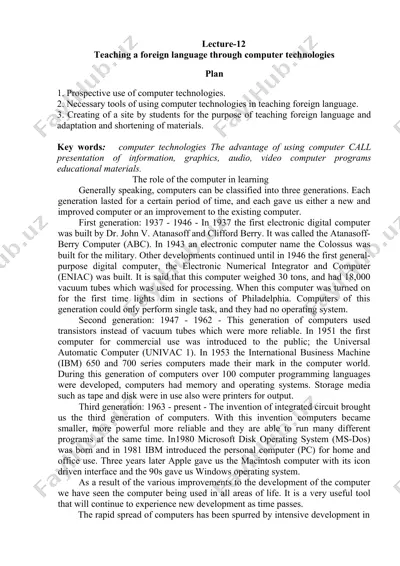
lecture-12 teaching a foreign language through computer technologies plan 1. prospective use of computer technologies. 2. necessary tools of using computer technologies in teaching foreign language. 3. creating of a site by students for the purpose of teaching foreign language and adaptation and shortening of materials. key words: computer technologies the advantage of using computer call presentation of information, graphics, audio, video computer programs educational materials. the role of the computer in learning generally speaking, computers can be classified into three generations. each generation lasted for a certain period of time, and each gave us either a new and improved computer or an improvement to the existing computer. first generation: 1937 - 1946 - in 1937 the first electronic digital computer was built by dr. john v. atanasoff and clifford berry. it was called the atanasoff-berry computer (abc). in 1943 an electronic computer name the colossus was built for the …
2 / 10
se also were printers for output. third generation: 1963 - present - the invention of integrated circuit brought us the third generation of computers. with this invention computers became smaller, more powerful more reliable and they are able to run many different programs at the same time. in1980 microsoft disk operating system (ms-dos) was born and in 1981 ibm introduced the personal computer (pc) for home and office use. three years later apple gave us the macintosh computer with its icon driven interface and the 90s gave us windows operating system. as a result of the various improvements to the development of the computer we have seen the computer being used in all areas of life. it is a very useful tool that will continue to experience new development as time passes. the rapid spread of computers has been spurred by intensive development in the field of computer technology. now …
3 / 10
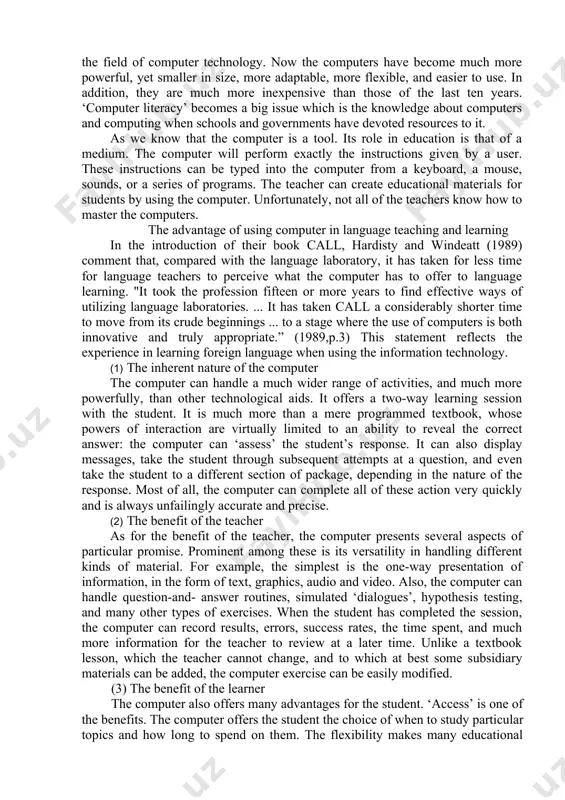
years to find effective ways of utilizing language laboratories. ... it has taken call a considerably shorter time to move from its crude beginnings ... to a stage where the use of computers is both innovative and truly appropriate.” (1989,p.3) this statement reflects the experience in learning foreign language when using the information technology. (1) the inherent nature of the computer the computer can handle a much wider range of activities, and much more powerfully, than other technological aids. it offers a two-way learning session with the student. it is much more than a mere programmed textbook, whose powers of interaction are virtually limited to an ability to reveal the correct answer: the computer can ‘assess’ the student’s response. it can also display messages, take the student through subsequent attempts at a question, and even take the student to a different section of package, depending in the nature of the …
4 / 10
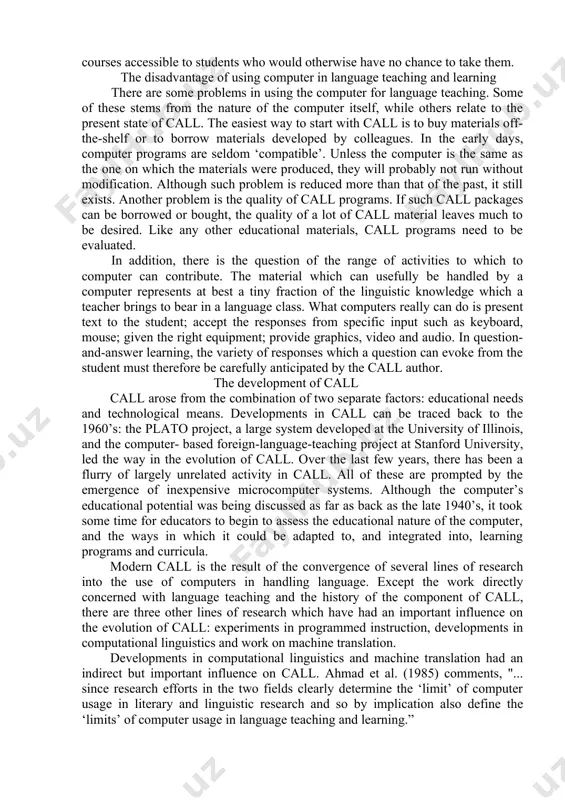
fits. the computer offers the student the choice of when to study particular topics and how long to spend on them. the flexibility makes many educational courses accessible to students who would otherwise have no chance to take them. the disadvantage of using computer in language teaching and learning there are some problems in using the computer for language teaching. some of these stems from the nature of the computer itself, while others relate to the present state of call. the easiest way to start with call is to buy materials off-the-shelf or to borrow materials developed by colleagues. in the early days, computer programs are seldom ‘compatible’. unless the computer is the same as the one on which the materials were produced, they will probably not run without modification. although such problem is reduced more than that of the past, it still exists. another problem is the quality of …
5 / 10
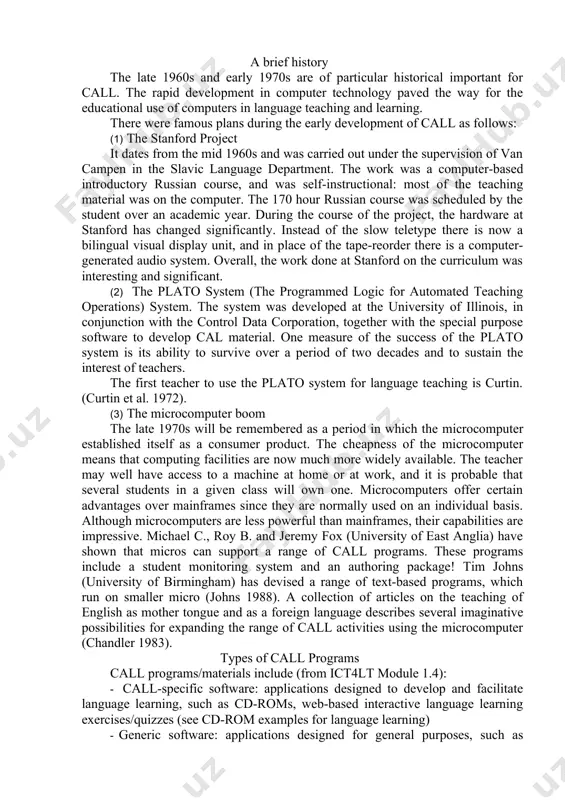
based foreign-language-teaching project at stanford university, led the way in the evolution of call. over the last few years, there has been a flurry of largely unrelated activity in call. all of these are prompted by the emergence of inexpensive microcomputer systems. although the computer’s educational potential was being discussed as far as back as the late 1940’s, it took some time for educators to begin to assess the educational nature of the computer, and the ways in which it could be adapted to, and integrated into, learning programs and curricula. modern call is the result of the convergence of several lines of research into the use of computers in handling language. except the work directly concerned with language teaching and the history of the component of call, there are three other lines of research which have had an important influence on the evolution of call: experiments in programmed instruction, …

Want to read more?

Download all 10 pages for free via Telegram.

Download full file

About "teaching a foreign language through computer technologies"

lecture-12 teaching a foreign language through computer technologies plan 1. prospective use of computer technologies. 2. necessary tools of using computer technologies in teaching foreign language. 3. creating of a site by students for the purpose of teaching foreign language and adaptation and shortening of materials. key words: computer technologies the advantage of using computer call presentation of information, graphics, audio, video computer programs educational materials. the role of the computer in learning generally speaking, computers can be classified into three generations. each generation lasted for a certain period of time, and each gave us either a new and improved computer or an improvement to the existing computer. first generation: 1937 - 1946 - in 1937 the first electro...

This file contains 10 pages in DOCX format (30.1 KB). To download "teaching a foreign language through computer technologies", click the Telegram button on the left.
Tags: teaching a foreign language thr… DOCX 10 pages Free download Telegram