action noun forms in old uzbek

DOCX 21 pages 39.0 KB Free download

Page preview (5 pages)

Scroll down 👇
1 / 21
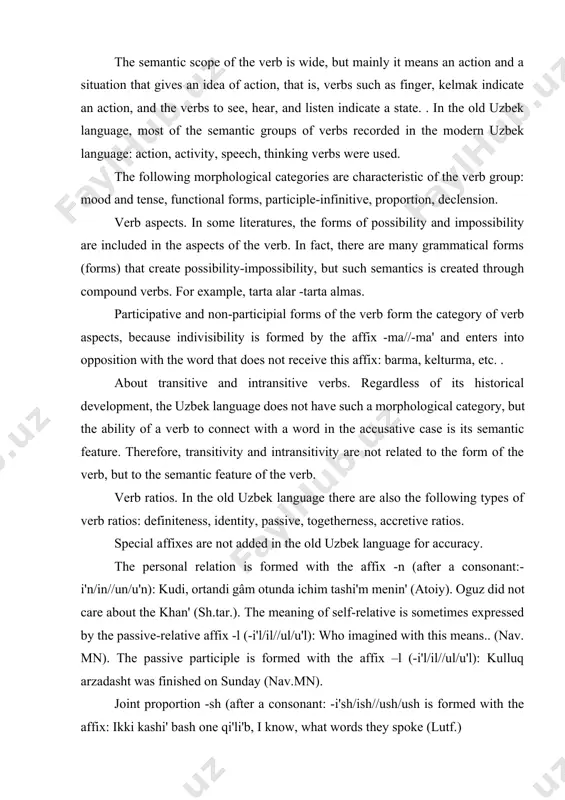
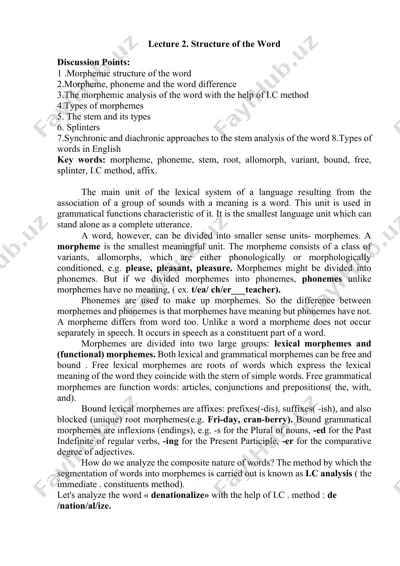
adverbs of manner plan: 1. action noun forms in old uzbek. 2. approachable. 3. adjective of manner the semantic scope of the verb is wide, but mainly it means an action and a situation that gives an idea of action, that is, verbs such as finger, kelmak indicate an action, and the verbs to see, hear, and listen indicate a state. . in the old uzbek language, most of the semantic groups of verbs recorded in the modern uzbek language: action, activity, speech, thinking verbs were used. the following morphological categories are characteristic of the verb group: mood and tense, functional forms, participle-infinitive, proportion, declension. verb aspects. in some literatures, the forms of possibility and impossibility are included in the aspects of the verb. in fact, there are many grammatical forms (forms) that create possibility-impossibility, but such semantics is created through compound verbs. for example, tarta alar -tarta almas. participative …
2 / 21
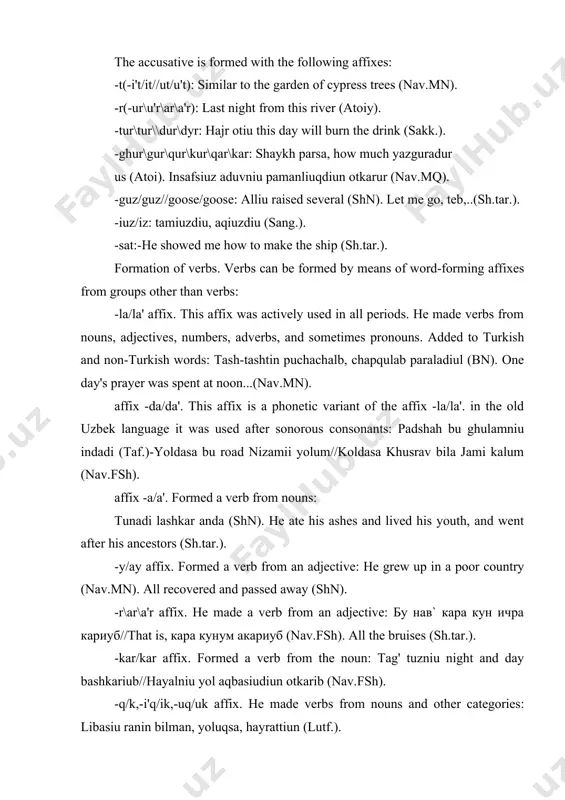
sometimes expressed by the passive-relative affix -l (-i'l/il//ul/u'l): who imagined with this means.. (nav. mn). the passive participle is formed with the affix –l (-i'l/il//ul/u'l): kulluq arzadasht was finished on sunday (nav.mn). joint proportion -sh (after a consonant: -i'sh/ish//ush/ush is formed with the affix: ikki kashi' bash one qi'li'b, i know, what words they spoke (lutf.) the accusative is formed with the following affixes: -t(-i't/it//ut/u't): similar to the garden of cypress trees (nav.mn). -r(-ur\u'r\ar\a'r): last night from this river (atoiy). -tur\tur\\dur\dyr: hajr otiu this day will burn the drink (sakk.). -ghur\gur\qur\kur\qar\kar: shaykh parsa, how much yazguradur us (atoi). insafsiuz aduvniu pamanliuqdiun otkarur (nav.mq). -guz/guz//goose/goose: alliu raised several (shn). let me go, teb,..(sh.tar.). -iuz/iz: tamiuzdiu, aqiuzdiu (sang.). -sat:-he showed me how to make the ship (sh.tar.). formation of verbs. verbs can be formed by means of word-forming affixes from groups other than verbs: -la/la' affix. this affix was actively used in …
3 / 21
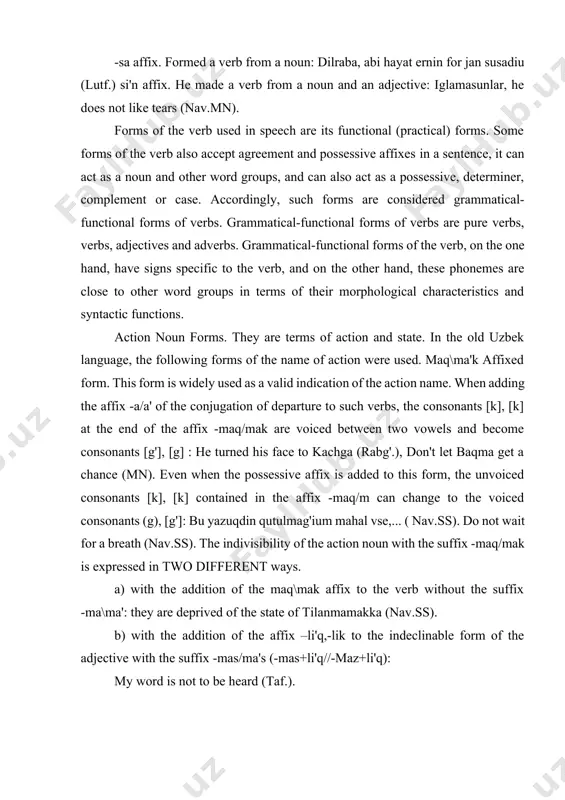
the noun: tag' tuzniu night and day bashkariub//hayalniu yol aqbasiudiun otkarib (nav.fsh). -q/k,-i'q/ik,-uq/uk affix. he made verbs from nouns and other categories: libasiu ranin bilman, yoluqsa, hayrattiun (lutf.). -sa affix. formed a verb from a noun: dilraba, abi hayat ernin for jan susadiu (lutf.) si'n affix. he made a verb from a noun and an adjective: iglamasunlar, he does not like tears (nav.mn). forms of the verb used in speech are its functional (practical) forms. some forms of the verb also accept agreement and possessive affixes in a sentence, it can act as a noun and other word groups, and can also act as a possessive, determiner, complement or case. accordingly, such forms are considered grammatical-functional forms of verbs. grammatical-functional forms of verbs are pure verbs, verbs, adjectives and adverbs. grammatical-functional forms of the verb, on the one hand, have signs specific to the verb, and on the other hand, …
4 / 21
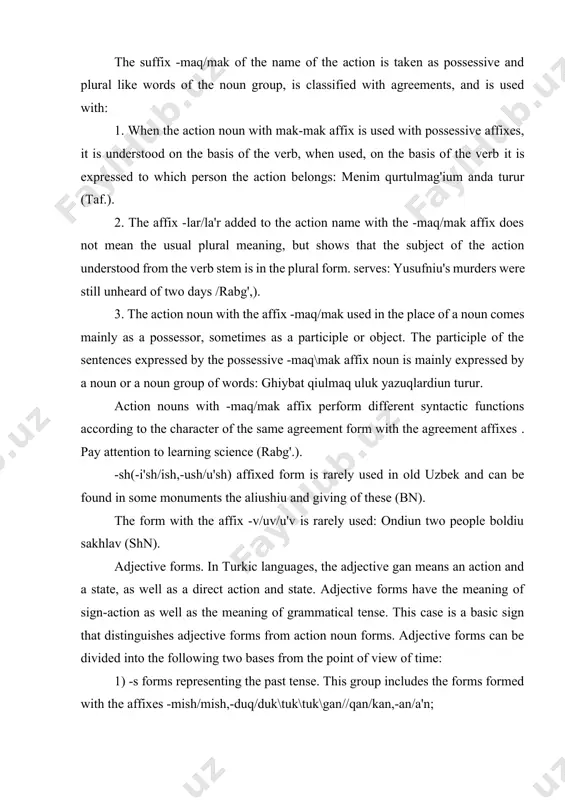
re deprived of the state of tilanmamakka (nav.ss). b) with the addition of the affix –li'q,-lik to the indeclinable form of the adjective with the suffix -mas/ma's (-mas+li'q//-maz+li'q): my word is not to be heard (taf.). the suffix -maq/mak of the name of the action is taken as possessive and plural like words of the noun group, is classified with agreements, and is used with: 1. when the action noun with mak-mak affix is used with possessive affixes, it is understood on the basis of the verb, when used, on the basis of the verb it is expressed to which person the action belongs: menim qurtulmag'ium anda turur (taf.). 2. the affix -lar/la'r added to the action name with the -maq/mak affix does not mean the usual plural meaning, but shows that the subject of the action understood from the verb stem is in the plural form. serves: yusufniu's murders …
5 / 21
ases from the point of view of time: 1) -s forms representing the past tense. this group includes the forms formed with the affixes -mish/mish,-duq/duk\tuk\tuk\gan//qan/kan,-an/a'n; 2) present-future adjective forms. this group consists of forms formed with -r(-ar/a'r\ -ur/ur,\- i'r/ir,\ yur and other affixes). past participles. the adjective with the suffix -gan/ga'n (-qan/kan) is characteristic for all periods of the old uzbek language and its active use, meaning and functions: 1. it is used in the attributive position and represents a determiner. adjectives with the suffix -gan/ga'n in the function form a verb (oborot) and they can be sentences: a) is in possessive + participle form: cherik tushken perge keldildr (rabg'.). we all agree with the words spoken by our two nobles (nahj.far.). b) it is in the form of a word combination: wafa qiul to those who are faithful (mn); 2. -g'an/gan is an adjectival noun and a noun. it …

Want to read more?

Download all 21 pages for free via Telegram.

Download full file

About "action noun forms in old uzbek"

adverbs of manner plan: 1. action noun forms in old uzbek. 2. approachable. 3. adjective of manner the semantic scope of the verb is wide, but mainly it means an action and a situation that gives an idea of action, that is, verbs such as finger, kelmak indicate an action, and the verbs to see, hear, and listen indicate a state. . in the old uzbek language, most of the semantic groups of verbs recorded in the modern uzbek language: action, activity, speech, thinking verbs were used. the following morphological categories are characteristic of the verb group: mood and tense, functional forms, participle-infinitive, proportion, declension. verb aspects. in some literatures, the forms of possibility and impossibility are included in the …

This file contains 21 pages in DOCX format (39.0 KB). To download "action noun forms in old uzbek", click the Telegram button on the left.
Tags: action noun forms in old uzbek DOCX 21 pages Free download Telegram