grammatical categories

DOCX 15 pages 439.0 KB Free download

Page preview (5 pages)

Scroll down 👇
1 / 15
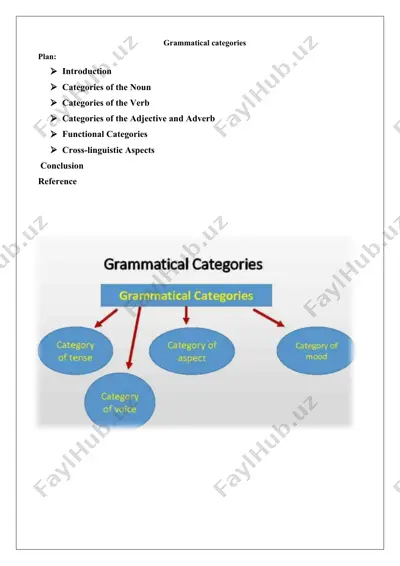
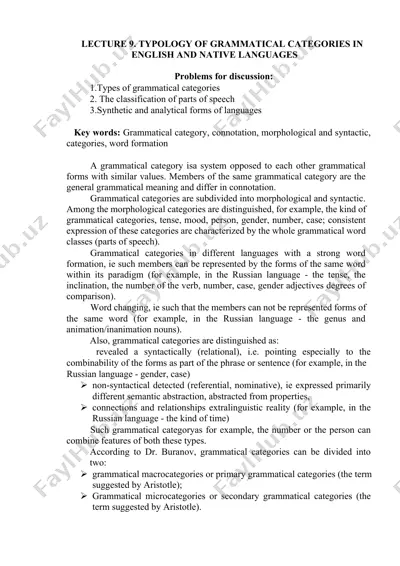
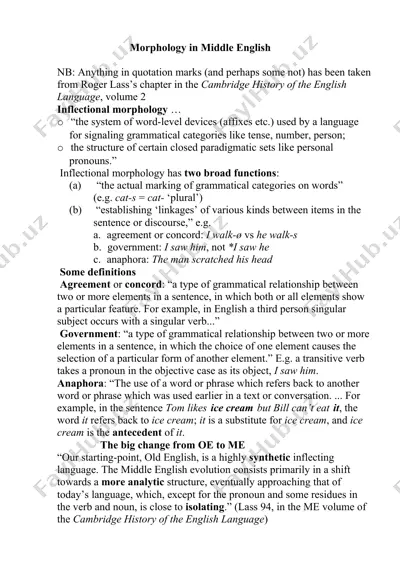
grammatical categories plan: · introduction · categories of the noun · categories of the verb · categories of the adjective and adverb · functional categories · cross-linguistic aspects conclusion reference introduction to grammatical categories grammatical categories are classes or groups of words that share common characteristics and functions within a language's structure. they are sets of linguistic elements (e.g., nouns, verbs, adjectives) or features (e.g., tense, number, case) that organize how words and sentences are formed and interpreted. these categories help define the roles words play in sentences and how they relate to one another syntactically and semantically.grammatical categories form the backbone of linguistic structure, providing the framework through which language conveys meaning, relationships, and context. these categories are essential for constructing coherent and grammatically correct sentences, enabling effective communication. this analysis focuses on two primary parts of speech—nouns and verbs—exploring their respective grammatical categories in depth. for nouns, we …
2 / 15
ular) or more than one (plural). in english, most nouns form their plural by adding “-s” or “-es” to the singular form, though irregular forms exist. · singular: refers to one entity. example: the cat sleeps on the mat. · plural: refers to more than one entity. example: the cats sleep on the mats. regular plural formation: · for most nouns, add “-s”: book → books, chair → chairs. · for nouns ending in -s, -sh, -ch, -x, or -z, add “-es”: bus → buses, church → churches. · for nouns ending in a consonant plus -y, change -y to -ies: city → cities. irregular plural formation: · some nouns change their form entirely: man → men, child → children. · others remain unchanged: sheep → sheep, deer → deer. analysis: the number category affects subject-verb agreement, ensuring syntactic coherence. for instance, in the dog runs, the singular subject “dog” …
3 / 15
performs the action, while “student” (objective) receives it. the possessive case, as in the teacher’s feedback was helpful, clarifies ownership. incorrect case usage, such as me went to the store instead of i went to the store, disrupts grammatical accuracy and clarity. gender (masculine, feminine, neutral, common) gender in english nouns is primarily associated with pronouns and reflects biological or social distinctions, though it is less prominent than in languages with grammatical gender (e.g., french or german). · masculine: refers to male entities. example: the king ruled wisely. pronoun: he/him. · feminine: refers to female entities. example: the queen ruled wisely. pronoun: she/her. · neutral: refers to inanimate objects or concepts. example: the table is wooden. pronoun: it. · common: refers to entities where gender is unspecified or irrelevant. example: the teacher spoke clearly. pronoun: they (singular, gender-neutral). analysis: english nouns typically lack grammatical gender, except in cases of biological …
4 / 15
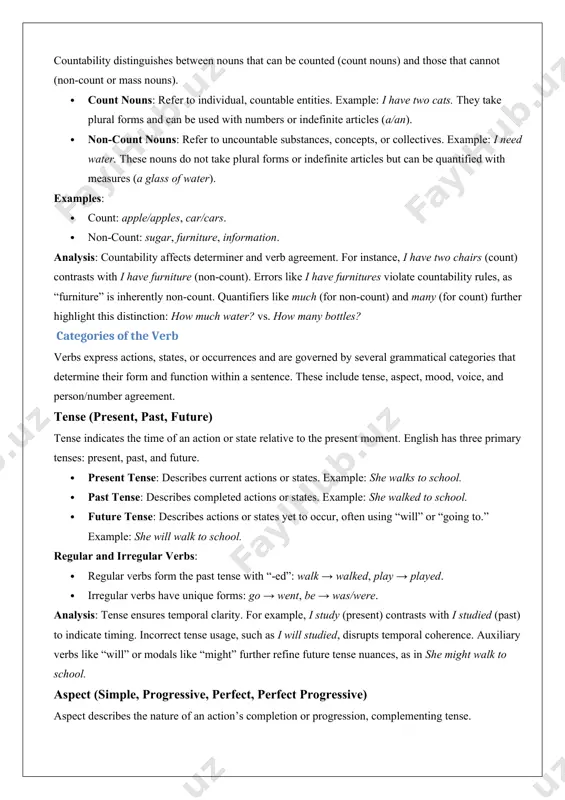
affects determiner and verb agreement. for instance, i have two chairs (count) contrasts with i have furniture (non-count). errors like i have furnitures violate countability rules, as “furniture” is inherently non-count. quantifiers like much (for non-count) and many (for count) further highlight this distinction: how much water? vs. how many bottles? categories of the verb verbs express actions, states, or occurrences and are governed by several grammatical categories that determine their form and function within a sentence. these include tense, aspect, mood, voice, and person/number agreement. tense (present, past, future) tense indicates the time of an action or state relative to the present moment. english has three primary tenses: present, past, and future. · present tense: describes current actions or states. example: she walks to school. · past tense: describes completed actions or states. example: she walked to school. · future tense: describes actions or states yet to occur, often …
5 / 15
e. example: i have eaten breakfast. (present perfect) · perfect progressive aspect: indicates ongoing actions with past initiation and present relevance. example: i have been eating breakfast for an hour. (present perfect progressive) examples across tenses: · past simple: i ate. · past progressive: i was eating. · past perfect: i had eaten. · past perfect progressive: i had been eating. analysis: aspect adds nuance to tense. for instance, i was studying when she called (past progressive) emphasizes the ongoing nature of the action, while i had studied (past perfect) highlights completion before another past event. errors like i am studied (incorrect use of progressive with stative verbs) violate aspect rules. mood (indicative, imperative, subjunctive) mood reflects the speaker’s attitude toward the action or state. · indicative mood: expresses facts or statements. example: she is here. · imperative mood: gives commands or requests. example: close the door. · subjunctive mood: …

Want to read more?

Download all 15 pages for free via Telegram.

Download full file

About "grammatical categories"

grammatical categories plan: · introduction · categories of the noun · categories of the verb · categories of the adjective and adverb · functional categories · cross-linguistic aspects conclusion reference introduction to grammatical categories grammatical categories are classes or groups of words that share common characteristics and functions within a language's structure. they are sets of linguistic elements (e.g., nouns, verbs, adjectives) or features (e.g., tense, number, case) that organize how words and sentences are formed and interpreted. these categories help define the roles words play in sentences and how they relate to one another syntactically and semantically.grammatical categories form the backbone of linguistic structure, providing the framework through which language con...

This file contains 15 pages in DOCX format (439.0 KB). To download "grammatical categories", click the Telegram button on the left.
Tags: grammatical categories DOCX 15 pages Free download Telegram