developing critical thinking skills in english language learners

DOCX 38 pages 61.0 KB Free download

Page preview (5 pages)

Scroll down 👇
1 / 38
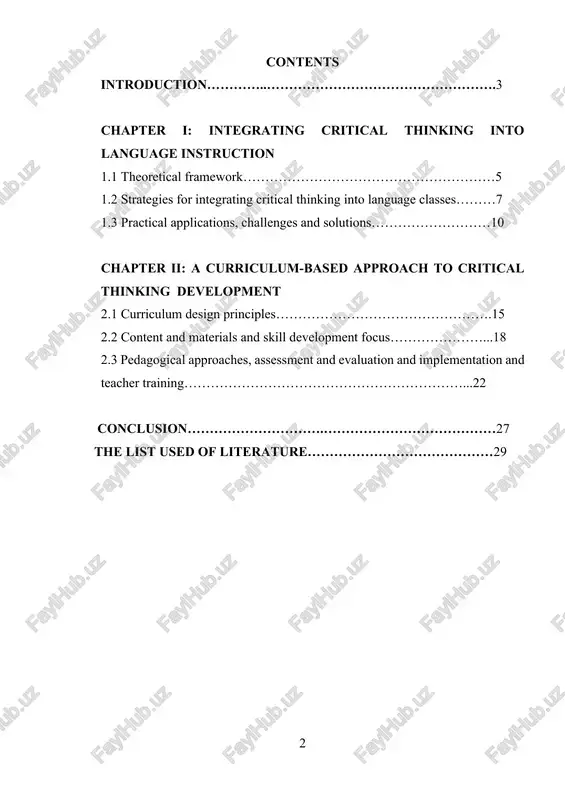
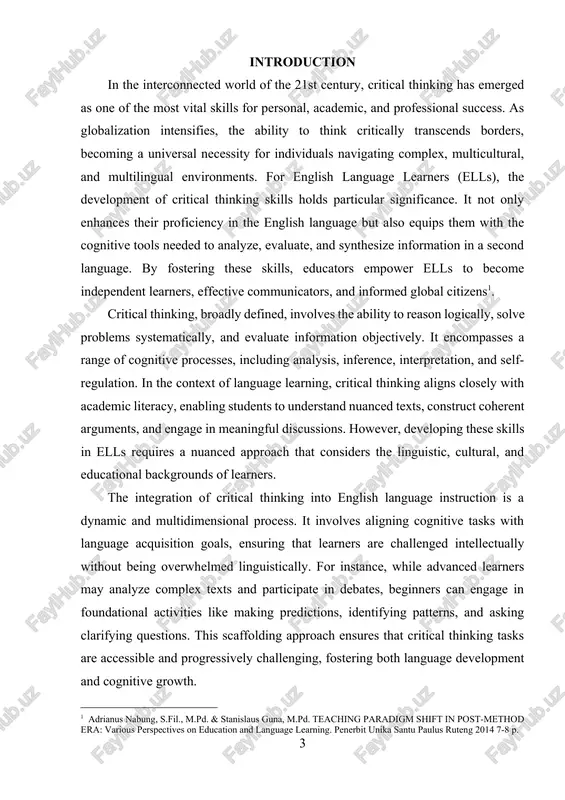
developing critical thinking skills in english language learners contents introduction…………..…………………………………………….3 chapter i: integrating critical thinking into language instruction 1.1 theoretical framework…………………………………………………5 1.2 strategies for integrating critical thinking into language classes………7 1.3 practical applications, challenges and solutions………………………10 chapter ii: a curriculum-based approach to critical thinking development 2.1 curriculum design principles………………………………………….15 2.2 content and materials and skill development focus…………………...18 2.3 pedagogical approaches, assessment and evaluation and implementation and teacher training………………………………………………………...22 conclusion………………………….…………………………………27 the list used of literature……………………………………29 introduction in the interconnected world of the 21st century, critical thinking has emerged as one of the most vital skills for personal, academic, and professional success. as globalization intensifies, the ability to think critically transcends borders, becoming a universal necessity for individuals navigating complex, multicultural, and multilingual environments. for english language learners (ells), the development of critical thinking skills holds particular significance. it not only enhances their proficiency in the english language but also equips them …
2 / 38
inference, interpretation, and self-regulation. in the context of language learning, critical thinking aligns closely with academic literacy, enabling students to understand nuanced texts, construct coherent arguments, and engage in meaningful discussions. however, developing these skills in ells requires a nuanced approach that considers the linguistic, cultural, and educational backgrounds of learners. the integration of critical thinking into english language instruction is a dynamic and multidimensional process. it involves aligning cognitive tasks with language acquisition goals, ensuring that learners are challenged intellectually without being overwhelmed linguistically. for instance, while advanced learners may analyze complex texts and participate in debates, beginners can engage in foundational activities like making predictions, identifying patterns, and asking clarifying questions. this scaffolding approach ensures that critical thinking tasks are accessible and progressively challenging, fostering both language development and cognitive growth. one of the primary reasons for emphasizing critical thinking in ell education is its role in promoting …
3 / 38
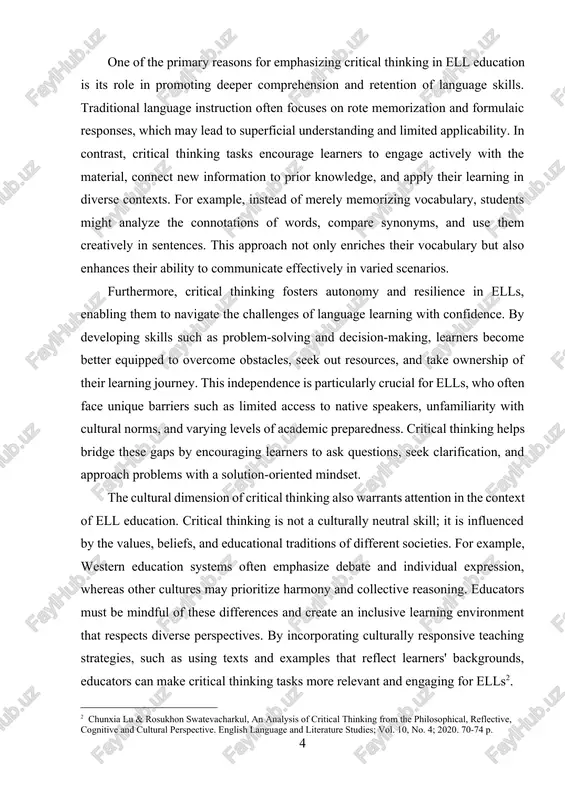
ng with confidence. by developing skills such as problem-solving and decision-making, learners become better equipped to overcome obstacles, seek out resources, and take ownership of their learning journey. this independence is particularly crucial for ells, who often face unique barriers such as limited access to native speakers, unfamiliarity with cultural norms, and varying levels of academic preparedness. critical thinking helps bridge these gaps by encouraging learners to ask questions, seek clarification, and approach problems with a solution-oriented mindset. the cultural dimension of critical thinking also warrants attention in the context of ell education. critical thinking is not a culturally neutral skill; it is influenced by the values, beliefs, and educational traditions of different societies. for example, western education systems often emphasize debate and individual expression, whereas other cultures may prioritize harmony and collective reasoning. educators must be mindful of these differences and create an inclusive learning environment that respects diverse …
4 / 38
dedness and adaptability. for instance, a group project on environmental issues might involve researching data, presenting arguments, and proposing solutions, all of which require critical thinking and effective communication. despite its numerous benefits, integrating critical thinking into ell instruction presents certain challenges. one common obstacle is the varying proficiency levels within a single classroom, which can make it difficult to design activities that are both cognitively stimulating and linguistically appropriate for all students. another challenge is the potential mismatch between critical thinking tasks and standardized assessment criteria, which often prioritize accuracy and fluency over depth of reasoning. to address these challenges, educators need to employ differentiated instruction, use formative assessments, and advocate for assessment frameworks that recognize the value of critical thinking. developing critical thinking skills in english language learners is a transformative endeavor that extends beyond language acquisition. it equips learners with the intellectual tools needed to navigate a …
5 / 38
.] 1.1 purpose of a theoretical framework guides research design: it helps determine what to study, how to structure the investigation, and how to interpret findings. connects to existing knowledge: relates your research to prior studies and established theories. explains relationships: demonstrates the connections between independent (teaching strategies) and dependent variables (critical thinking skills development). provides justification: justifies why a particular approach is suitable for addressing the research problem. components of a theoretical framework; relevant theories: bloom's taxonomy of cognitive skills: this hierarchical model categorizes cognitive skills from basic (remembering, understanding) to advanced levels (analyzing, evaluating, creating). it provides a foundation for designing activities that foster critical thinking. sociocultural theory (vygotsky): highlights the role of social interaction and cultural tools in learning. for ells, collaborative activities and scaffolding are crucial in developing both language and critical thinking. constructivism (piaget and bruner): emphasizes active learning where students construct knowledge through experiences. …

Want to read more?

Download all 38 pages for free via Telegram.

Download full file

About "developing critical thinking skills in english language learners"

developing critical thinking skills in english language learners contents introduction…………..…………………………………………….3 chapter i: integrating critical thinking into language instruction 1.1 theoretical framework…………………………………………………5 1.2 strategies for integrating critical thinking into language classes………7 1.3 practical applications, challenges and solutions………………………10 chapter ii: a curriculum-based approach to critical thinking development 2.1 curriculum design principles………………………………………….15 2.2 content and materials and skill development focus…………………...18 2.3 pedagogical approaches, assessment and evaluation and implementation and teacher training………………………………………………………...22 conclusion………………………….…………………………………27 the list used of literature……………………………………29 introduction in the interconnected world of ...

This file contains 38 pages in DOCX format (61.0 KB). To download "developing critical thinking skills in english language learners", click the Telegram button on the left.

Tags: developing critical thinking sk… DOCX 38 pages Free download Telegram