article (grammar)

DOCX 101.3 KB Free download

Page preview (5 pages)

Scroll down 👇
1
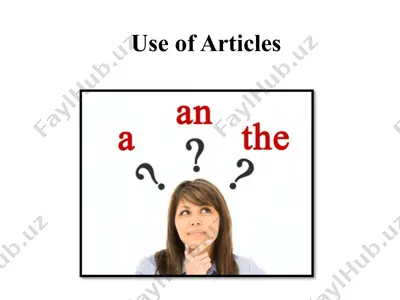
1411371947_59224.docx article (grammar) plan: · 1 types · 2 variation among languages · 3 evolution an article (abbreviated art) is a word that combines with a noun to indicate the type of reference being made by the noun. articles specify the grammatical definiteness of the noun, in some languages extending to volume or numerical scope. the articles in the english languageare the and a/an, and (in some contexts) some. 'an' and 'a' are modern forms of the old english 'an', which in anglian dialects was the number 'one' (compare 'on', in saxon dialects) and survived into modern scots as the number 'ane'. both 'on' (respelled 'one' by the normans) and 'an' survived into modern english, with 'one' used as the number and 'an' ('a', before nouns that begin with a consonant sound) as an indefinite article. in some languages, articles are a special part of speech, which cannot easily be …
2
ages may have various forms of each article, according to grammatical attributes such as gender, number, or case, or according to adjacent sounds. definite article a definite article indicates that its noun is a particular one (or ones) identifiable to the listener. it may be something that the speaker has already mentioned, or it may be something uniquely specified. the definite article in english, for both singular and plural nouns, is the. the children know the fastest way home. the sentence above refers to specific children and a specific way home; it contrasts with the much more general observation that: children know the fastest way home. the latter sentence refers to children in general, perhaps all or most of them. likewise, give me the book. refers to a specific book whose identity is known or obvious to the listener; as such it has a markedly different meaning from give me …
3
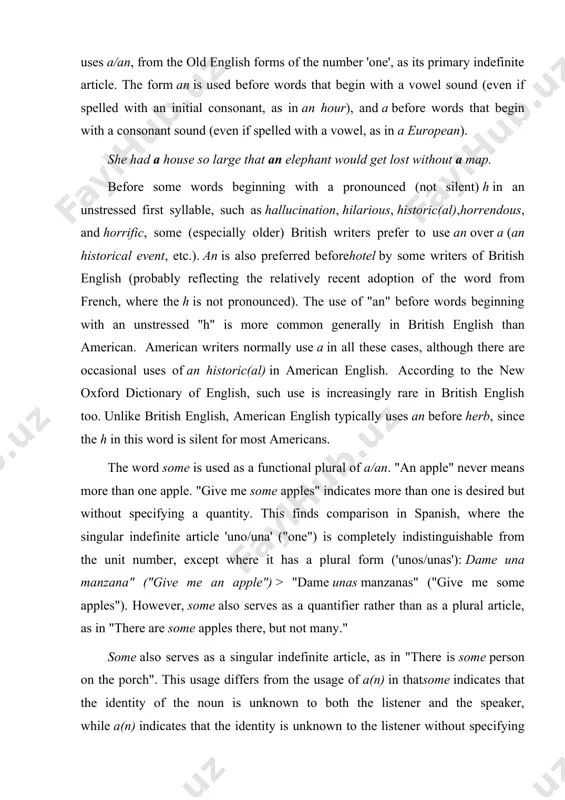
orrendous, and horrific, some (especially older) british writers prefer to use an over a (an historical event, etc.). an is also preferred beforehotel by some writers of british english (probably reflecting the relatively recent adoption of the word from french, where the h is not pronounced). the use of "an" before words beginning with an unstressed "h" is more common generally in british english than american. american writers normally use a in all these cases, although there are occasional uses of an historic(al) in american english. according to the new oxford dictionary of english, such use is increasingly rare in british english too. unlike british english, american english typically uses an before herb, since the h in this word is silent for most americans. the word some is used as a functional plural of a/an. "an apple" never means more than one apple. "give me some apples" indicates more than …
4
itive article a partitive article is a type of indefinite article used with a mass noun such as water, to indicate a non-specific quantity of it. partitive articles are used in french and italian in addition to definite and indefinite articles. the nearest equivalent in english is some, although this is considered a determiner and not an article. french: voulez-vous du café ? do you want (some) coffee? (or, dialectally but more accurately, do you want some of this coffee?) see also more information about the french partitive article. haida has a partitive article (suffixed -gyaa) referring to "part of something or... to one or more objects of a given group or category," e.g.tluugyaa uu hal tlaahlaang 'he is making a boat (a member of the category of boats). negative article a negative article specifies none of its noun, and can thus be regarded as neither definite nor indefinite. on …
5
ese, indonesian,japanese, hindi and russian. linguists believe the common ancestor of the indo-european languages, proto indo-european, did not have articles. most of the languages in this family do not have definite or indefinite articles; there is no article in latin, sanskrit, persian, nor in some modern indo-european languages, such as the baltic languages and mostslavic languages. although classical greek has a definite article (which has survived into modern greek and which bears strong resemblance to the german definite article), the earlier homeric greek did not. articles developed independently in several language families. not all languages have both definite and indefinite articles, and some languages have different types of definite and indefinite articles to distinguish finer shades of meaning; for example, french and italian have a partitive article used for indefinitemass nouns, while colognian has two distinct sets of definite articles indicating focus and uniqueness, and macedonian uses definite articles in …

Want to read more?

Download the full file for free via Telegram.

Download full file

About "article (grammar)"

1411371947_59224.docx article (grammar) plan: · 1 types · 2 variation among languages · 3 evolution an article (abbreviated art) is a word that combines with a noun to indicate the type of reference being made by the noun. articles specify the grammatical definiteness of the noun, in some languages extending to volume or numerical scope. the articles in the english languageare the and a/an, and (in some contexts) some. 'an' and 'a' are modern forms of the old english 'an', which in anglian dialects was the number 'one' (compare 'on', in saxon dialects) and survived into modern scots as the number 'ane'. both 'on' (respelled 'one' by the normans) and 'an' survived into modern english, with 'one' used as the …

DOCX format, 101.3 KB. To download "article (grammar)", click the Telegram button on the left.
Tags: article (grammar) DOCX Free download Telegram