comparative typology and its major distinctive features

DOC 85,5 KB Bepul yuklash

Sahifa ko'rinishi (5 sahifa)

Pastga aylantiring 👇
1
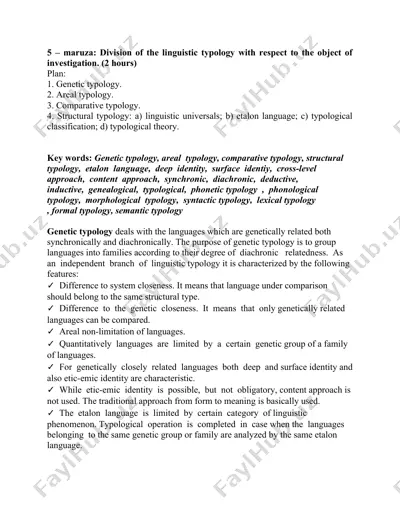
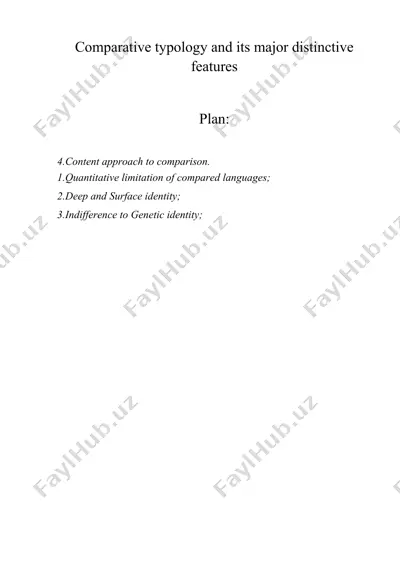
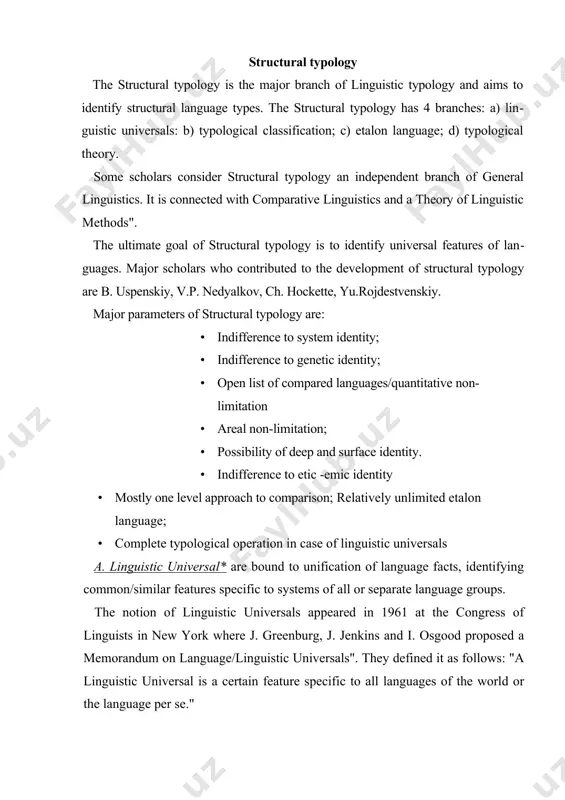
1451618569_62784.doc comparative typology and its major distinctive features plan: 1.quantitative limitation of compared languages; 2.deep and surface identity; 3.indifference to genetic identity; 4.content approach to comparison. structural typology the structural typology is the major branch of linguistic typology and aims to identify structural language types. the structural typology has 4 branches: a) lin​guistic universals: b) typological classification; c) etalon language; d) typological theory. some scholars consider structural typology an independent branch of general linguistics. it is connected with comparative linguistics and a theory of linguistic methods". the ultimate goal of structural typology is to identify universal features of lan​guages. major scholars who contributed to the development of structural typology are b. uspenskiy, v.p. nedyalkov, ch. hockette, yu.rojdestvenskiy. major parameters of structural typology are: · indifference to system identity; · indifference to genetic identity; · open list of compared languages/quantitative non-limitation · areal non-limitation; · possibility of deep and surface identity. …
2
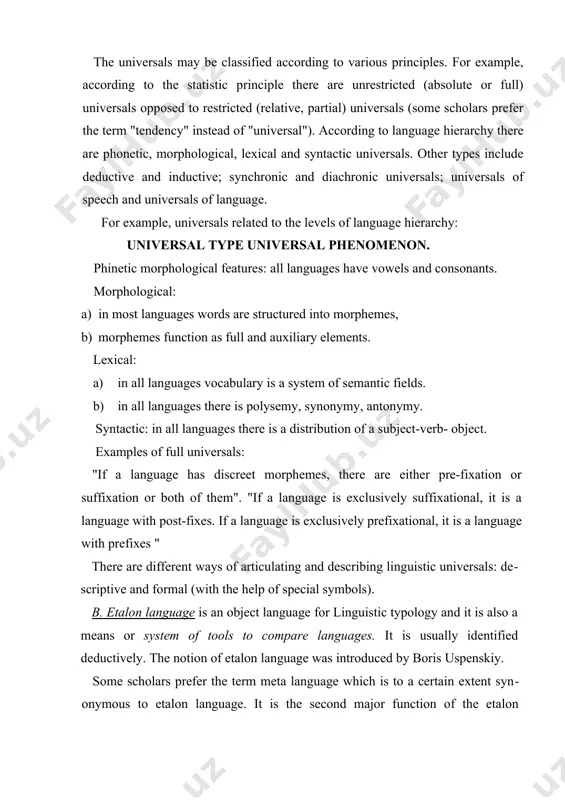
als opposed to restricted (relative, partial) universals (some scholars prefer the term "tendency" instead of "universal"). according to language hierarchy there are pho​netic, morphological, lexical and syntactic universals. other types include deduc​tive and inductive; synchronic and diachronic universals; universals of speech and universals of language. for example, universals related to the levels of language hierarchy: universal type universal phenomenon. phinetic morphological features: all languages have vowels and consonants. morphological: a) in most languages words are structured into morphemes, b) morphemes function as full and auxiliary elements. lexical: a) in all languages vocabulary is a system of semantic fields. b) in all languages there is polysemy, synonymy, antonymy. syntactic: in all languages there is a distribution of a subject-verb- object. examples of full universals: "if a language has discreet morphemes, there are either pre-fixation or suffixation or both of them". "if a language is exclusively suffixational, it is a language with …
3
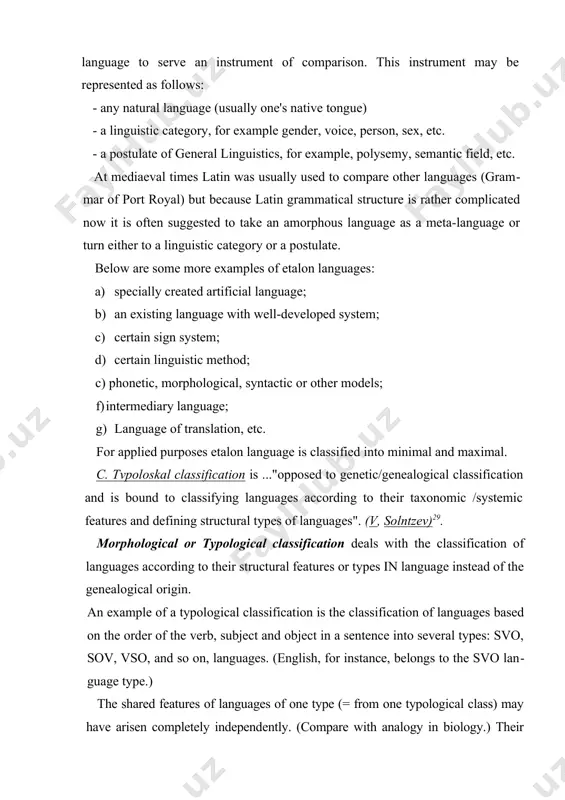
imes latin was usually used to compare other languages (gram​mar of port royal) but because latin grammatical structure is rather complicated now it is often suggested to take an amorphous language as a meta-language or turn either to a linguistic category or a postulate. below are some more examples of etalon languages: a) specially created artificial language; b) an existing language with well-developed system; c) certain sign system; d) certain linguistic method; c) phonetic, morphological, syntactic or other models; f) intermediary language; g) language of translation, etc. for applied purposes etalon language is classified into minimal and maximal. c. tvpoloskal classification is ..."opposed to genetic/genealogical classifica​tion and is bound to classifying languages according to their taxonomic /systemic features and defining structural types of languages". (v, solntzev)29. morphological or typological classification deals with the classification of lan​guages according to their structural features or types in language instead of the genealogical origin. …
4
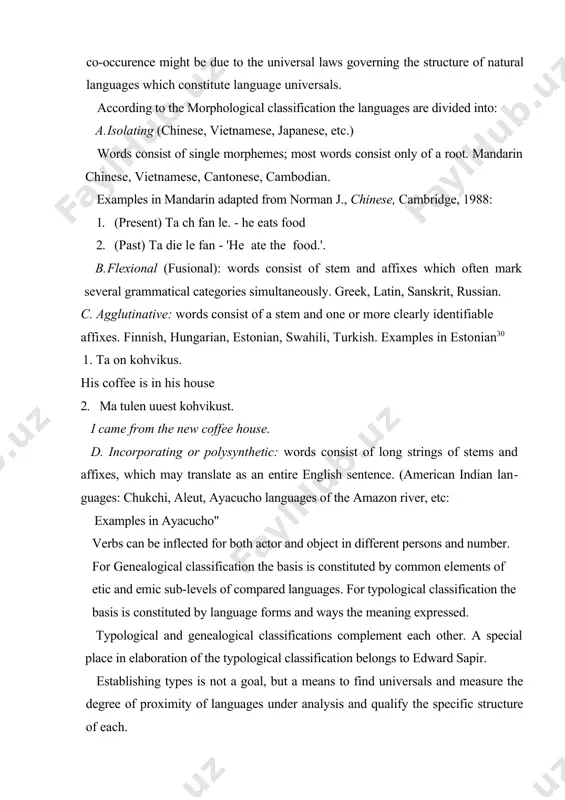
) ta die le fan - 'he ate the food.'. b. flexional (fusional): words consist of stem and affixes which often mark several grammatical categories simultaneously. greek, latin, sanskrit, russian. c. agglutinative: words consist of a stem and one or more clearly identifiable affixes. finnish, hungarian, estonian, swahili, turkish. examples in estonian30 1. ta on kohvikus. his coffee is in his house 2. ma tulen uuest kohvikust. i came from the new coffee house. d. incorporating or polysynthetic: words consist of long strings of stems and affixes, which may translate as an entire english sentence. (american indian lan​guages: chukchi, aleut, ayacucho languages of the amazon river, etc: examples in ayacucho" verbs can be inflected for both actor and object in different persons and number. for genealogical classification the basis is constituted by common elements of etic and emic sub-levels of compared languages. for typological classification the basis is constituted by …
5
gs of sign languages are for the most part arbitrary. 5.all human languages utilize a finite set of discrete sounds (or gestures) that are combined to fonn meaningful elements or words, which themselves form an infinite set of possible sentences. 6.all grammars contain rules for the formation of words and sentences of a simi​lar kind. 7. every spoken language includes discrete sound segments like p, n, or a, which can be defined by a finite set of sound properties or features. every spoken language has a class of vowels and a class of consonants. 8. similar grammatical categories (for example, noun, verb) are found in all lan​guages. 9. there are semantic universals, such as "male" or "female," "animate" or "hu​man," found in every language in the world. 10. every language has a way of referring to past time, forming questions, issu​ing commands, and so on. 11. speakers of all languages …

Ko'proq o'qimoqchimisiz?

Faylni Telegram orqali bepul yuklab oling.

To'liq faylni yuklab olish

"comparative typology and its major distinctive features" haqida

1451618569_62784.doc comparative typology and its major distinctive features plan: 1.quantitative limitation of compared languages; 2.deep and surface identity; 3.indifference to genetic identity; 4.content approach to comparison. structural typology the structural typology is the major branch of linguistic typology and aims to identify structural language types. the structural typology has 4 branches: a) lin​guistic universals: b) typological classification; c) etalon language; d) typological theory. some scholars consider structural typology an independent branch of general linguistics. it is connected with comparative linguistics and a theory of linguistic methods". the ultimate goal of structural typology is to identify universal features of lan​guages. major scholars who contributed t...

DOC format, 85,5 KB. "comparative typology and its major distinctive features"ni yuklab olish uchun chap tomondagi Telegram tugmasini bosing.
Teglar: comparative typology and its ma… DOC Bepul yuklash Telegram