the subject-matter of comparative typology

DOC 58,5 КБ Бесплатная загрузка

Предварительный просмотр (5 стр.)

Прокрутите вниз 👇
1
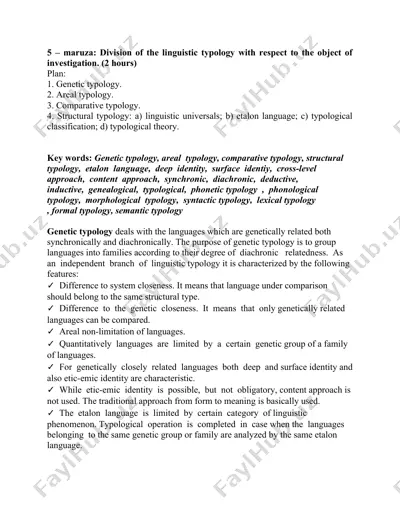
1451619105_62790.doc the subject-matter of comparative typology plan: · typological classification of languages · classification of linguistic typology · language universals · unrestricted universals. · substantive. · formal. · comparative typology · the port-royal grammar the word typology consists of two greek morphemes: a) typos means type and b)logos means science or word. typology is a branch of science which is typical to all sciences without any exception. in this respect their typological method is not limited with the sphere of one science. it has a universal rise. so typology may be divided into: 1. non-linguistic and 2. linguistic typology non-linguistic typology is the subject matter of the sciences except linguistics. linguistic typology is a new branch of general linguistics, which studies the systems of languages comparatively, also finds common laws of languages and establishes differences and similarities between them. typological classification of languages in linguistics we may come across many …
2
stic typology which studies the similarities and the relationship between the related languages. it is applicated to the systems of genetically related languages. geneological typology developed from the comparative-historical linguistics dominated during the 19th century in europe. it’s origin was stimulated by the discovery of sanskrit, the ancient classical language of india. the discovery of sanskrit disclosed the possibility of a comparative study of languages. the concept of relative languages was confirmed by the existence in india of a sister of the familiar languages of europe e.g. sanskrit “ mata” means “mother”, in the accus. case “matarum” dvau - two trayah - three as ti - he is etc. before the discovery of sanskrit european linguistics possessed very vague similarities for the current grammars built on the greek model. they didn’t set clearly the features of each languages. it is worth to mention that at the same time sanskrit discovery …
3
hip is not taken into consideration. structural linguistic lypology can be understood as a systematisation of linguistic phenomenon from different languages according to their specific structural features. structural typological research makes it possible to establish some traits that are universal, unique and special. language universals the languages of the world present us with a vast array of structural similarities and differences/ one way of answering this question is to adopt a historical persrective, investigating the origins of language and pointing to the importance of linguistic change/ an alternative approach is to make a detailed description of the similarities or differences, regardless of their historical antecedents, and proceed from there to generalize about the structure and function of human language. there are two main ways of approaching the similarities and differences of language structures: if we look for the structural features that all or most languages have in common, so we …
4
nion b.a. uspensky published his monographic research “структурная типология язика” (1965). in 1966 there appeared j. greenberg’s book “language universals with special references to feature hierarchies”. these works were followed by a number of other research works published as articles and special volumes. according to the “memorandum” language universals are by their nature summary statements about characteristics or tendencies shared by all human speakers. as such they constitute the most general laws of a science of linguistics. language universals study the universal features in the systems of different languages of the world. they find similarities which are typical of the absolute or overwhelming majority of languages. types of universals are as follows: 1. definitional universals, 2. empirical universals. definitional universals are connected with the fact which the speaker possesses and uses his extrapolation. it means that linguistic phenomenon exists in the system of those languages which the scholar does not …
5
ious (e.g.: all languages have vowels); and the interesting ones often seem to require considerable technical qualification. most of the time, in fact it is clear that absoluta (or exeptionless) universals do not exist. as a result, many lanuists look instead for trends or tendencies across languages - ‘relative’ universals - which can be givenstatistical expression. for example, in over 99% of languages whose word order has been studied, grammatical subjects precede objects. and in a phonological study of over 300 languages less than 3% have no nasal consonant. linguistic features that are ststistically dominant in this way are often referred to as ‘unmarked’, and grammar that incorporates norms of this kind is knownas a ‘core grammar’. substantive. substantive universals comprise the set of categories that is needed in order to analyse a language, such as ‘noun’, ‘quesyion’, ‘first- person’, ‘antonym’ and ‘vowel’. do all languages have nouns and vowels? …

Хотите читать дальше?

Скачайте полный файл бесплатно через Telegram.

Скачать полный файл

О "the subject-matter of comparative typology"

1451619105_62790.doc the subject-matter of comparative typology plan: · typological classification of languages · classification of linguistic typology · language universals · unrestricted universals. · substantive. · formal. · comparative typology · the port-royal grammar the word typology consists of two greek morphemes: a) typos means type and b)logos means science or word. typology is a branch of science which is typical to all sciences without any exception. in this respect their typological method is not limited with the sphere of one science. it has a universal rise. so typology may be divided into: 1. non-linguistic and 2. linguistic typology non-linguistic typology is the subject matter of the sciences except linguistics. linguistic typology is a new branch of general linguistics,...

Формат DOC, 58,5 КБ. Чтобы скачать "the subject-matter of comparative typology", нажмите кнопку Telegram слева.
Теги: the subject-matter of comparati… DOC Бесплатная загрузка Telegram