using tests in teaching foreign language

DOCX 6 стр. 21,3 КБ Бесплатная загрузка

Предварительный просмотр (5 стр.)

Прокрутите вниз 👇
1 / 6
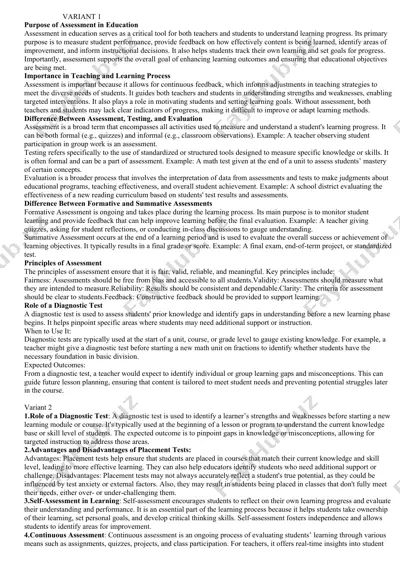
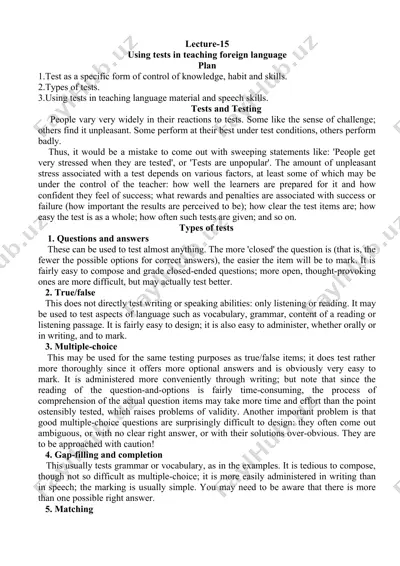
lecture-15 using tests in teaching foreign language plan 1.test as a specific form of control of knowledge, habit and skills. 2.types of tests. 3.using tests in teaching language material and speech skills. tests and testing people vary very widely in their reactions to tests. some like the sense of challenge; others find it unpleasant. some perform at their best under test conditions, others perform badly. thus, it would be a mistake to come out with sweeping statements like: 'people get very stressed when they are tested', or 'tests are unpopular'. the amount of unpleasant stress associated with a test depends on various factors, at least some of which may be under the control of the teacher: how well the learners are prepared for it and how confident they feel of success; what rewards and penalties are associated with success or failure (how important the results are perceived to be); how …
2 / 6
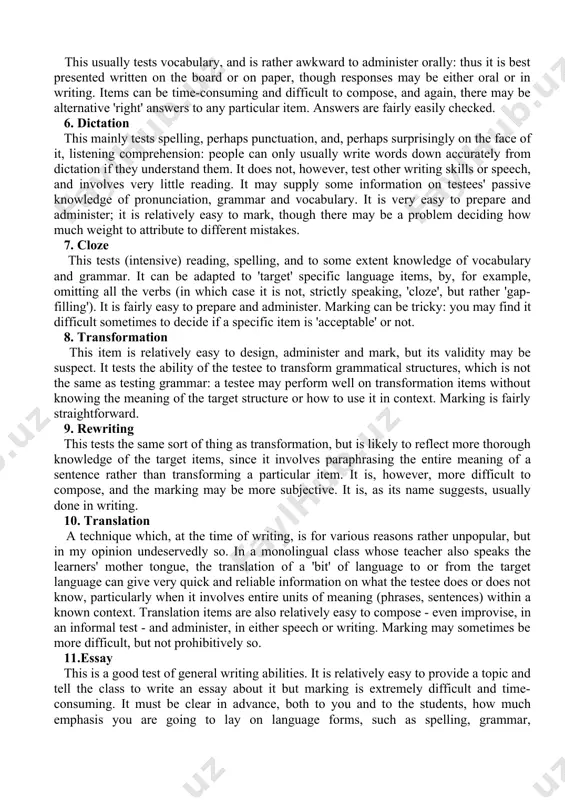
is fairly time-consuming, the process of comprehension of the actual question items may take more time and effort than the point ostensibly tested, which raises problems of validity. another important problem is that good multiple-choice questions are surprisingly difficult to design: they often come out ambiguous, or with no clear right answer, or with their solutions over-obvious. they are to be approached with caution! 4. gap-filling and completion this usually tests grammar or vocabulary, as in the examples. it is tedious to compose, though not so difficult as multiple-choice; it is more easily administered in writing than in speech; the marking is usually simple. you may need to be aware that there is more than one possible right answer. 5. matching this usually tests vocabulary, and is rather awkward to administer orally: thus it is best presented written on the board or on paper, though responses may be either oral …
3 / 6
y to prepare and administer. marking can be tricky: you may find it difficult sometimes to decide if a specific item is 'acceptable' or not. 8. transformation this item is relatively easy to design, administer and mark, but its validity may be suspect. it tests the ability of the testee to transform grammatical structures, which is not the same as testing grammar: a testee may perform well on transformation items without knowing the meaning of the target structure or how to use it in context. marking is fairly straightforward. 9. rewriting this tests the same sort of thing as transformation, but is likely to reflect more thorough knowledge of the target items, since it involves paraphrasing the entire meaning of a sentence rather than transforming a particular item. it is, however, more difficult to compose, and the marking may be more subjective. it is, as its name suggests, usually done …
4 / 6
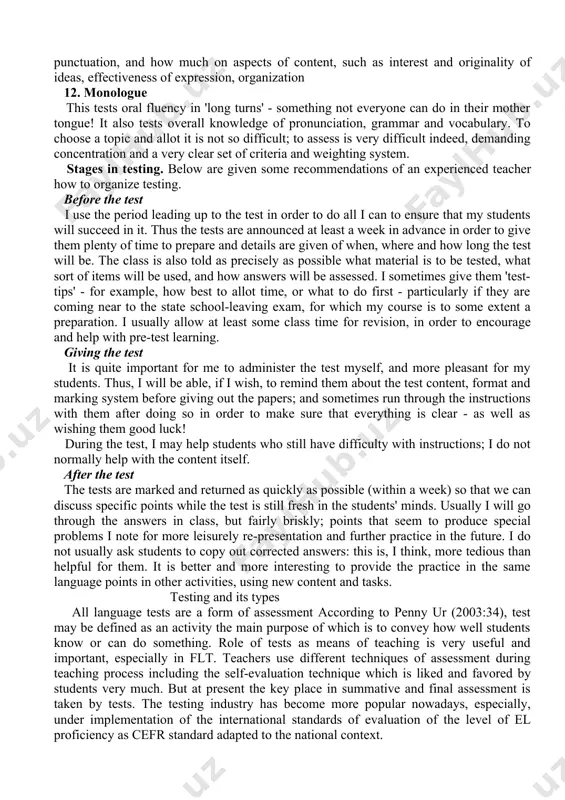
st and originality of ideas, effectiveness of expression, organization 12. monologue this tests oral fluency in 'long turns' - something not everyone can do in their mother tongue! it also tests overall knowledge of pronunciation, grammar and vocabulary. to choose a topic and allot it is not so difficult; to assess is very difficult indeed, demanding concentration and a very clear set of criteria and weighting system. stages in testing. below are given some recommendations of an experienced teacher how to organize testing. before the test i use the period leading up to the test in order to do all i can to ensure that my students will succeed in it. thus the tests are announced at least a week in advance in order to give them plenty of time to prepare and details are given of when, where and how long the test will be. the class is also …
5 / 6
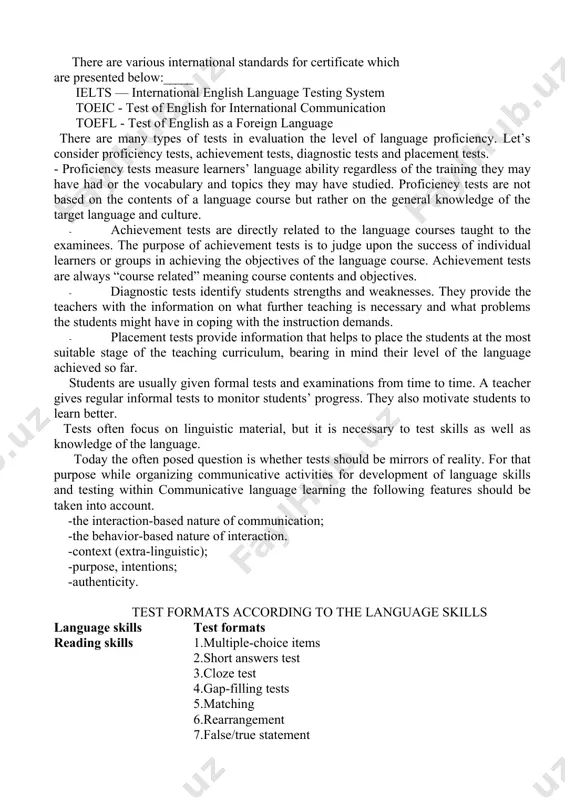
inds. usually i will go through the answers in class, but fairly briskly; points that seem to produce special problems i note for more leisurely re-presentation and further practice in the future. i do not usually ask students to copy out corrected answers: this is, i think, more tedious than helpful for them. it is better and more interesting to provide the practice in the same language points in other activities, using new content and tasks. testing and its types all language tests are a form of assessment according to penny ur (2003:34), test may be defined as an activity the main purpose of which is to convey how well students know or can do something. role of tests as means of teaching is very useful and important, especially in flt. teachers use different techniques of assessment during teaching process including the self-evaluation technique which is liked and favored by …

Хотите читать дальше?

Скачайте все 6 страниц бесплатно через Telegram.

Скачать полный файл

О "using tests in teaching foreign language"

lecture-15 using tests in teaching foreign language plan 1.test as a specific form of control of knowledge, habit and skills. 2.types of tests. 3.using tests in teaching language material and speech skills. tests and testing people vary very widely in their reactions to tests. some like the sense of challenge; others find it unpleasant. some perform at their best under test conditions, others perform badly. thus, it would be a mistake to come out with sweeping statements like: 'people get very stressed when they are tested', or 'tests are unpopular'. the amount of unpleasant stress associated with a test depends on various factors, at least some of which may be under the control of the teacher: how well the learners …

Этот файл содержит 6 стр. в формате DOCX (21,3 КБ). Чтобы скачать "using tests in teaching foreign language", нажмите кнопку Telegram слева.
Теги: using tests in teaching foreign… DOCX 6 стр. Бесплатная загрузка Telegram