assessment in teaching foreign languages

DOCX 6 стр. 21,2 КБ Бесплатная загрузка

Предварительный просмотр (5 стр.)

Прокрутите вниз 👇
1 / 6
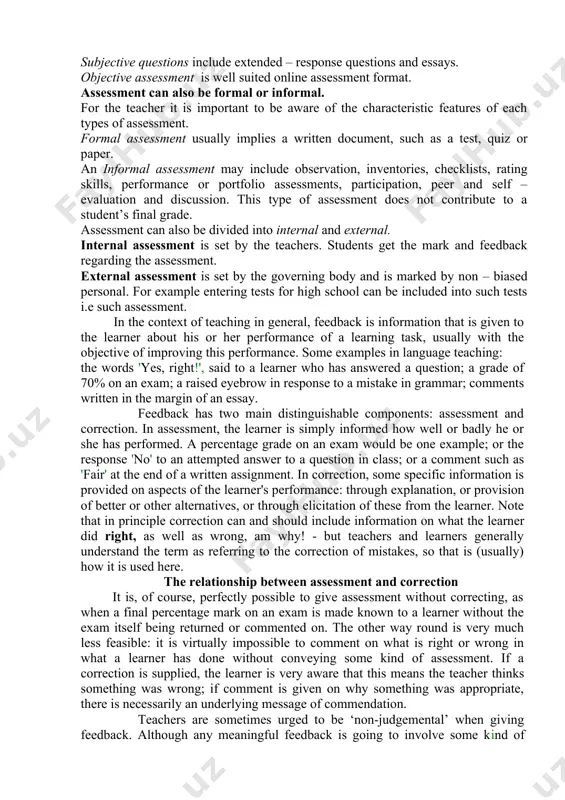
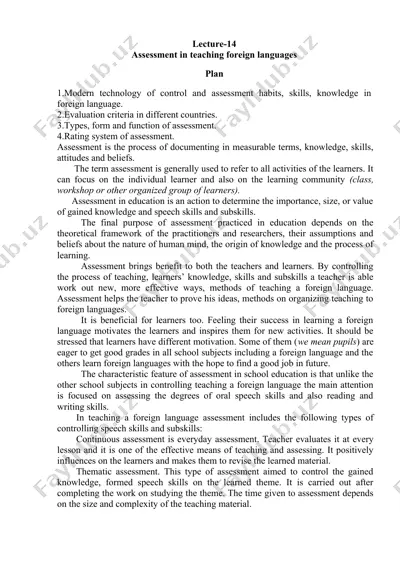
lecture-14 assessment in teaching foreign languages plan 1.modern technology of control and assessment habits, skills, knowledge in foreign language. 2.evaluation criteria in different countries. 3.types, form and function of assessment. 4.rating system of assessment. assessment is the process of documenting in measurable terms, knowledge, skills, attitudes and beliefs. the term assessment is generally used to refer to all activities of the learners. it can focus on the individual learner and also on the learning community (class, workshop or other organized group of learners). assessment in education is an action to determine the importance, size, or value of gained knowledge and speech skills and subskills. the final purpose of assessment practiced in education depends on the theoretical framework of the practitioners and researchers, their assumptions and beliefs about the nature of human mind, the origin of knowledge and the process of learning. assessment brings benefit to both the teachers and learners. …
2 / 6
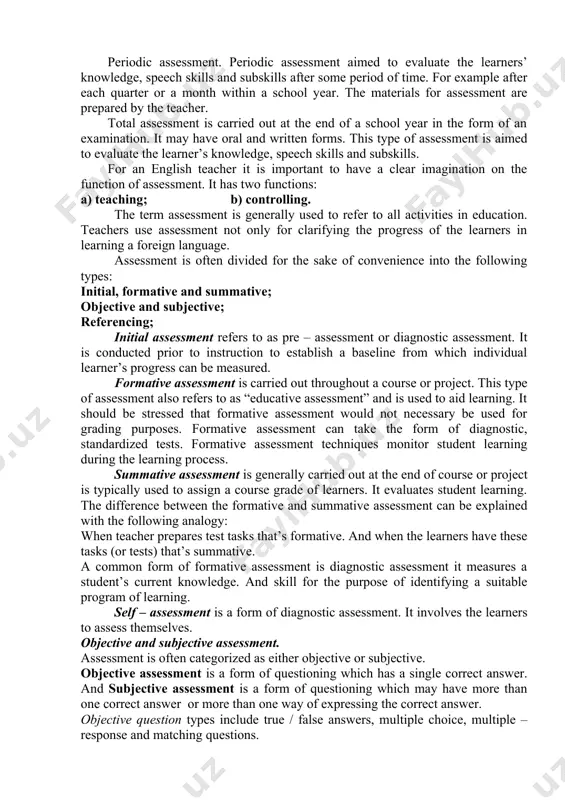
sessment includes the following types of controlling speech skills and subskills: continuous assessment is everyday assessment. teacher evaluates it at every lesson and it is one of the effective means of teaching and assessing. it positively influences on the learners and makes them to revise the learned material. thematic assessment. this type of assessment aimed to control the gained knowledge, formed speech skills on the learned theme. it is carried out after completing the work on studying the theme. the time given to assessment depends on the size and complexity of the teaching material. periodic assessment. periodic assessment aimed to evaluate the learners’ knowledge, speech skills and subskills after some period of time. for example after each quarter or a month within a school year. the materials for assessment are prepared by the teacher. total assessment is carried out at the end of a school year in the form of …
3 / 6
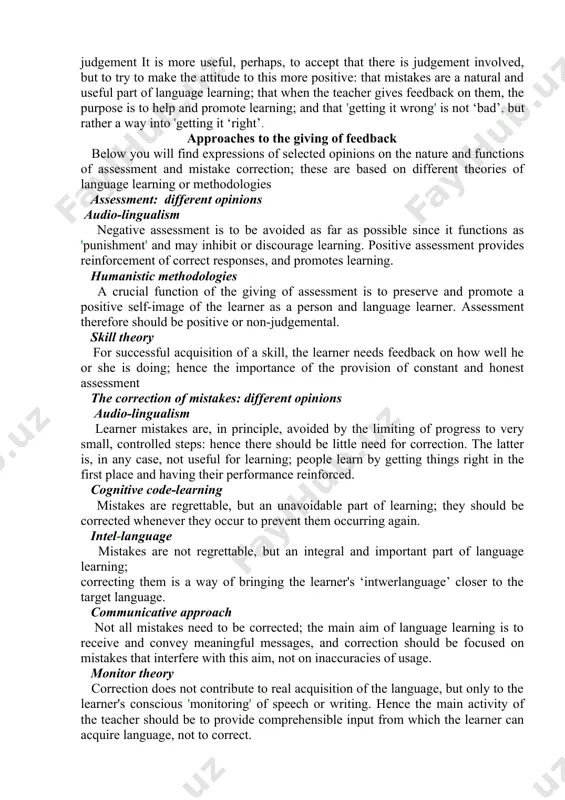
ary be used for grading purposes. formative assessment can take the form of diagnostic, standardized tests. formative assessment techniques monitor student learning during the learning process. summative assessment is generally carried out at the end of course or project is typically used to assign a course grade of learners. it evaluates student learning. the difference between the formative and summative assessment can be explained with the following analogy: when teacher prepares test tasks that’s formative. and when the learners have these tasks (or tests) that’s summative. a common form of formative assessment is diagnostic assessment it measures a student’s current knowledge. and skill for the purpose of identifying a suitable program of learning. self – assessment is a form of diagnostic assessment. it involves the learners to assess themselves. objective and subjective assessment. assessment is often categorized as either objective or subjective. objective assessment is a form of questioning which …
4 / 6
rnal assessment is set by the teachers. students get the mark and feedback regarding the assessment. external assessment is set by the governing body and is marked by non – biased personal. for example entering tests for high school can be included into such tests i.e such assessment. in the context of teaching in general, feedback is information that is given to the learner about his or her performance of a learning task, usually with the objective of improving this performance. some examples in language teaching: the words 'yes, right!', said to a learner who has answered a question; a grade of 70% on an exam; a raised eyebrow in response to a mistake in grammar; comments written in the margin of an essay. feedback has two main distinguishable components: assessment and correction. in assessment, the learner is simply informed how well or badly he or she has performed. a …
5 / 6
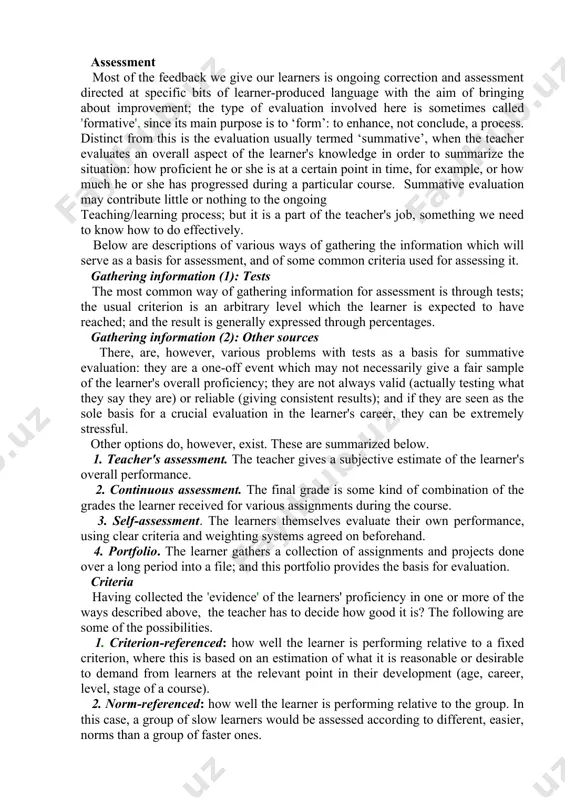
is supplied, the learner is very aware that this means the teacher thinks something was wrong; if comment is given on why something was appropriate, there is necessarily an underlying message of commendation. teachers are sometimes urged to be ‘non-judgemental’ when giving feedback. although any meaningful feedback is going to involve some kind of judgement it is more useful, perhaps, to accept that there is judgement involved, but to try to make the attitude to this more positive: that mistakes are a natural and useful part of language learning; that when the teacher gives feedback on them, the purpose is to help and promote learning; and that 'getting it wrong' is not ‘bad’, but rather a way into 'getting it ‘right’. approaches to the giving of feedback below you will find expressions of selected opinions on the nature and functions of assessment and mistake correction; these are based on different …

Хотите читать дальше?

Скачайте все 6 страниц бесплатно через Telegram.

Скачать полный файл

О "assessment in teaching foreign languages"

lecture-14 assessment in teaching foreign languages plan 1.modern technology of control and assessment habits, skills, knowledge in foreign language. 2.evaluation criteria in different countries. 3.types, form and function of assessment. 4.rating system of assessment. assessment is the process of documenting in measurable terms, knowledge, skills, attitudes and beliefs. the term assessment is generally used to refer to all activities of the learners. it can focus on the individual learner and also on the learning community (class, workshop or other organized group of learners). assessment in education is an action to determine the importance, size, or value of gained knowledge and speech skills and subskills. the final purpose of assessment practiced in education depends on the theoretical...

Этот файл содержит 6 стр. в формате DOCX (21,2 КБ). Чтобы скачать "assessment in teaching foreign languages", нажмите кнопку Telegram слева.

Теги: assessment in teaching foreign … DOCX 6 стр. Бесплатная загрузка Telegram