earth science unit powerpoint

PPTX 29 sahifa 5,5 MB Bepul yuklash

Sahifa ko'rinishi (5 sahifa)

Pastga aylantiring 👇
1 / 29
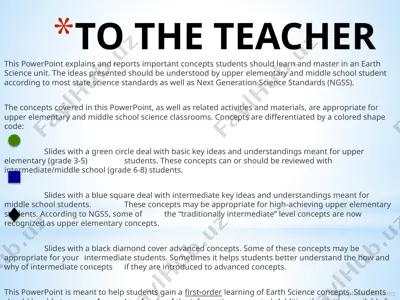
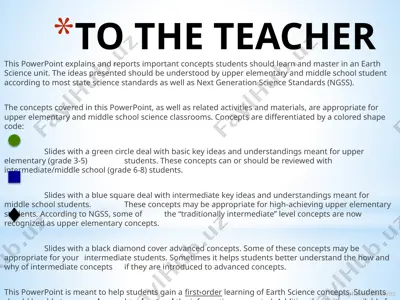
powerpoint presentation © stephanie elkowitz 1 to the teacher this powerpoint explains and reports important concepts students should learn and master in an earth science unit. the ideas presented should be understood by upper elementary and middle school student according to most state science standards as well as next generation science standards (ngss). the concepts covered in this powerpoint, as well as related activities and materials, are appropriate for upper elementary and middle school science classrooms. concepts are differentiated by a colored shape code: slides with a green circle deal with basic key ideas and understandings meant for upper elementary (grade 3-5) students. these concepts can or should be reviewed with intermediate/middle school (grade 6-8) students. slides with a blue square deal with intermediate key ideas and understandings meant for middle school students. these concepts may be appropriate for high-achieving upper elementary students. according to ngss, some of the “traditionally …
2 / 29
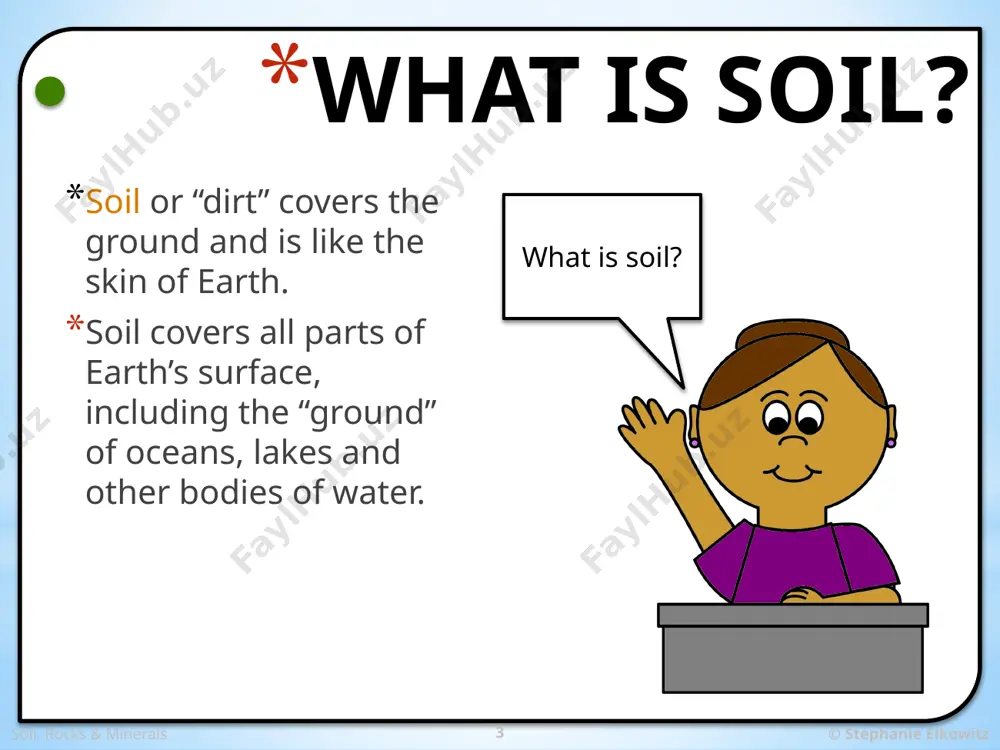
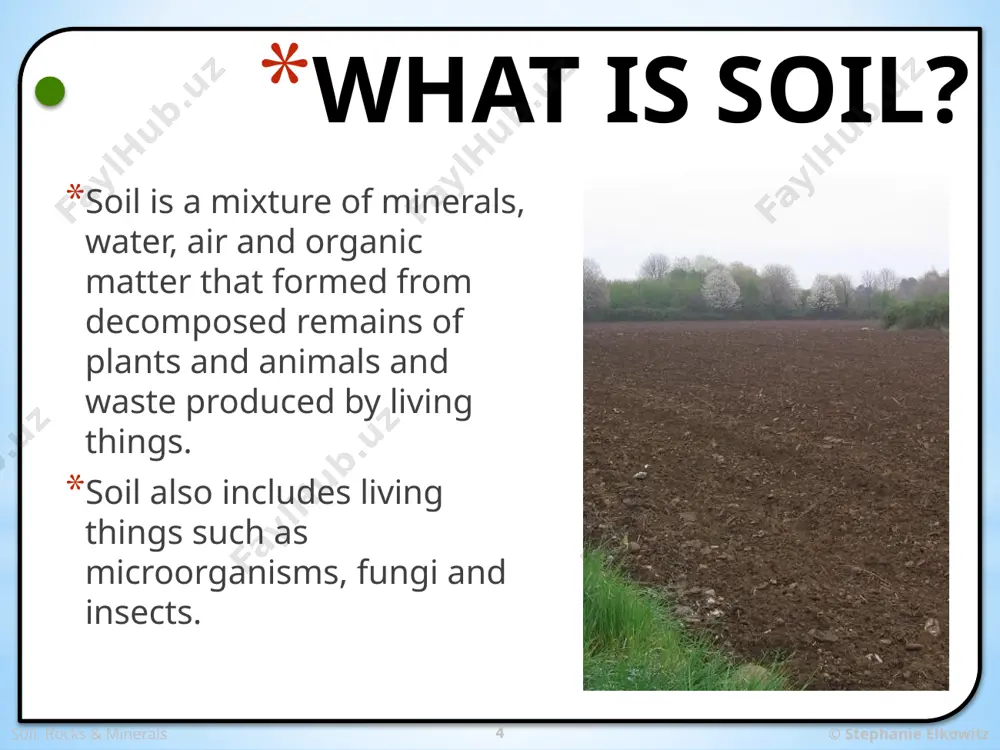
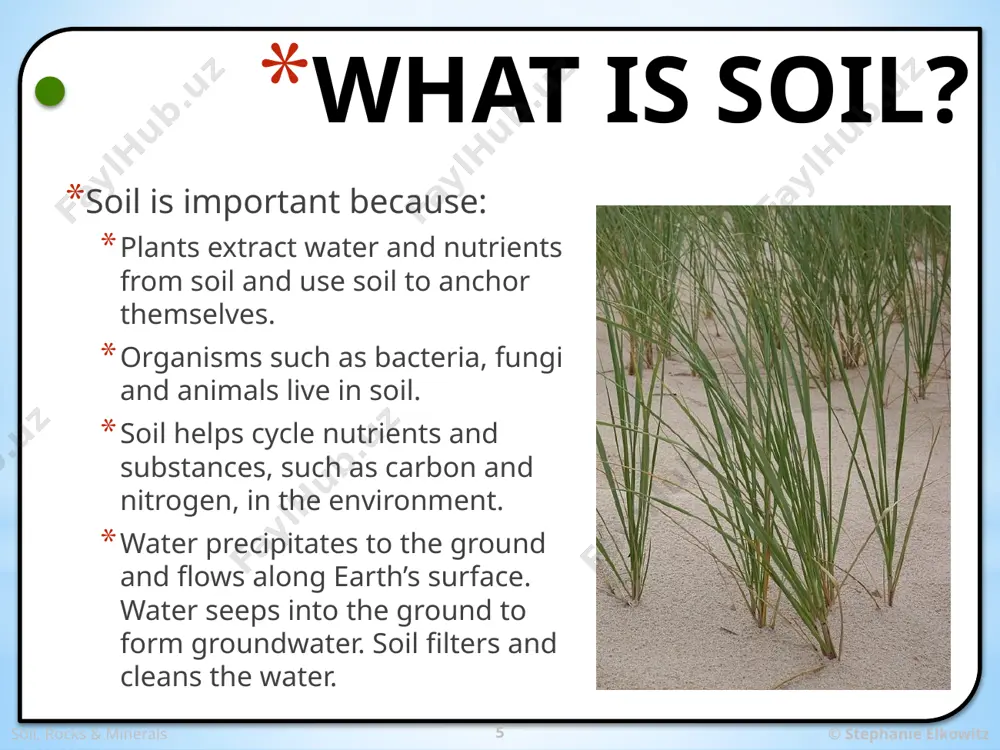
including the “ground” of oceans, lakes and other bodies of water. what is soil? soil, rocks & minerals © stephanie elkowitz 4 what is soil? soil is a mixture of minerals, water, air and organic matter that formed from decomposed remains of plants and animals and waste produced by living things. soil also includes living things such as microorganisms, fungi and insects. soil, rocks & minerals © stephanie elkowitz 5 what is soil? soil is important because: plants extract water and nutrients from soil and use soil to anchor themselves. organisms such as bacteria, fungi and animals live in soil. soil helps cycle nutrients and substances, such as carbon and nitrogen, in the environment. water precipitates to the ground and flows along earth’s surface. water seeps into the ground to form groundwater. soil filters and cleans the water. soil, rocks & minerals © stephanie elkowitz 6 parts of soil when …
3 / 29
rients, such as nitrogen, in the soil. bacteria are plentiful in soil - 1 teaspoon of soil can have up to 1 billion bacteria! animals: some animals, such as snakes and groundhogs burrow in soil, insects (ex. worms) in soil help decompose dead organisms fungi: important decomposers that break down dead organisms soil, rocks & minerals © stephanie elkowitz 9 soil formation soil can take a long time to form. in fact, soil can take up to 1,000 years to form! there are 4 factors that influence how fast soil forms: organisms topography climate parent material soil, rocks & minerals © stephanie elkowitz 10 soil formation factor #1: organisms living things known as decomposers help break down dead organisms into organic matter. organic matter is an important part of soil. the kind and amount of decomposers in the soil can affect how fast organic matter forms. soil, rocks & minerals …
4 / 29
mation in order for soil to form, there must first be parent material. parent material is solid rock and minerals. parent material is often bedrock. bedrock is hard, solid rock that covers earth. this rock is formed from different natural processes. it can become exposed when overlying soil or rock erodes. soil, rocks & minerals © stephanie elkowitz 15 soil formation over time, parent material is weathered or broken down into small particles. the most influential weathering factors are wind, water and plants. soil, rocks & minerals © stephanie elkowitz 16 soil formation eventually parent material is completely broken down into small particles. water and gases mix with the rock and mineral particles. plants begin to grow in the material, organisms move into the material and larger organisms roam the surface of the material. organisms die and decompose into organic matter, which is incorporated into the material. over time, the …
5 / 29
ot as rough as sand. when dry, it feels like smooth powder. when wet, it feels slippery. because its particles are smaller, it allows some drainage and air to pass through but holds onto nutrients. it can be easily packed down, which allows less water and air to pass through. soil, rocks & minerals © stephanie elkowitz 21 clay clay is made of tiny or fine particles with a diameter less than 0.002 millimeters. when dry, clay feel smooth and hard. when wet, it feels sticky. because its particles are fine, it holds onto water and nutrients very well and does not allow air to pass through easily. when wet, clay gets “heavy” from the water and then becomes very hard when dry. soil, rocks & minerals © stephanie elkowitz 22 types of soil the three soil textures form mixtures to make up different types of soil. each type of …

Ko'proq o'qimoqchimisiz?

Barcha 29 sahifani Telegram orqali bepul yuklab oling.

To'liq faylni yuklab olish

"earth science unit powerpoint" haqida

powerpoint presentation © stephanie elkowitz 1 to the teacher this powerpoint explains and reports important concepts students should learn and master in an earth science unit. the ideas presented should be understood by upper elementary and middle school student according to most state science standards as well as next generation science standards (ngss). the concepts covered in this powerpoint, as well as related activities and materials, are appropriate for upper elementary and middle school science classrooms. concepts are differentiated by a colored shape code: slides with a green circle deal with basic key ideas and understandings meant for upper elementary (grade 3-5) students. these concepts can or should be reviewed with intermediate/middle school (grade 6-8) students. slides with...

Bu fayl PPTX formatida 29 sahifadan iborat (5,5 MB). "earth science unit powerpoint"ni yuklab olish uchun chap tomondagi Telegram tugmasini bosing.
Teglar: earth science unit powerpoint PPTX 29 sahifa Bepul yuklash Telegram