stylistics

PPTX 18 pages 82.4 KB Free download

Page preview (5 pages)

Scroll down 👇
1 / 18
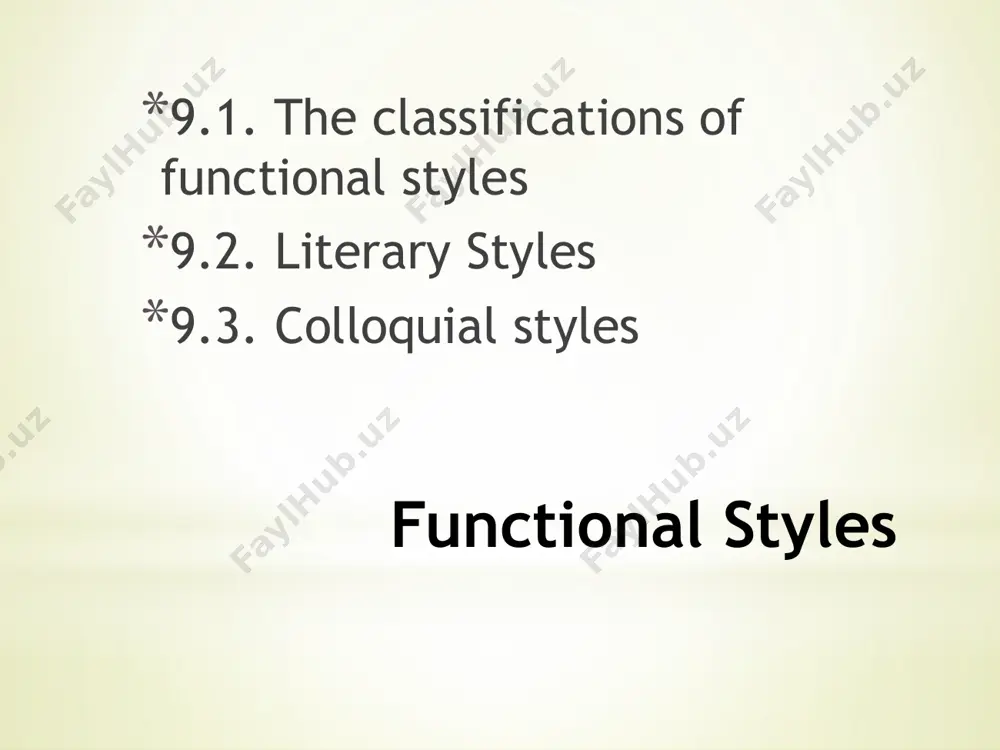
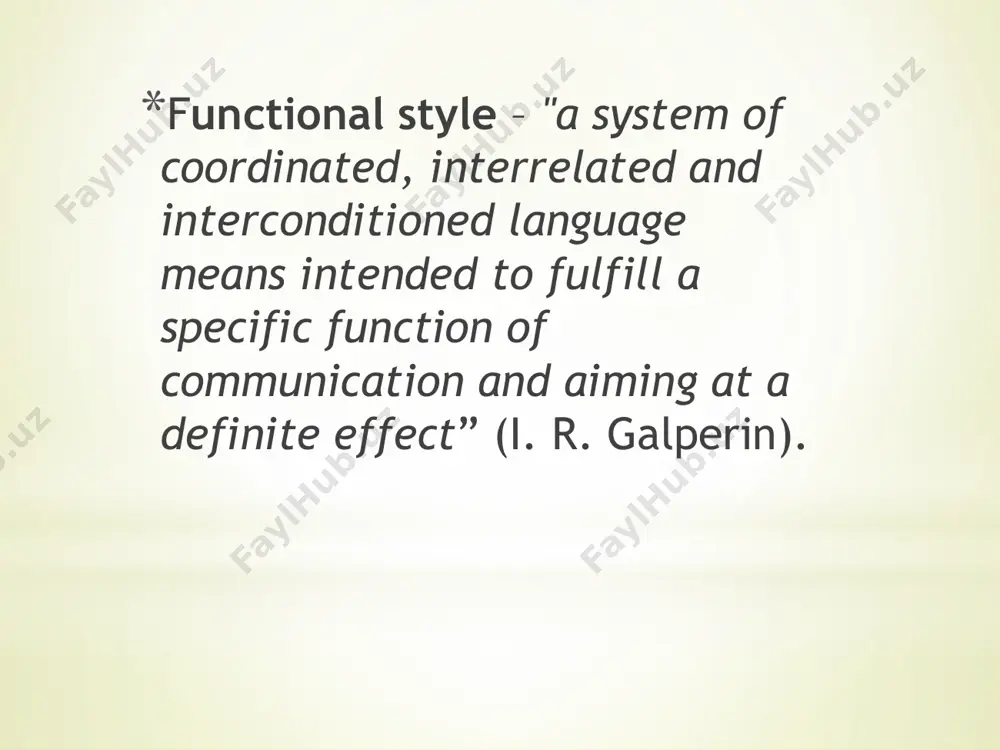
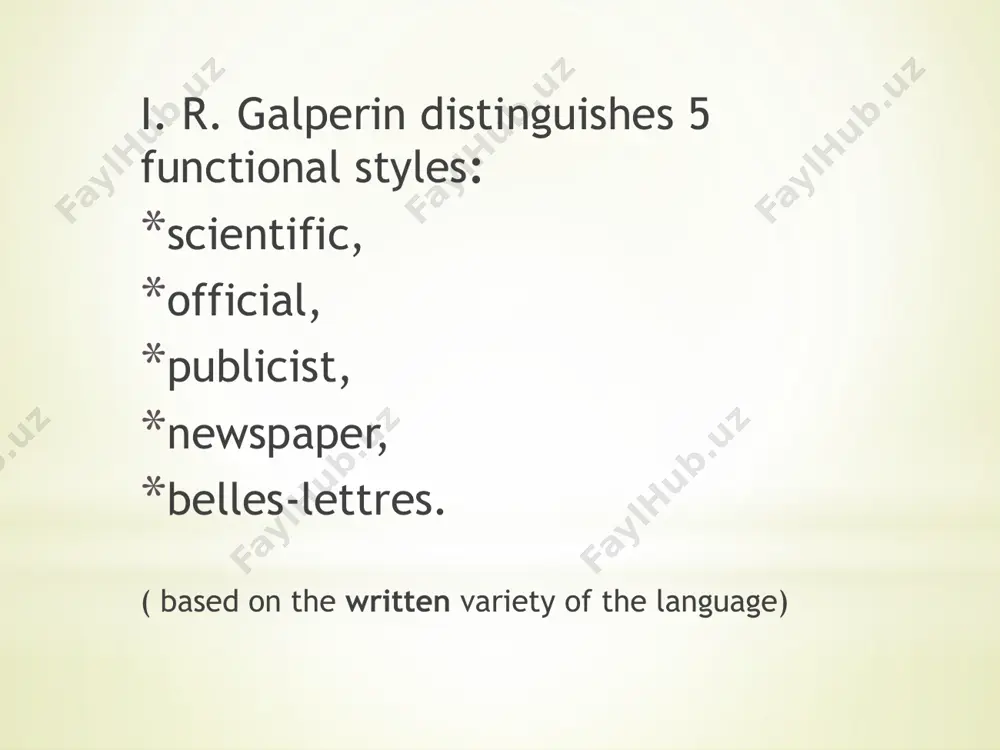
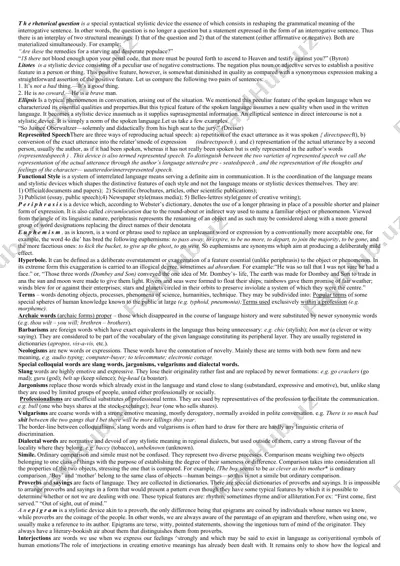
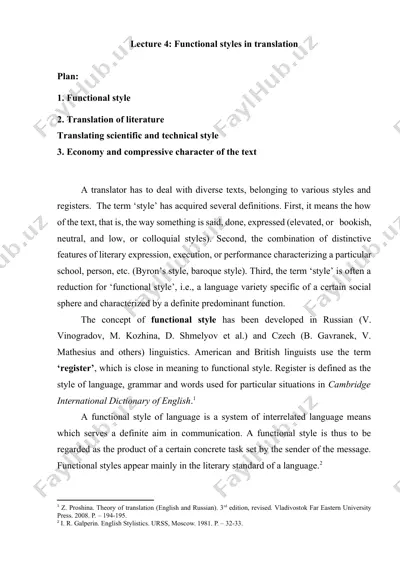
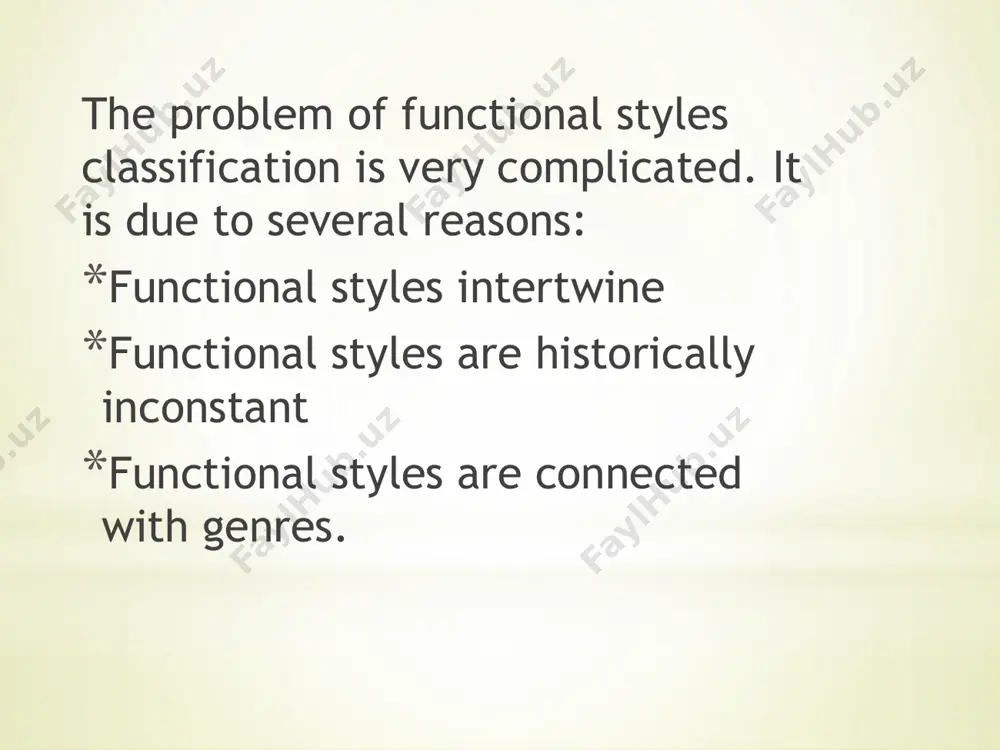
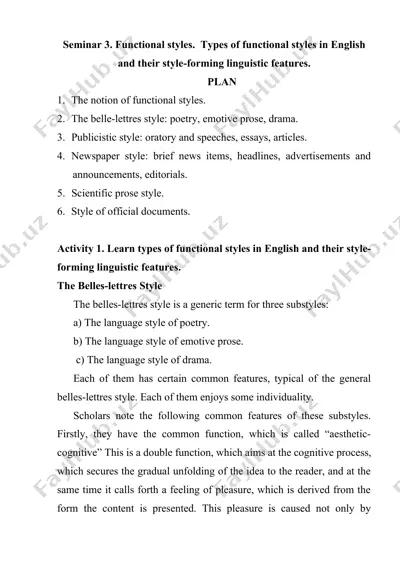
functional styles stylistics lecture 9 functional styles functional styles 9.1. the classifications of functional styles 9.2. literary styles 9.3. colloquial styles functional style – "a system of coordinated, interrelated and interconditioned language means intended to fulfill a specific function of communication and aiming at a definite effect” (i. r. galperin). the problem of functional styles classification is very complicated. it is due to several reasons: functional styles intertwine functional styles are historically inconstant functional styles are connected with genres. i. r. galperin distinguishes 5 functional styles: scientific, official, publicist, newspaper, belles-lettres. ( based on the written variety of the language) yuri skrebnev in addition to literary or bookish styles adds free or colloquial styles: a) literary colloquial style, b) familiar colloquial style. literary styles a) scientific, b) official documents, c) publicist (newspaper), d) newspaper, e) belles-lettres. the scientific prose style → in professional communication. the functions: to describe new concepts, …
2 / 18
words: perform, comprise, susceptible, approximate, simultaneous. the logical emphasis may be expressed lexically quantitative expressiveness exceeds qualitative one: much less limited, much the same, most essential. grammatical peculiarities: morphology: the author's speech – the 1st person →"we": we are coming to realise. impersonal sentences with "it" and constructions with "one. the preference is given to the passive voice and non-personal forms of the verb. present continuous and future tenses are used more often than present simple. syntax: the sentences used are mainly complex and if simple, rather extended. the word order is mainly direct. the wide use of attributes, almost each noun has a post- or prepositional attribute, prepositional, participial, gerundial or infinitive construction. the use of specific prepositional groups: ultra rapid computer machines. the abundance of conjunctions and connectives: not merely ... but also, whether ... or, both ... and, as ... as ...; thereby, therewith, hereby. the official …
3 / 18
sitional pattern: every document has its own stereotyped form. the form itself is informative and tells you with what kind of letter we deal with. syntactical features – the predominance of extended simple and complex sentences, wide use of participial constructions, homogeneous members. morphological peculiarities are passive constructions, they make the letters impersonal. there is a tendency to avoid pronoun reference. the publicist style - pragmatic function of persuasion directed at influencing the reader and shaping his views, in accordance with the argumentation of the author. the functions: to exert a constant and deep influence on public opinion, to convince the reader or the listener that the interpretation given by the writer or the speaker is the only correct one, to cause the audience to accept the point of view not only by logical argumentation, but by emotional appeal as well it is widely used for propaganda. the sub-styles are: …
4 / 18
dvertisements and announcements; headlines; the editorial. general lexical peculiarities: proper names: toponyms, anthroponoms, names of institutions and organizations, a lot of numerals and dates. abundance of internationalisms. tendency to produce neologisms e.g. vital issue, pillar of society. a great number of special political and economic terms, non-term political vocabulary, abstract words, newspaper clichés, abbreviations. general grammatical peculiarities: syntactic constructions, indicating a lack of assurance of the reporter as to the correctness of the facts reported or his desire to avoid responsibility. complex sentences with a developed system of clauses. syntactical complexes: verbal constructions (infinitive, participial, gerundial) and verbal noun constructions. specific word order – five-w-and-h-pattern rule. attributive noun groups (the national income and expenditure figures). a lot of quotations and direct speech, a developed system of direct speech rendering. a simple verb is often substituted by a set expression: e.g. make contact with, exhibit a tendency to, serve the purpose …
5 / 18
stylistics - Page 5

Want to read more?

Download all 18 pages for free via Telegram.

Download full file

About "stylistics"

functional styles stylistics lecture 9 functional styles functional styles 9.1. the classifications of functional styles 9.2. literary styles 9.3. colloquial styles functional style – "a system of coordinated, interrelated and interconditioned language means intended to fulfill a specific function of communication and aiming at a definite effect” (i. r. galperin). the problem of functional styles classification is very complicated. it is due to several reasons: functional styles intertwine functional styles are historically inconstant functional styles are connected with genres. i. r. galperin distinguishes 5 functional styles: scientific, official, publicist, newspaper, belles-lettres. ( based on the written variety of the language) yuri skrebnev in addition to literary or bookish styles ...

This file contains 18 pages in PPTX format (82.4 KB). To download "stylistics", click the Telegram button on the left.
Tags: stylistics PPTX 18 pages Free download Telegram