noun clauses

DOCX 6 sahifa 17,9ย KB Bepul yuklash

Sahifa ko'rinishi (5 sahifa)

Pastga aylantiring ๐Ÿ‘‡
1 / 6
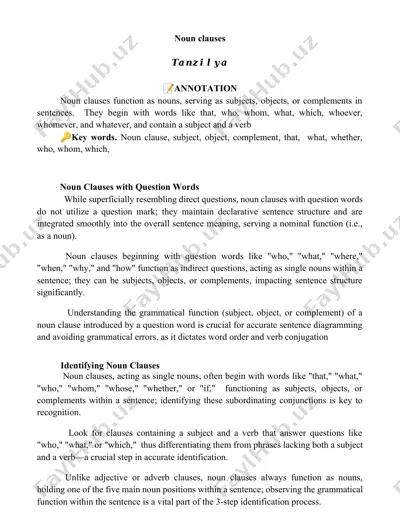
noun clauses ๐‘ป๐’‚๐’๐’›๐’Š๐’๐’š๐’‚ ๐Ÿ“annotation noun clauses function as nouns, serving as subjects, objects, or complements in sentences. they begin with words like that, who, whom, what, which, whoever, whomever, and whatever, and contain a subject and a verb ๐Ÿ”‘key words. noun clause, subject, object, complement, that, what, whether, who, whom, which, noun clauses with question words while superficially resembling direct questions, noun clauses with question words do not utilize a question mark; they maintain declarative sentence structure and are integrated smoothly into the overall sentence meaning, serving a nominal function (i.e., as a noun). noun clauses beginning with question words like "who," "what," "where," "when," "why," and "how" function as indirect questions, acting as single nouns within a sentence; they can be subjects, objects, or complements, impacting sentence structure significantly. understanding the grammatical function (subject, object, or complement) of a noun clause introduced by a question word is crucial for โ€ฆ
2 / 6
"if," or interrogative words like "who," "what," "when," creating a dependent clause serving a noun function within a larger sentence structure. a single sentence can contain multiple embedded noun clauses, creating complex sentence structures with layers of meaning; for example, analyzing 2-3 such clauses reveals intricate grammatical relationships. noun clauses, unlike phrases, function as single grammatical unitsโ€”they act as nouns, fulfilling roles like subject (e.g., "that he left early surprised me") or object (e.g., "i know that she is intelligent"). noun clauses and sentence structure understanding the 3 main types of noun clausesโ€”declarative, interrogative, and imperativeโ€”is crucial for correctly identifying their function and parsing complex sentences with multiple embedded clauses. analyzing the relationship between a noun clause and its governing verb (e.g., "he believes [that the earth is round]") reveals how the clause functions as a single syntactic unit, impacting the overall sentence meaning and structure. noun clauses, acting as โ€ฆ
3 / 6
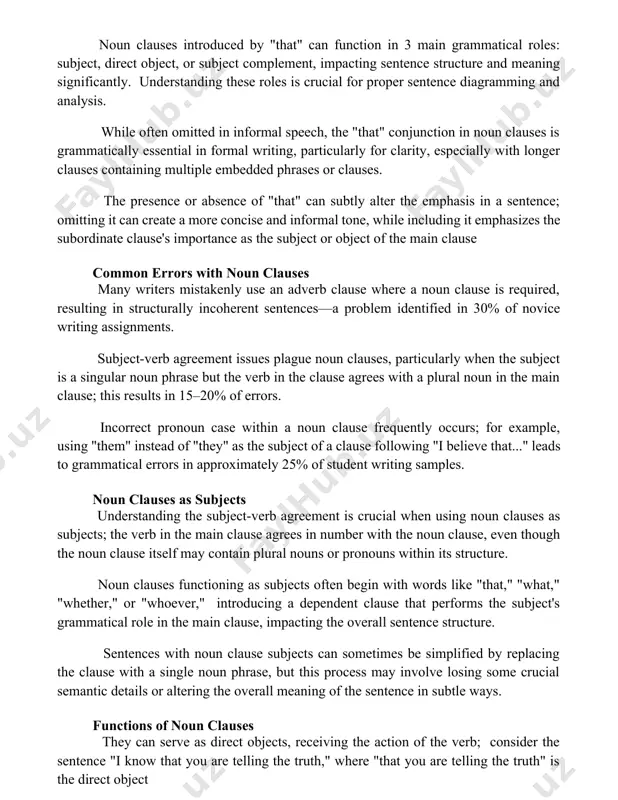
2 types of noun clause complements within a sentence's structure. noun clauses with that noun clauses introduced by "that" can function in 3 main grammatical roles: subject, direct object, or subject complement, impacting sentence structure and meaning significantly. understanding these roles is crucial for proper sentence diagramming and analysis. while often omitted in informal speech, the "that" conjunction in noun clauses is grammatically essential in formal writing, particularly for clarity, especially with longer clauses containing multiple embedded phrases or clauses. the presence or absence of "that" can subtly alter the emphasis in a sentence; omitting it can create a more concise and informal tone, while including it emphasizes the subordinate clause's importance as the subject or object of the main clause common errors with noun clauses many writers mistakenly use an adverb clause where a noun clause is required, resulting in structurally incoherent sentencesโ€”a problem identified in 30% of novice โ€ฆ
4 / 6
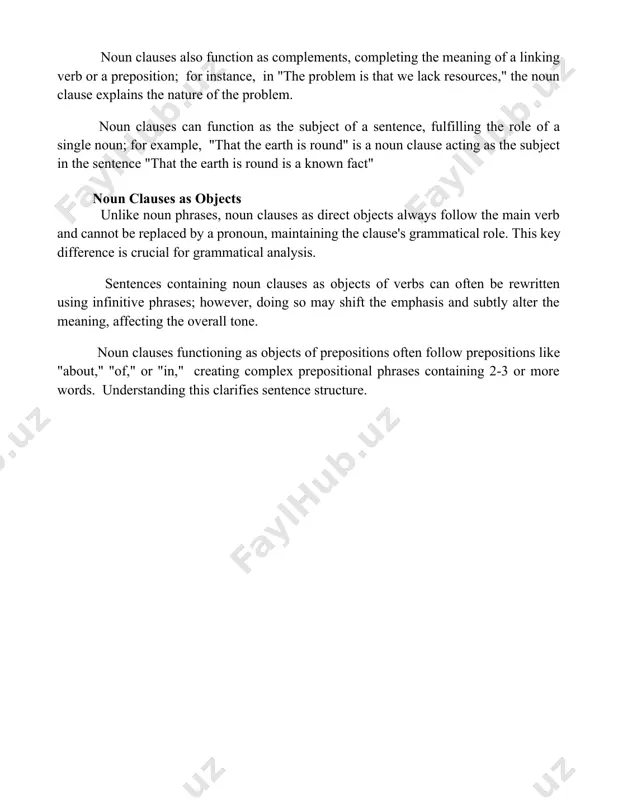
entence structure. sentences with noun clause subjects can sometimes be simplified by replacing the clause with a single noun phrase, but this process may involve losing some crucial semantic details or altering the overall meaning of the sentence in subtle ways. functions of noun clauses they can serve as direct objects, receiving the action of the verb; consider the sentence "i know that you are telling the truth," where "that you are telling the truth" is the direct object noun clauses also function as complements, completing the meaning of a linking verb or a preposition; for instance, in "the problem is that we lack resources," the noun clause explains the nature of the problem. noun clauses can function as the subject of a sentence, fulfilling the role of a single noun; for example, "that the earth is round" is a noun clause acting as the subject in the sentence "that โ€ฆ
5 / 6
book: an esl/efl teacher's course. heinle heinle. 3. eastwood, j. (2006). oxford learner's grammar. oxford university press. 4

Ko'proq o'qimoqchimisiz?

Barcha 6 sahifani Telegram orqali bepul yuklab oling.

To'liq faylni yuklab olish

"noun clauses" haqida

noun clauses ๐‘ป๐’‚๐’๐’›๐’Š๐’๐’š๐’‚ ๐Ÿ“annotation noun clauses function as nouns, serving as subjects, objects, or complements in sentences. they begin with words like that, who, whom, what, which, whoever, whomever, and whatever, and contain a subject and a verb ๐Ÿ”‘key words. noun clause, subject, object, complement, that, what, whether, who, whom, which, noun clauses with question words while superficially resembling direct questions, noun clauses with question words do not utilize a question mark; they maintain declarative sentence structure and are integrated smoothly into the overall sentence meaning, serving a nominal function (i.e., as a noun). noun clauses beginning with question words like "who," "what," "where," "when," "why," and "how" function as indirect questions, acting as single nouns within...

Bu fayl DOCX formatida 6 sahifadan iborat (17,9ย KB). "noun clauses"ni yuklab olish uchun chap tomondagi Telegram tugmasini bosing.
Teglar: noun clauses DOCX 6 sahifa Bepul yuklash Telegram