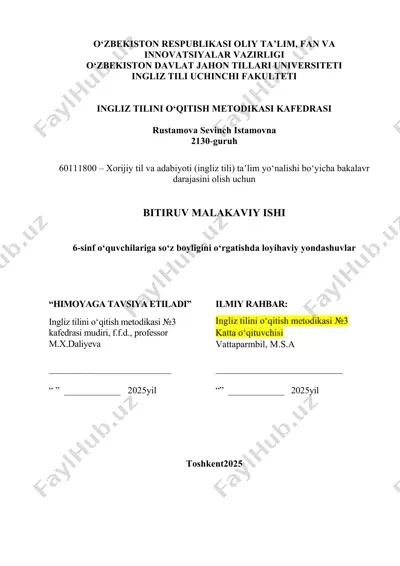
project based strategies for teaching vocabulary to 6th-grade students

DOCX 10 sahifa 24,4 KB Bepul yuklash

Sahifa ko'rinishi (5 sahifa)

Pastga aylantiring 👇
1 / 10
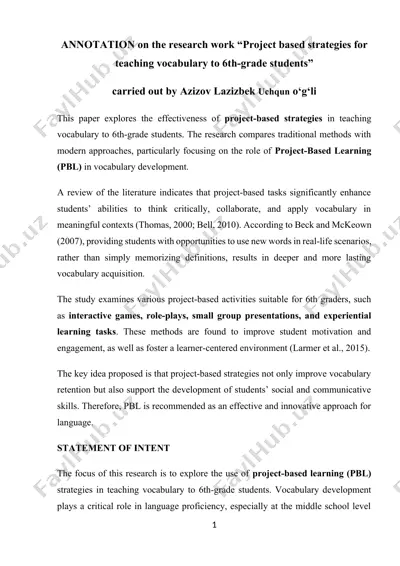
annotation on the research work “project based strategies for teaching vocabulary to 6th-grade students” carried out by azizov lazizbek uchqun o‘g‘li this paper explores the effectiveness of project-based strategies in teaching vocabulary to 6th-grade students. the research compares traditional methods with modern approaches, particularly focusing on the role of project-based learning (pbl) in vocabulary development. a review of the literature indicates that project-based tasks significantly enhance students’ abilities to think critically, collaborate, and apply vocabulary in meaningful contexts (thomas, 2000; bell, 2010). according to beck and mckeown (2007), providing students with opportunities to use new words in real-life scenarios, rather than simply memorizing definitions, results in deeper and more lasting vocabulary acquisition. the study examines various project-based activities suitable for 6th graders, such as interactive games, role-plays, small group presentations, and experiential learning tasks. these methods are found to improve student motivation and engagement, as well as foster a learner-centered …
2 / 10
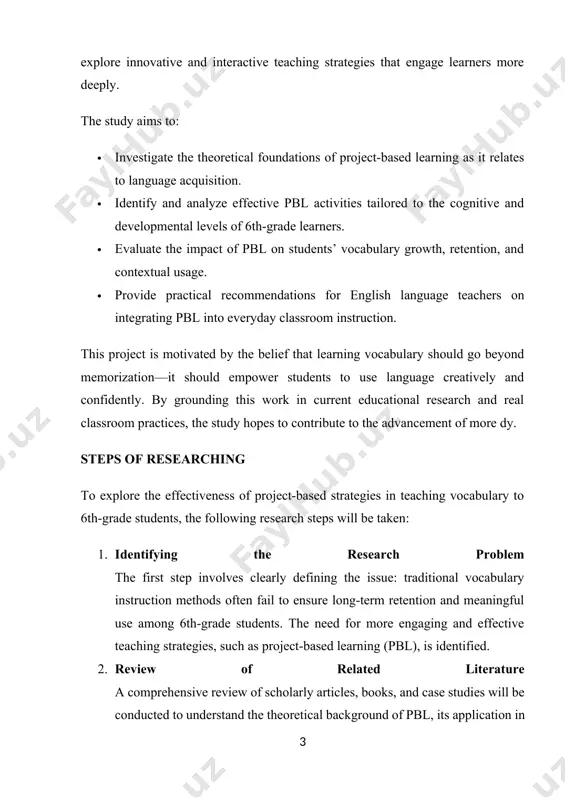
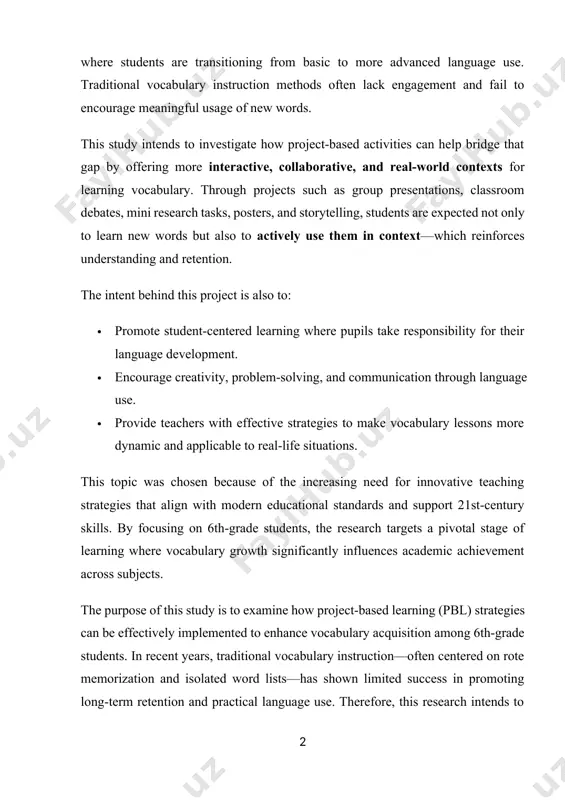
, collaborative, and real-world contexts for learning vocabulary. through projects such as group presentations, classroom debates, mini research tasks, posters, and storytelling, students are expected not only to learn new words but also to actively use them in context—which reinforces understanding and retention. the intent behind this project is also to: · promote student-centered learning where pupils take responsibility for their language development. · encourage creativity, problem-solving, and communication through language use. · provide teachers with effective strategies to make vocabulary lessons more dynamic and applicable to real-life situations. this topic was chosen because of the increasing need for innovative teaching strategies that align with modern educational standards and support 21st-century skills. by focusing on 6th-grade students, the research targets a pivotal stage of learning where vocabulary growth significantly influences academic achievement across subjects. the purpose of this study is to examine how project-based learning (pbl) strategies can be effectively …
3 / 10
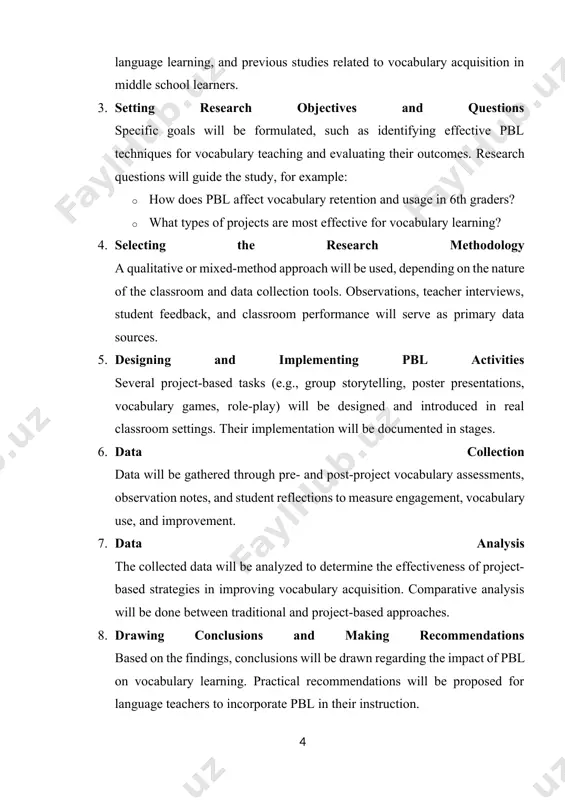
elief that learning vocabulary should go beyond memorization—it should empower students to use language creatively and confidently. by grounding this work in current educational research and real classroom practices, the study hopes to contribute to the advancement of more dy. steps of researching to explore the effectiveness of project-based strategies in teaching vocabulary to 6th-grade students, the following research steps will be taken: 1. identifying the research problem the first step involves clearly defining the issue: traditional vocabulary instruction methods often fail to ensure long-term retention and meaningful use among 6th-grade students. the need for more engaging and effective teaching strategies, such as project-based learning (pbl), is identified. 2. review of related literature a comprehensive review of scholarly articles, books, and case studies will be conducted to understand the theoretical background of pbl, its application in language learning, and previous studies related to vocabulary acquisition in middle school learners. 3. …
4 / 10
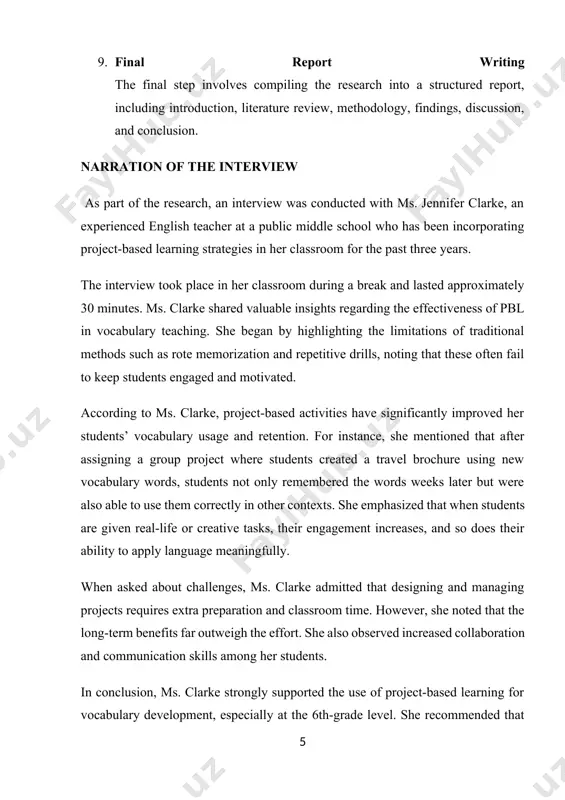
ll be gathered through pre- and post-project vocabulary assessments, observation notes, and student reflections to measure engagement, vocabulary use, and improvement. 7. data analysis the collected data will be analyzed to determine the effectiveness of project-based strategies in improving vocabulary acquisition. comparative analysis will be done between traditional and project-based approaches. 8. drawing conclusions and making recommendations based on the findings, conclusions will be drawn regarding the impact of pbl on vocabulary learning. practical recommendations will be proposed for language teachers to incorporate pbl in their instruction. 9. final report writing the final step involves compiling the research into a structured report, including introduction, literature review, methodology, findings, discussion, and conclusion. narration of the interview as part of the research, an interview was conducted with ms. jennifer clarke, an experienced english teacher at a public middle school who has been incorporating project-based learning strategies in her classroom for the past …
5 / 10
meaningfully. when asked about challenges, ms. clarke admitted that designing and managing projects requires extra preparation and classroom time. however, she noted that the long-term benefits far outweigh the effort. she also observed increased collaboration and communication skills among her students. in conclusion, ms. clarke strongly supported the use of project-based learning for vocabulary development, especially at the 6th-grade level. she recommended that teachers gradually integrate pbl elements into their lessons, starting with small tasks like storytelling or poster-making, and then moving toward more complex projects. final reflection throughout the process of exploring project-based strategies for teaching vocabulary to 6th-grade students, i have gained a deeper understanding of how meaningful, student-centered learning can significantly enhance language acquisition. unlike traditional methods that often rely on memorization, project-based learning (pbl) encourages active participation, creativity, and contextual understanding of vocabulary. this research has shown that when students are involved in hands-on projects—such as …

Ko'proq o'qimoqchimisiz?

Barcha 10 sahifani Telegram orqali bepul yuklab oling.

To'liq faylni yuklab olish

"project based strategies for teaching vocabulary to 6th-grade students" haqida

annotation on the research work “project based strategies for teaching vocabulary to 6th-grade students” carried out by azizov lazizbek uchqun o‘g‘li this paper explores the effectiveness of project-based strategies in teaching vocabulary to 6th-grade students. the research compares traditional methods with modern approaches, particularly focusing on the role of project-based learning (pbl) in vocabulary development. a review of the literature indicates that project-based tasks significantly enhance students’ abilities to think critically, collaborate, and apply vocabulary in meaningful contexts (thomas, 2000; bell, 2010). according to beck and mckeown (2007), providing students with opportunities to use new words in real-life scenarios, rather than simply memorizing definitions, results i...

Bu fayl DOCX formatida 10 sahifadan iborat (24,4 KB). "project based strategies for teaching vocabulary to 6th-grade students"ni yuklab olish uchun chap tomondagi Telegram tugmasini bosing.
Teglar: project based strategies for te… DOCX 10 sahifa Bepul yuklash Telegram