verbs and their classifications

PPTX 33 pages 125.0 KB Free download

Page preview (5 pages)

Scroll down 👇
1 / 33
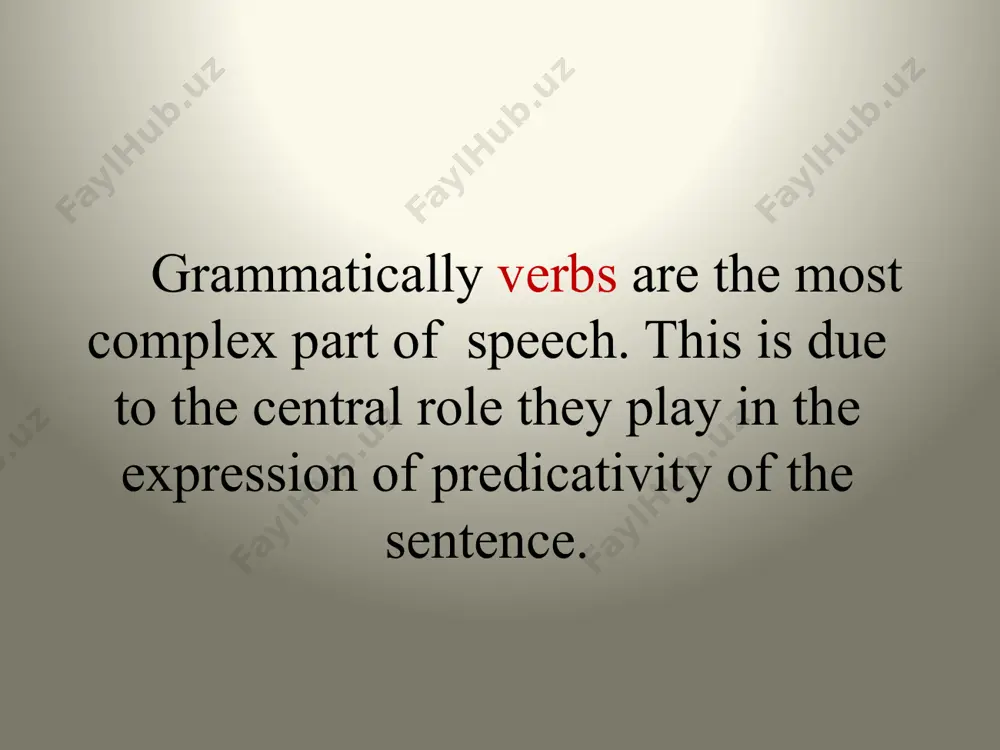
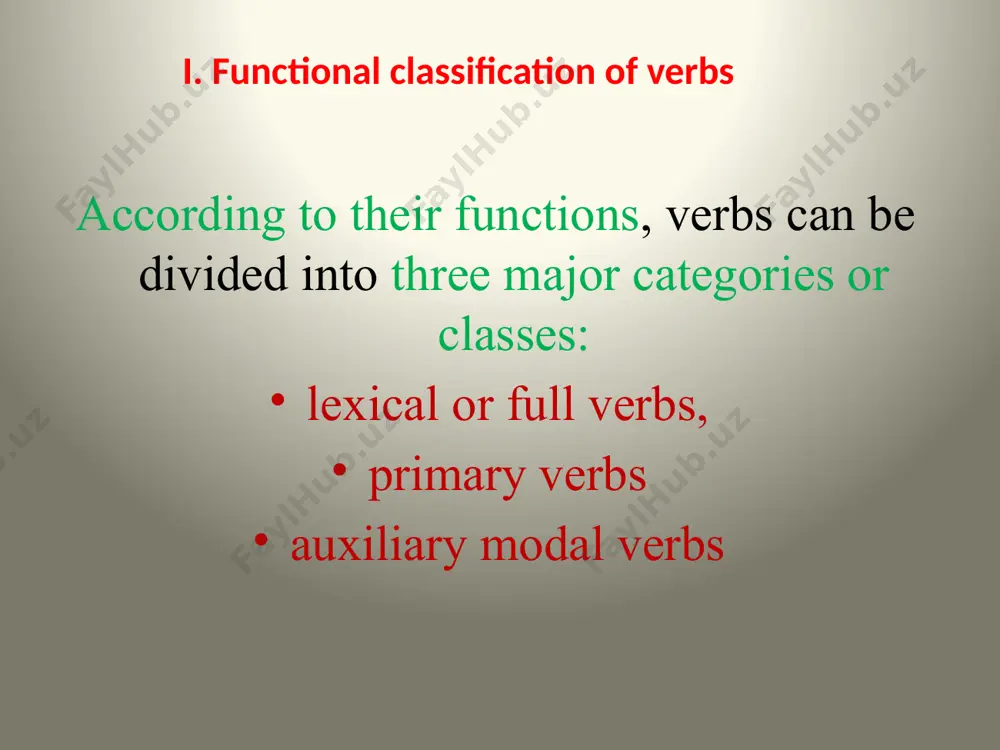
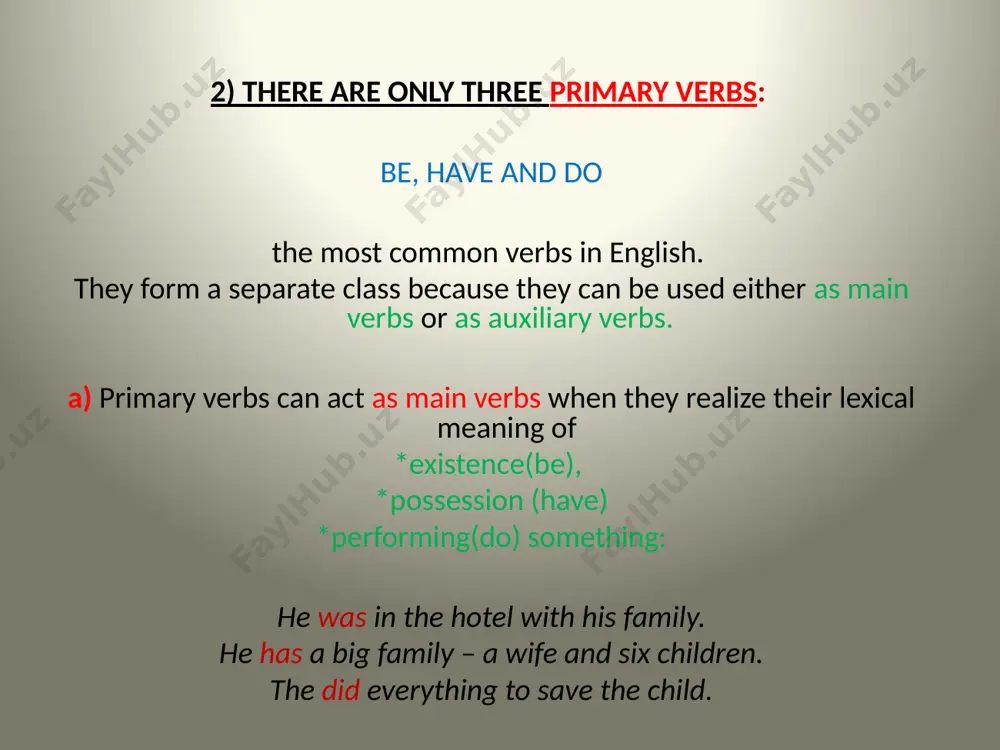
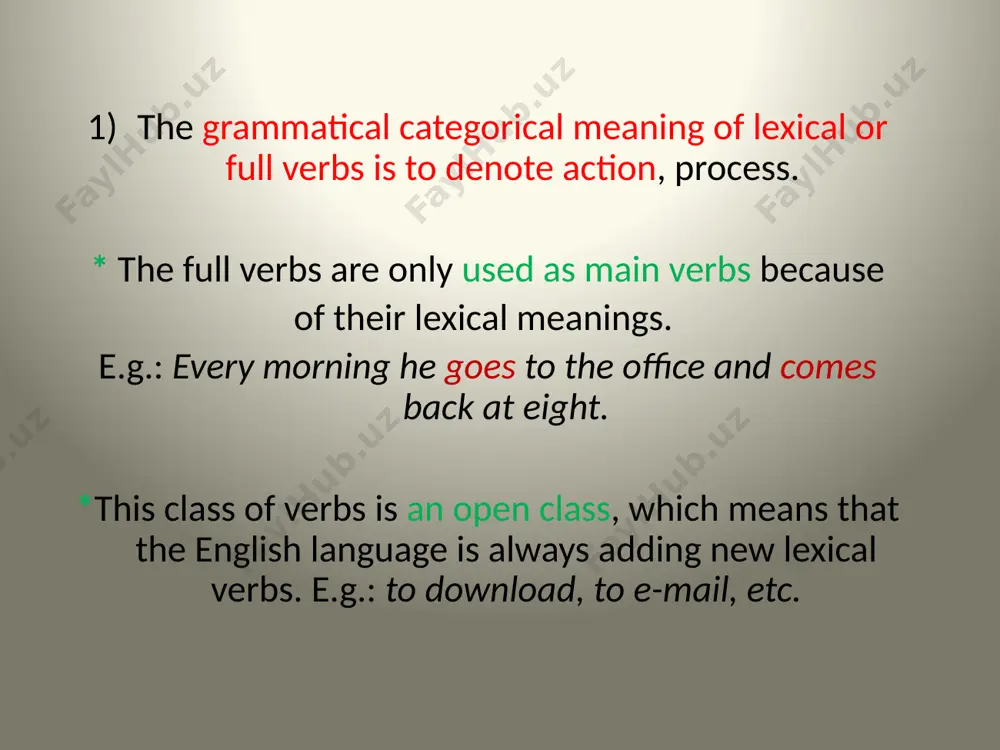
lecture 7 lecture 7 verb as the central part of speech. its different classifications. grammatically verbs are the most complex part of speech. this is due to the central role they play in the expression of predicativity of the sentence. i. functional classification of verbs according to their functions, verbs can be divided into three major categories or classes: lexical or full verbs, primary verbs auxiliary modal verbs the grammatical categorical meaning of lexical or full verbs is to denote action, process. * the full verbs are only used as main verbs because of their lexical meanings. e.g.: every morning he goes to the office and comes back at eight. *this class of verbs is an open class, which means that the english language is always adding new lexical verbs. e.g.: to download, to e-mail, etc. 2) there are only three primary verbs: be, have and do the most common …
2 / 33
passive voice: the letter was sent to him. *the auxiliary do is used in negative statements and in questions; this is known as do insertion. for instance: where do you live? he does not speak french. 3) auxiliary modal verbs (can, may, must, could, might, have to, be able to, have to, shall, will, should, would, need, etc.) are used only as auxiliary verbs to express : ability, possibility, obligation, necessity, volition or prediction of the action, process or state which is denoted by the main verb. cf.: people thought he might have been joking.(possibility) he would probably go there. (volition/prediction) ii. semantic classification of lexical (full) verbs linguists differentiate seven semantic classes of full verbs (biber et al. 2003: 106-114). they are: activity verbs, communication verbs, mental verbs, causative verbs, verbs of occurrence, verbs of existence or relationship, verbs of aspect. 1. activity verbs usually refer to an action …
3 / 33
tal’ verbs are: believe, find, listen, read, think, consider, hear, love, remember, understand, expect, know, mean, see, want, feel, like, need, suppose, wonder. they decided to watch tv. somehow i doubt it. he remembered all our names. 4. causative verbs, such as allow, let, enable, require, cause, force and help indicate that some person or things help to bring about a new state of affairs. these verbs often occur with a derived noun as the direct object, which reports the action or event that was facilitated (in the examples below the direct object is underlined). for instance: this information enables the formulation of precise questions. 5. verbs of occurrence report events that occur without an actor. often the subjects of these verbs are effected by the event that is described by the verb, as in these examples (subjects are underlined): the lights changed. the term ‘feature’ has occurred many times …
4 / 33
rphological classification of verbs is the way how they form simple past and past participle or participle ii. accordingly verbs are divided into two large groups: *regular * irregular verbs a) regular verbs form past simple and past participle by adding the inflectional suffix –ed, while irregular verbs form these forms individually. b)english irregular verbs can be differentiated into the following subgroups: verbs that form simple past and participle ii *by means vowel gradation(1) drink – drank – drunk begin – began - begun sing – sang – sung sink – sank – sunk *verbs with vowel gradation + affixation for participle ii(2) break – broke – broken take – took -taken give – gave – given write – wrote – written verbs with vowel gradation + the same suffixation forms for simple past and participle ii. (3) bring – brought – brought catch – caught – caught teach – …
5 / 33
redicate) non-finite verb forms: 1. nick can speak five languages. (infinitive, part of a compound modal verbal predicate.) 2. dancing is my favorite good pastime. (gerund, subject) 3. i like dancing. (gerund, direct object) 4. he sat on the sofa reading a book. (participle i, adv. modifier of attending circumstances) 5. he saw a dancing girl. (participle i, attribute) 6. there was a broken vase in the box. (participle ii, attribute) 2. finite verbs have tense contrast i.e. the distinction between present and past tenses: she works hard. she worked hard. while non-finite verb forms don’t have tense distinction i.e. they don’t have grammatical category of tense. 3. finite verbs have grammatical categories of person and number while non-finite verbs don’t have any of these distinctions. he / she / jim reads the paper every morning. i / we / you / they read the paper every morning. 4. both, …

Want to read more?

Download all 33 pages for free via Telegram.

Download full file

About "verbs and their classifications"

lecture 7 lecture 7 verb as the central part of speech. its different classifications. grammatically verbs are the most complex part of speech. this is due to the central role they play in the expression of predicativity of the sentence. i. functional classification of verbs according to their functions, verbs can be divided into three major categories or classes: lexical or full verbs, primary verbs auxiliary modal verbs the grammatical categorical meaning of lexical or full verbs is to denote action, process. * the full verbs are only used as main verbs because of their lexical meanings. e.g.: every morning he goes to the office and comes back at eight. *this class of verbs is an open class, which means …

This file contains 33 pages in PPTX format (125.0 KB). To download "verbs and their classifications", click the Telegram button on the left.

Tags: verbs and their classifications PPTX 33 pages Free download Telegram