modal verbs
Предварительный просмотр (5 стр.)
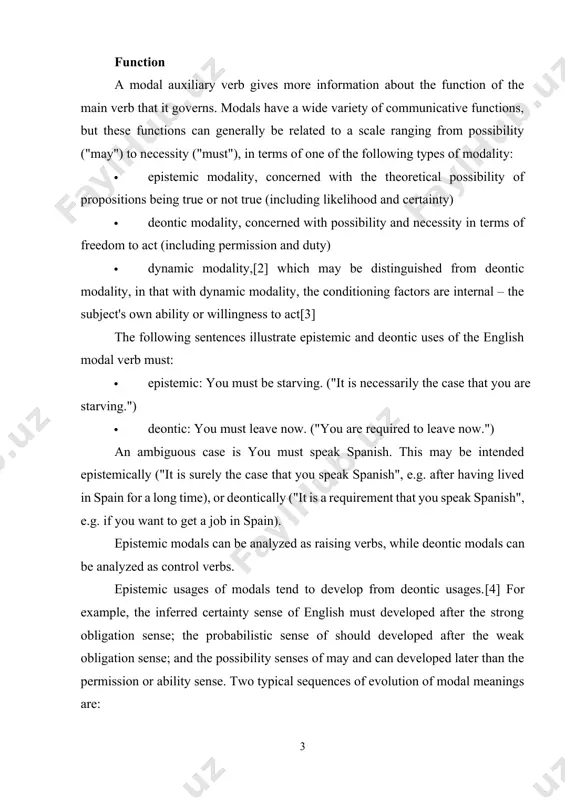
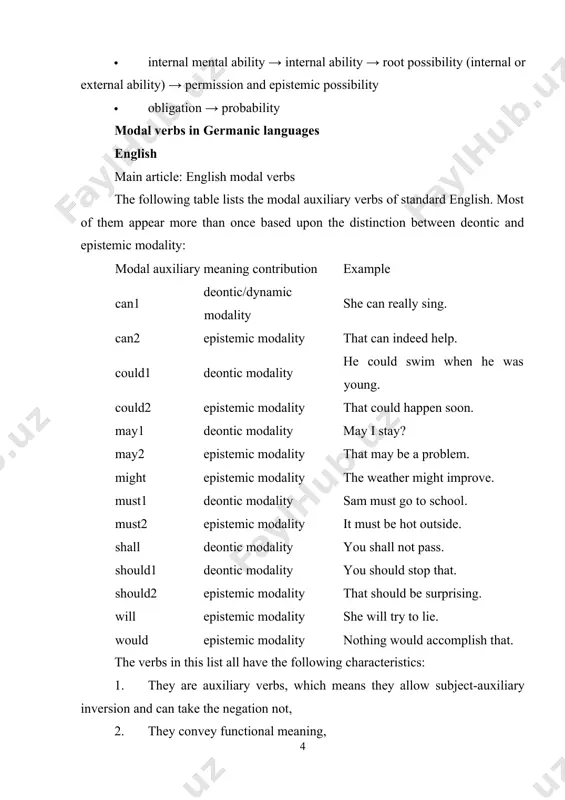
Прокрутите вниз 👇![modal verbs theme: verbs contents 1 function 2 modal verbs in germanic languages 2.1 english 2.1.1 defectiveness 2.2 other west germanic languages 2.2.1 morphology and syntax 3 modal verbs in other languages 3.1 hawaiian creole english 3.2 hawaiian 3.3 french 3.4 mandarin chinese 3.5 spanish 4 see also 5 bibliography 6 references 7 external links function a modal auxiliary verb gives more information about the function of the main verb that it governs. modals have a wide variety of communicative functions, but these functions can generally be related to a scale ranging from possibility ("may") to necessity ("must"), in terms of one of the following types of modality: · epistemic modality, concerned with the theoretical possibility of propositions being true or not true (including likelihood and certainty) · deontic modality, concerned with possibility and necessity in terms of freedom to act (including permission and duty) · dynamic modality,[2] which may …](/media/previews/pages/preview_uczt1Zv.webp "modal verbs - Страница 1")
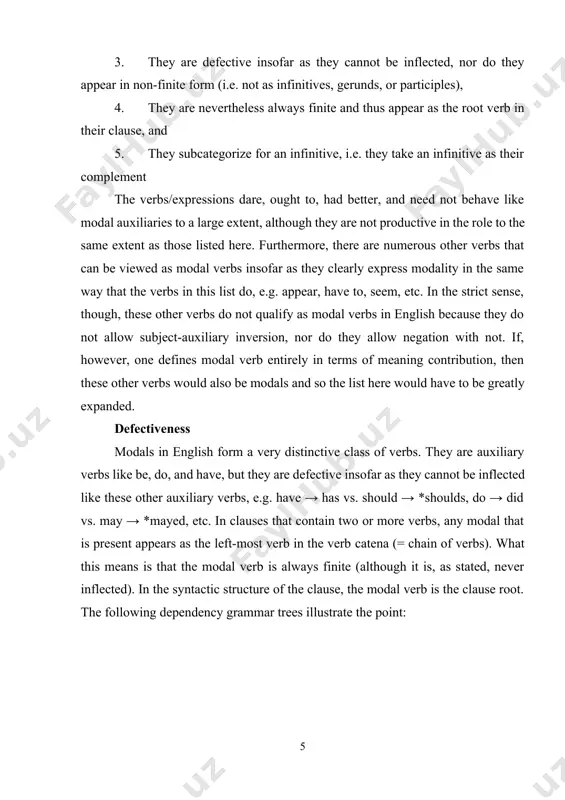
![ed an independent, present tense meaning. the german verb möchten is sometimes taught as a vocabulary word and included in the list of modal verbs, but it is actually the past subjunctive form of mögen. the english verbs dare and need have both a modal use (he dare not do it), and a non-modal use (he doesn't dare to do it). the dutch, west frisian, and afrikaans verbs durven, doarre, and durf are not considered modals (but they are there, nevertheless) because their modal use has disappeared, but they have a non-modal use analogous with the english dare. some english modals consist of more than one word, such as "had better" and "would rather".[6] owing to their modal characteristics, modal verbs are among a very select group of verbs in afrikaans that have a preterite form. most verbs in afrikaans only have a present and a perfect form. some other …](/media/previews/pages/preview_3AsAYvL.webp "modal verbs - Страница 5")
О "modal verbs"
modal verbs theme: verbs contents 1 function 2 modal verbs in germanic languages 2.1 english 2.1.1 defectiveness 2.2 other west germanic languages 2.2.1 morphology and syntax 3 modal verbs in other languages 3.1 hawaiian creole english 3.2 hawaiian 3.3 french 3.4 mandarin chinese 3.5 spanish 4 see also 5 bibliography 6 references 7 external links function a modal auxiliary verb gives more information about the function of the main verb that it governs. modals have a wide variety of communicative functions, but these functions can generally be related to a scale ranging from possibility ("may") to necessity ("must"), in terms of one of the following types of modality: · epistemic modality, concerned with the theoretical possibility of propositions being true …
Этот файл содержит 12 стр. в формате DOCX (68,4 КБ). Чтобы скачать "modal verbs", нажмите кнопку Telegram слева.
 PPTX
PPTX
 PDF
PDF
 DOC
DOC
 DOCX
DOCX
 DOCX
DOCX
 DOCX
DOCX
 DOCX
DOCX
 DOC
DOC
 DOCX
DOCX
 DOCX
DOCX
 DOC
DOC
 DOC
DOC