word formation problems for discussion

DOC 55,0 КБ Бесплатная загрузка

Предварительный просмотр (5 стр.)

Прокрутите вниз 👇
1
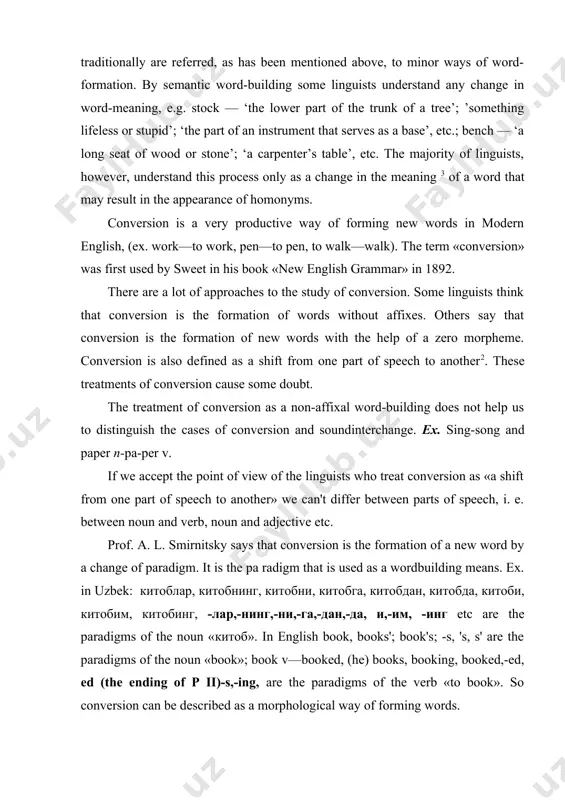
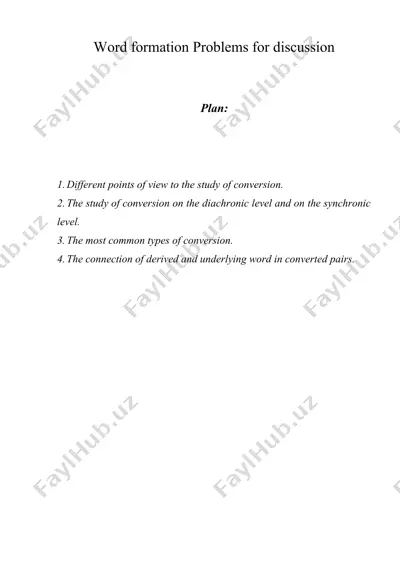
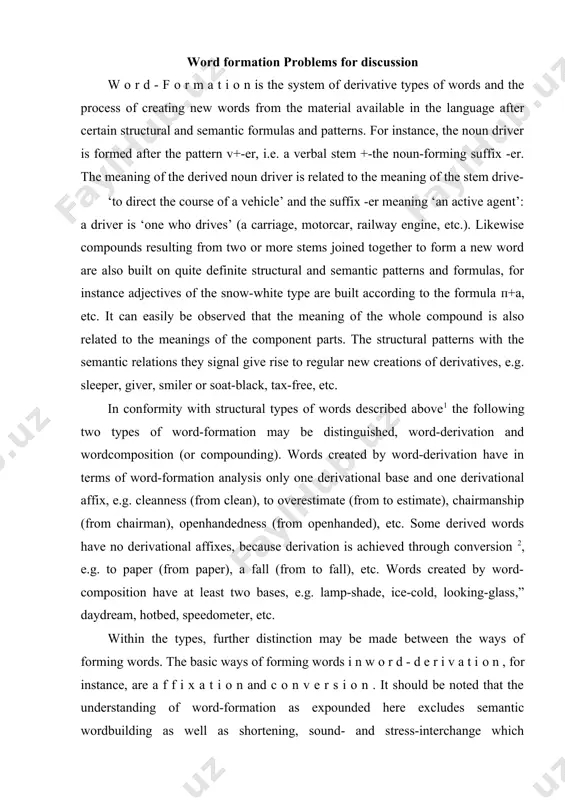
1557122600_74250.doc word formation problems for discussion plan: 1. different points of view to the study of conversion. 2. the study of conversion on the diachronic level and on the synchronic level. 3. the most common types of conversion. 4. the connection of derived and underlying word in converted pairs. word formation problems for discussion w o r d - f o r m a t i o n is the system of derivative types of words and the process of creating new words from the material available in the language after certain structural and semantic formulas and patterns. for instance, the noun driver is formed after the pattern v+-er, i.e. a verbal stem +-the noun-forming suffix -er. the meaning of the derived noun driver is related to the meaning of the stem drive- ‘to direct the course of a vehicle’ and the suffix -er meaning ‘an active agent’: a driver …
2
ugh conversion 2, e.g. to paper (from paper), a fall (from to fall), etc. words created by word-composition have at least two bases, e.g. lamp-shade, ice-cold, looking-glass,” daydream, hotbed, speedometer, etc. within the types, further distinction may be made between the ways of forming words. the basic ways of forming words i n w o r d - d e r i v a t i о n , for instance, are a f f i x a t i o n and c o n v e r s i o n . it should be noted that the understanding of word-formation as expounded here excludes semantic wordbuilding as well as shortening, sound- and stress-interchange which traditionally are referred, as has been mentioned above, to minor ways of word-formation. by semantic word-building some linguists understand any change in word-meaning, e.g. stock — ‘the lower part of the trunk of …
3
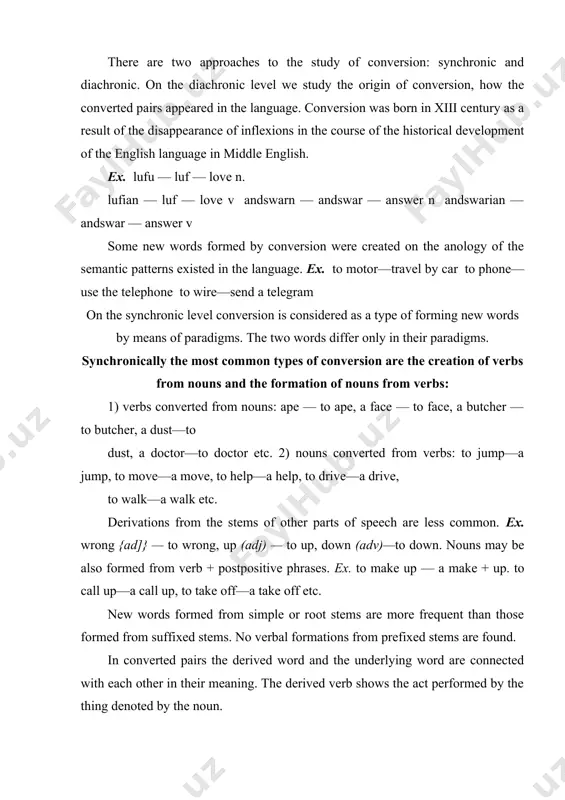
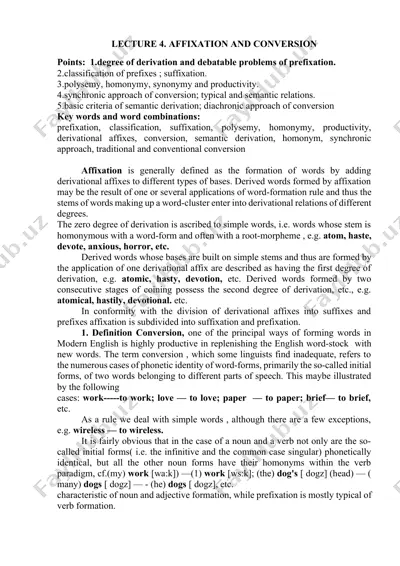
etween parts of speech, i. e. between noun and verb, noun and adjective etc. prof. a. l. smirnitsky says that conversion is the formation of a new word by a change of paradigm. it is the pa radigm that is used as a wordbuilding means. ex. in uzbek: китоблар, китобнинг, китобни, китобга, китобдан, китобда, китоби, китобим, китобинг, -лар,-нинг,-ни,-га,-дан,-да, и,-им, -инг etc are the paradigms of the noun «китоб». in english book, books'; book's; -s, 's, s' are the paradigms of the noun «book»; book v—booked, (he) books, booking, booked,-ed, ed (the ending of p ii)-s,-ing, are the paradigms of the verb «to book». so conversion can be described as a morphological way of forming words. there are two approaches to the study of conversion: synchronic and diachronic. on the diachronic level we study the origin of conversion, how the converted pairs appeared in the language. conversion was born in xiii …
4
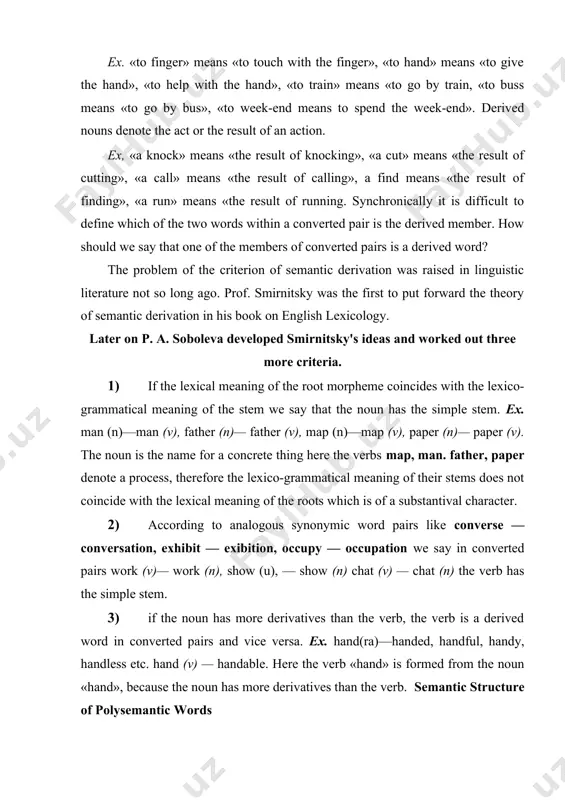
o down. nouns may be also formed from verb + postpositive phrases. ex. to make up — a make + up. to call up—a call up, to take off—a take off etc. new words formed from simple or root stems are more frequent than those formed from suffixed stems. no verbal formations from prefixed stems are found. in converted pairs the derived word and the underlying word are connected with each other in their meaning. the derived verb shows the act performed by the thing denoted by the noun. ex. «to finger» means «to touch with the finger», «to hand» means «to give the hand», «to help with the hand», «to train» means «to go by train, «to buss means «to go by bus», «to week-end means to spend the week-end». derived nouns denote the act or the result of an action. ex, «a knock» means «the result of knocking», …
5
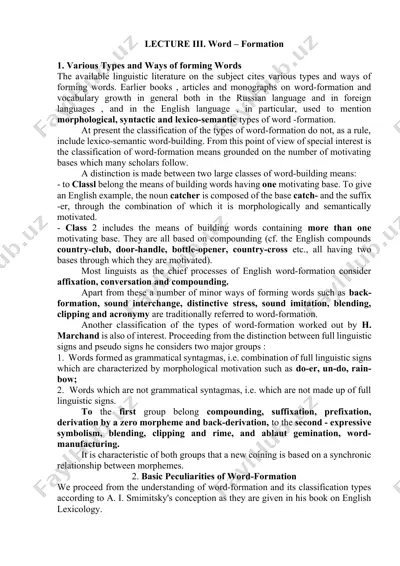
— conversation, exhibit — exibition, occupy — occupation we say in converted pairs work (v)— work (n), show (u), — show (n) chat (v) — chat (n) the verb has the simple stem. 3) if the noun has more derivatives than the verb, the verb is a derived word in converted pairs and vice versa. ex. hand(ra)—handed, handful, handy, handless etc. hand (v) — handable. here the verb «hand» is formed from the noun «hand», because the noun has more derivatives than the verb. semantic structure of polysemantic words the word table, e.g., has at least nine meanings in modern english: 1. a piece of furniture; 2. the persons seated at a table; 3. sing. the food put on a table, meals; 4. a thin flat piece of stone, metal, wood, etc.; 5. pl. slabs of stone; 6. words cut into them or written on them (the ten tables); 2 …

Хотите читать дальше?

Скачайте полный файл бесплатно через Telegram.

Скачать полный файл

О "word formation problems for discussion"

1557122600_74250.doc word formation problems for discussion plan: 1. different points of view to the study of conversion. 2. the study of conversion on the diachronic level and on the synchronic level. 3. the most common types of conversion. 4. the connection of derived and underlying word in converted pairs. word formation problems for discussion w o r d - f o r m a t i o n is the system of derivative types of words and the process of creating new words from the material available in the language after certain structural and semantic formulas and patterns. for instance, the noun driver is formed after the pattern v+-er, i.e. a verbal stem +-the noun-forming suffix -er. the meaning of …

Формат DOC, 55,0 КБ. Чтобы скачать "word formation problems for discussion", нажмите кнопку Telegram слева.
Теги: word formation problems for dis… DOC Бесплатная загрузка Telegram