explaining reading question types

PPTX 10 sahifa 682,7 KB Bepul yuklash

Sahifa ko'rinishi (5 sahifa)

Pastga aylantiring 👇
1 / 10
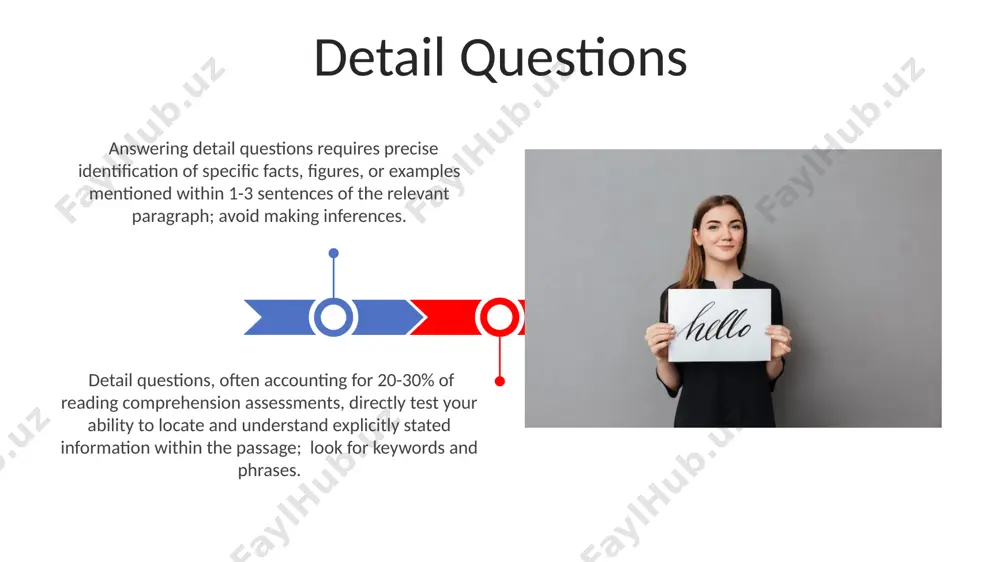
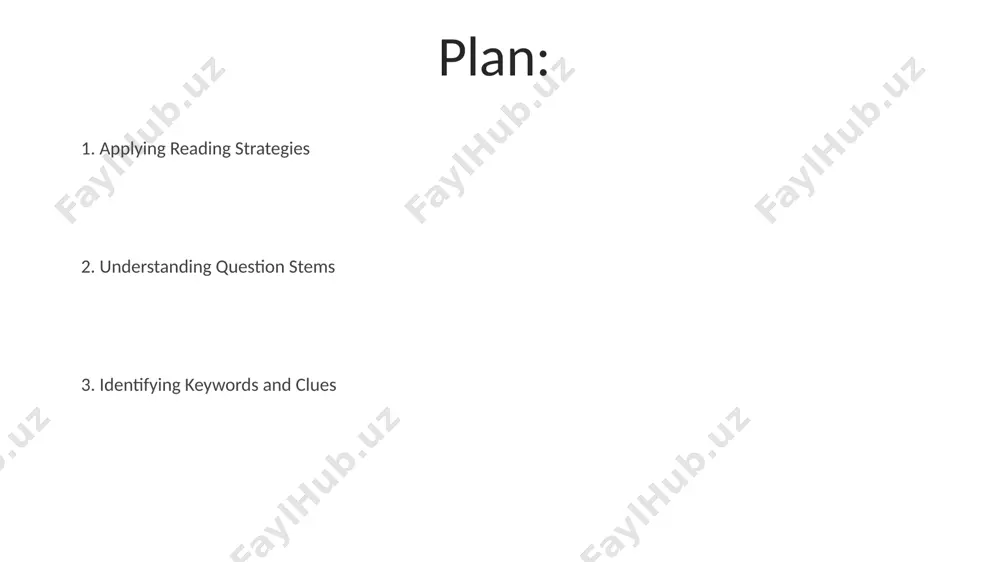
powerpoint presentation explaining reading question types kamilla saidova plan: 1. applying reading strategies 2. understanding question stems 3. identifying keywords and clues detail questions answering detail questions requires precise identification of specific facts, figures, or examples mentioned within 1-3 sentences of the relevant paragraph; avoid making inferences. detail questions, often accounting for 20-30% of reading comprehension assessments, directly test your ability to locate and understand explicitly stated information within the passage; look for keywords and phrases. vocabulary questions these questions frequently test high-frequency vocabulary words (around 2000-3000 words) encountered in academic texts and standardized tests, demanding strong lexical knowledge. vocabulary questions often present 3-5 answer choices, requiring precise understanding of a word's meaning within its specific context; synonyms may be subtly different. main idea questions unlike detail questions, main idea questions assess comprehension of the text's overall message. eliminate answer choices that focus on specific examples or isolated facts; instead, …
2 / 10
ons figurative language questions, like those involving metaphors or similes (2 common types), test your ability to identify and interpret non-literal meanings within a text, going beyond the surface level of words. correctly answering these questions often hinges on identifying at least 2 key literary devices and explaining how they impact the text's meaning, mood, or character development, showing a deep comprehension of the text. inference questions inference questions require you to go beyond the text's literal meaning; using 2-3 clues, you must deduce a conclusion not explicitly stated, demonstrating your comprehension of implied ideas. successfully answering inference questions (often 20-30% of a reading test) hinges on your ability to synthesize information from different parts of the passage to form a logical conclusion. synthesis questions successfully answering synthesis questions frequently necessitates identifying 3-5 key details spread across multiple paragraphs and then formulating a concise, well-supported response demonstrating comprehension. synthesis questions …
3 / 10
explaining reading question types - Page 3
4 / 10
explaining reading question types - Page 4
5 / 10
explaining reading question types - Page 5

Ko'proq o'qimoqchimisiz?

Barcha 10 sahifani Telegram orqali bepul yuklab oling.

To'liq faylni yuklab olish

"explaining reading question types" haqida

powerpoint presentation explaining reading question types kamilla saidova plan: 1. applying reading strategies 2. understanding question stems 3. identifying keywords and clues detail questions answering detail questions requires precise identification of specific facts, figures, or examples mentioned within 1-3 sentences of the relevant paragraph; avoid making inferences. detail questions, often accounting for 20-30% of reading comprehension assessments, directly test your ability to locate and understand explicitly stated information within the passage; look for keywords and phrases. vocabulary questions these questions frequently test high-frequency vocabulary words (around 2000-3000 words) encountered in academic texts and standardized tests, demanding strong lexical knowledge. vocabul...

Bu fayl PPTX formatida 10 sahifadan iborat (682,7 KB). "explaining reading question types"ni yuklab olish uchun chap tomondagi Telegram tugmasini bosing.
Teglar: explaining reading question typ… PPTX 10 sahifa Bepul yuklash Telegram