semasiology

DOCX 23.9 KB Free download

Page preview (5 pages)

Scroll down 👇
1
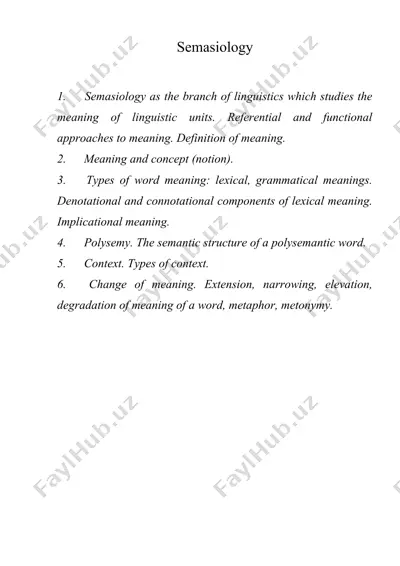
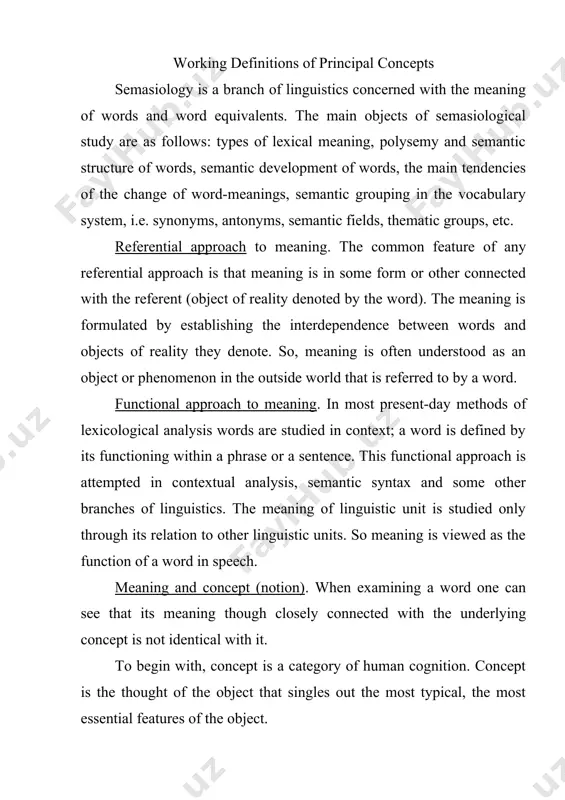
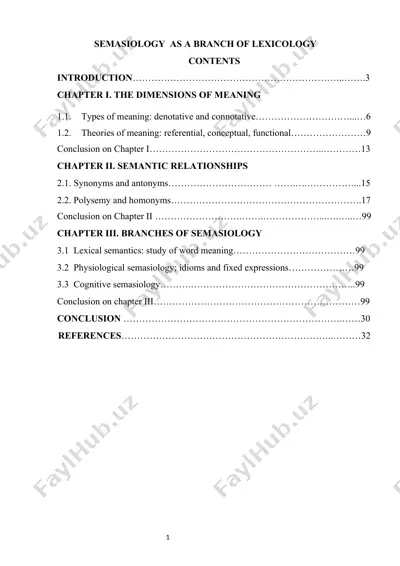
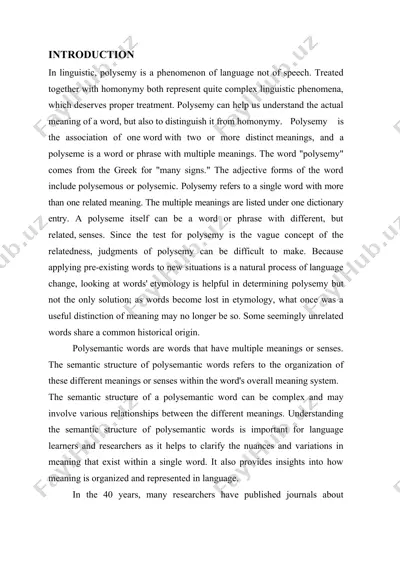
1405752818_56501.docx semasiology 1. semasiology as the branch of linguistics which studies the meaning of linguistic units. referential and functional approaches to meaning. definition of meaning. 2. meaning and concept (notion). 3. types of word meaning: lexical, grammatical meanings. denotational and connotational components of lexical meaning. implicational meaning. 4. polysemy. the semantic structure of a polysemantic word. 5. context. types of context. 6. change of meaning. extension, narrowing, elevation, degradation of meaning of a word, metaphor, metonymy. working definitions of principal concepts semasiology is a branch of linguistics concerned with the meaning of words and word equivalents. the main objects of semasiological study are as follows: types of lexical meaning, polysemy and semantic structure of words, semantic development of words, the main tendencies of the change of word-meanings, semantic grouping in the vocabulary system, i.e. synonyms, antonyms, semantic fields, thematic groups, etc. referential approach to meaning. the common feature of any …
2
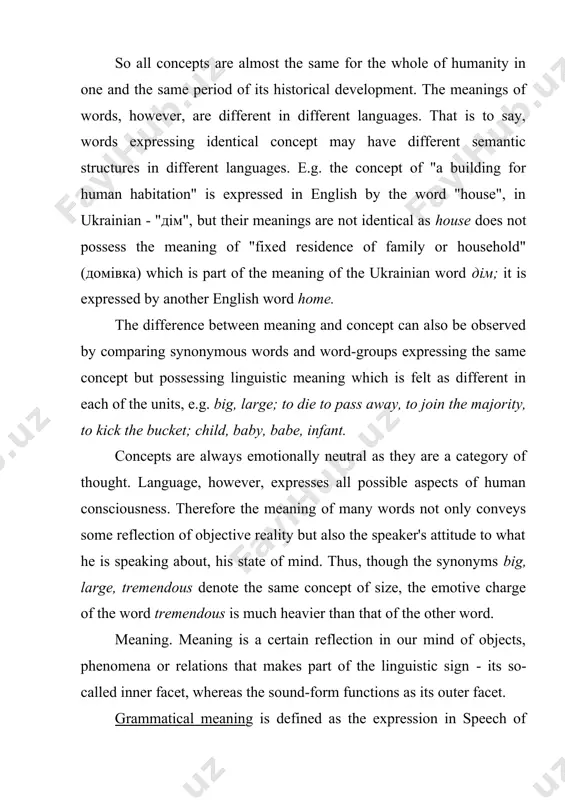
with the underlying concept is not identical with it. to begin with, concept is a category of human cognition. concept is the thought of the object that singles out the most typical, the most essential features of the object. so all concepts are almost the same for the whole of humanity in one and the same period of its historical development. the meanings of words, however, are different in different languages. that is to say, words expressing identical concept may have different semantic structures in different languages. e.g. the concept of "a building for human habitation" is expressed in english by the word "house", in ukrainian - "дім", but their meanings are not identical as house does not possess the meaning of "fixed residence of family or household" (домівка) which is part of the meaning of the ukrainian word дiм; it is expressed by another english word home. the difference …
3
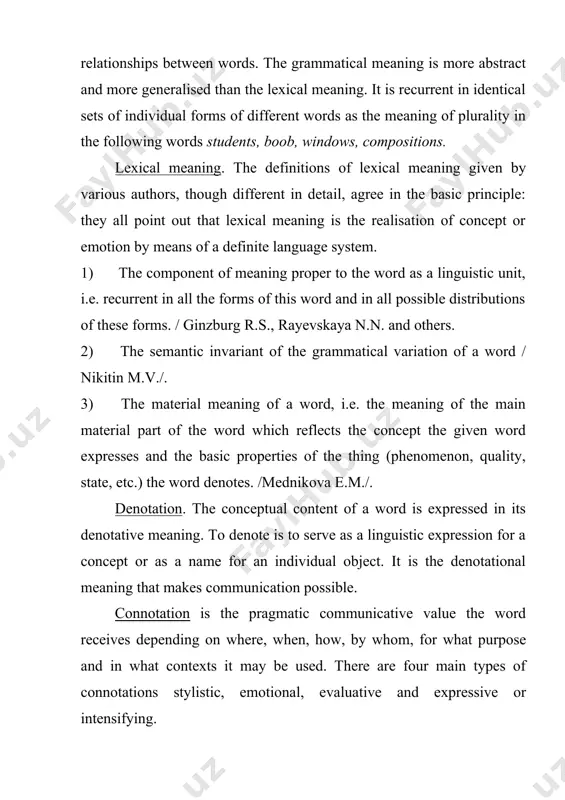
the grammatical meaning is more abstract and more generalised than the lexical meaning. it is recurrent in identical sets of individual forms of different words as the meaning of plurality in the following words students, boob, windows, compositions. lexical meaning. the definitions of lexical meaning given by various authors, though different in detail, agree in the basic principle: they all point out that lexical meaning is the realisation of concept or emotion by means of a definite language system. 1) the component of meaning proper to the word as a linguistic unit, i.e. recurrent in all the forms of this word and in all possible distributions of these forms. / ginzburg r.s., rayevskaya n.n. and others. 2) the semantic invariant of the grammatical variation of a word / nikitin m.v./. 3) the material meaning of a word, i.e. the meaning of the main material part of the word which reflects …
4
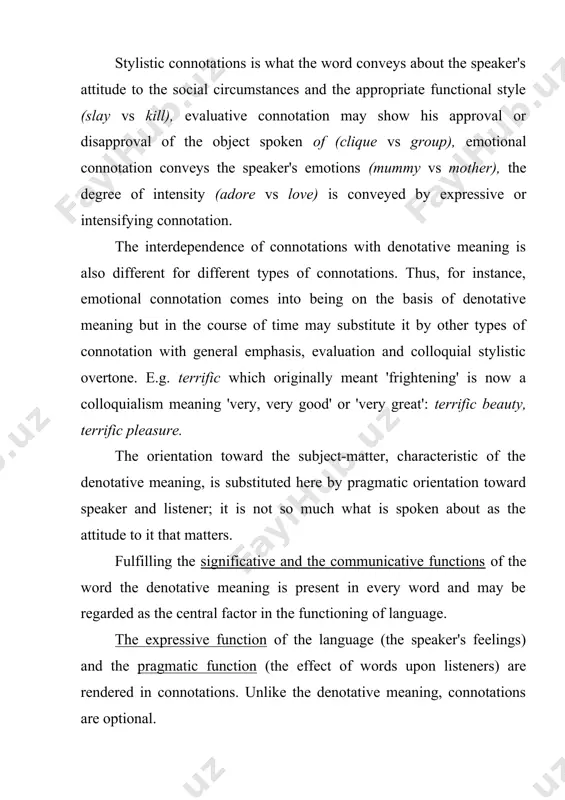
he interdependence of connotations with denotative meaning is also different for different types of connotations. thus, for instance, emotional connotation comes into being on the basis of denotative meaning but in the course of time may substitute it by other types of connotation with general emphasis, evaluation and colloquial stylistic overtone. e.g. terrific which originally meant 'frightening' is now a colloquialism meaning 'very, very good' or 'very great': terrific beauty, terrific pleasure. the orientation toward the subject-matter, characteristic of the denotative meaning, is substituted here by pragmatic orientation toward speaker and listener; it is not so much what is spoken about as the attitude to it that matters. fulfilling the significative and the communicative functions of the word the denotative meaning is present in every word and may be regarded as the central factor in the functioning of language. the expressive function of the language (the speaker's feelings) and the …
5
constitute its semantic structure. frequency - combinability - polysemy are closely connected. a special formula known as "zipf's law" has been worked out to express the correlation between frequency, word length and polysemy: the shorter the word, the higher its frequency of use; the higher the frequency, the wider its combinability , i.e. the more word combinations it enters; the wider its combinability, the more meanings are realised in these contexts. the word in one of its meanings is termed a lexico-semantic variant of this word. for example the word table has at least 9 lexico-semantic variants: 1 a piece of furniture 2. the persons seated at table 3. the food put on a table 4. a thin flat piece of stone, metal, wood 5. a slab of stone 6. plateau, extensive area of high land 7. an orderly arrangement of facts, etc. the problem in polysemy is that of …

Want to read more?

Download the full file for free via Telegram.

Download full file

About "semasiology"

1405752818_56501.docx semasiology 1. semasiology as the branch of linguistics which studies the meaning of linguistic units. referential and functional approaches to meaning. definition of meaning. 2. meaning and concept (notion). 3. types of word meaning: lexical, grammatical meanings. denotational and connotational components of lexical meaning. implicational meaning. 4. polysemy. the semantic structure of a polysemantic word. 5. context. types of context. 6. change of meaning. extension, narrowing, elevation, degradation of meaning of a word, metaphor, metonymy. working definitions of principal concepts semasiology is a branch of linguistics concerned with the meaning of words and word equivalents. the main objects of semasiological study are as follows: types of lexical meaning, polyse...

DOCX format, 23.9 KB. To download "semasiology", click the Telegram button on the left.
Tags: semasiology DOCX Free download Telegram