sat 3 answers

PDF 40 стр. 6,0 МБ Бесплатная загрузка

Предварительный просмотр (5 стр.)

Прокрутите вниз 👇
1 / 40
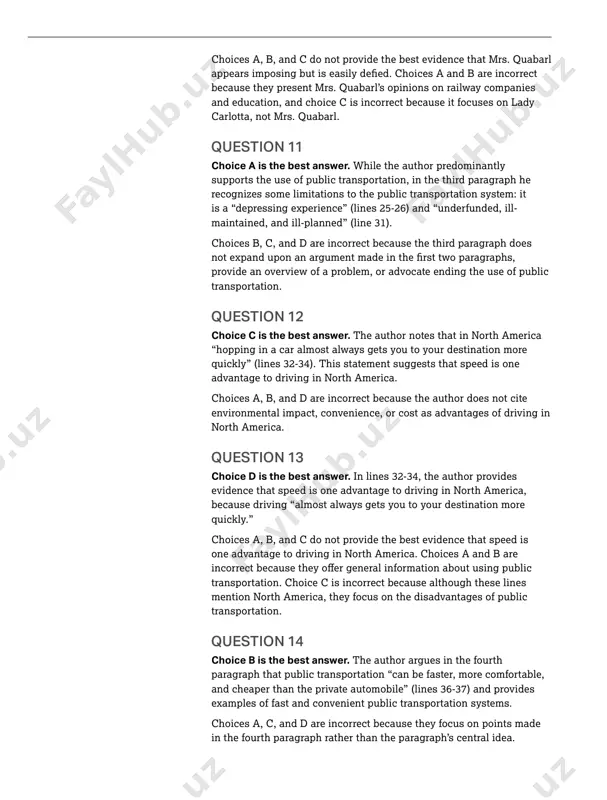
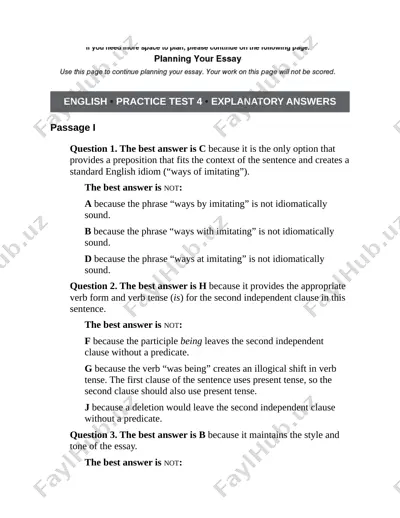
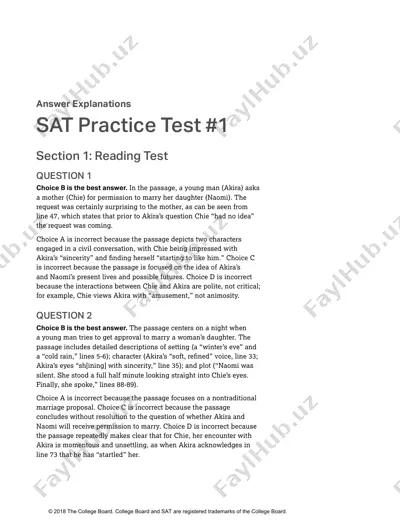
answer explanations sat practice test #3 section 1: reading test question 1 choice b is the best answer. in the passage, lady carlotta is approached by the “imposingly attired lady” mrs. quabarl while standing at a train station (lines 32-35). mrs. quabarl assumes lady carlotta is her new nanny, miss hope: “you must be miss hope, the governess i’ve come to meet” (lines 36-37). lady carlotta does not correct mrs. quabarl’s mistake and replies, “very well, if i must i must” (line 39). choices a, c, and d are incorrect because the passage is not about a woman weighing a job choice, seeking revenge on an acquaintance, or disliking her new employer. question 2 choice c is the best answer. in lines 1-3, the narrator states that lady carlotta “stepped out on to the platform of the small wayside station and took a turn or two up and down its …
2 / 40
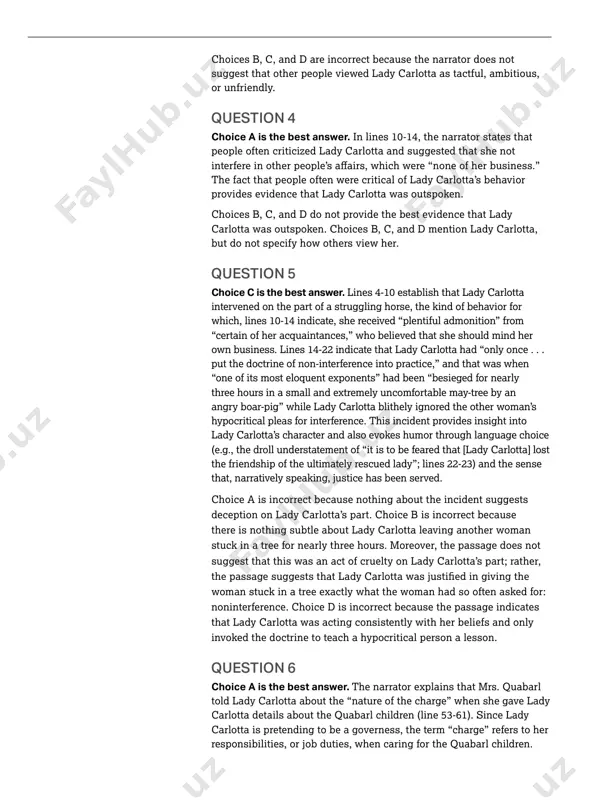
’s behavior provides evidence that lady carlotta was outspoken. choices b, c, and d do not provide the best evidence that lady carlotta was outspoken. choices b, c, and d mention lady carlotta, but do not specify how others view her. question 5 choice c is the best answer. lines 4-10 establish that lady carlotta intervened on the part of a struggling horse, the kind of behavior for which, lines 10-14 indicate, she received “plentiful admonition” from “certain of her acquaintances,” who believed that she should mind her own business. lines 14-22 indicate that lady carlotta had “only once . . . put the doctrine of non-interference into practice,” and that was when “one of its most eloquent exponents” had been “besieged for nearly three hours in a small and extremely uncomfortable may-tree by an angry boar-pig” while lady carlotta blithely ignored the other woman’s hypocritical pleas for interference. this …
3 / 40
etails about the quabarl children (line 53-61). since lady carlotta is pretending to be a governess, the term “charge” refers to her responsibilities, or job duties, when caring for the quabarl children. answer explanations choices b, c, and d are incorrect because in this context “charge” does not mean attack, fee, or expense. question 7 choice a is the best answer. lady carlotta learns about mrs. quabarl’s children claude, wilfrid, and irene (lines 53-58). the narrator then describes mrs. quabarl’s child viola as “something or other else of a mould equally commonplace among children of that class and type in the twentieth century” (lines 58-61). this statement about viola implies that all of the quabarl children have skills typical, or “of a mould equally commonplace,” to other peers in their social class. choices b, c, and d are incorrect because the narrator does not indicate that all of the quabarl …
4 / 40
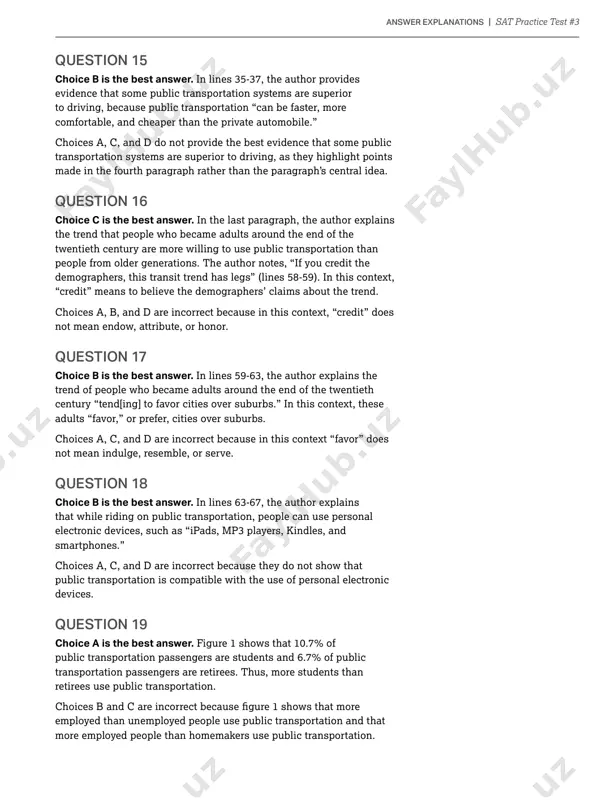
sed. the least show of unexpected resistance goes a long way towards rendering them cowed and apologetic.” choices a, b, and c do not provide the best evidence that mrs. quabarl because they present mrs. quabarl’s opinions on railway companies and education, and choice c is incorrect because it focuses on lady carlotta, not mrs. quabarl. question 11 choice a is the best answer. while the author predominantly supports the use of public transportation, in the third paragraph he recognizes some limitations to the public transportation system: it is a “depressing experience” (lines 25-26) and “underfunded, ill- maintained, and ill-planned” (line 31). choices b, c, and d are incorrect because the third paragraph does provide an overview of a problem, or advocate ending the use of public transportation. question 12 choice c is the best answer. the author notes that in north america “hopping in a car almost always gets …
5 / 40
d d are incorrect because they focus on points made in the fourth paragraph rather than the paragraph’s central idea. answer explanations question 15 choice b is the best answer. in lines 35-37, the author provides evidence that some public transportation systems are superior to driving, because public transportation “can be faster, more comfortable, and cheaper than the private automobile.” choices a, c, and d do not provide the best evidence that some public transportation systems are superior to driving, as they highlight points made in the fourth paragraph rather than the paragraph’s central idea. question 16 choice c is the best answer. in the last paragraph, the author explains the trend that people who became adults around the end of the twentieth century are more willing to use public transportation than people from older generations. the author notes, “if you credit the demographers, this transit trend has legs” (lines …

Хотите читать дальше?

Скачайте все 40 страниц бесплатно через Telegram.

Скачать полный файл

О "sat 3 answers"

answer explanations sat practice test #3 section 1: reading test question 1 choice b is the best answer. in the passage, lady carlotta is approached by the “imposingly attired lady” mrs. quabarl while standing at a train station (lines 32-35). mrs. quabarl assumes lady carlotta is her new nanny, miss hope: “you must be miss hope, the governess i’ve come to meet” (lines 36-37). lady carlotta does not correct mrs. quabarl’s mistake and replies, “very well, if i must i must” (line 39). choices a, c, and d are incorrect because the passage is not about a woman weighing a job choice, seeking revenge on an acquaintance, or disliking her new employer. question 2 choice c is the best answer. …

Этот файл содержит 40 стр. в формате PDF (6,0 МБ). Чтобы скачать "sat 3 answers", нажмите кнопку Telegram слева.
Теги: sat 3 answers PDF 40 стр. Бесплатная загрузка Telegram