maps in writing task 1

PPTX 16 стр. 74,9 КБ Бесплатная загрузка

Предварительный просмотр (4 стр.)

Прокрутите вниз 👇

1 / 16
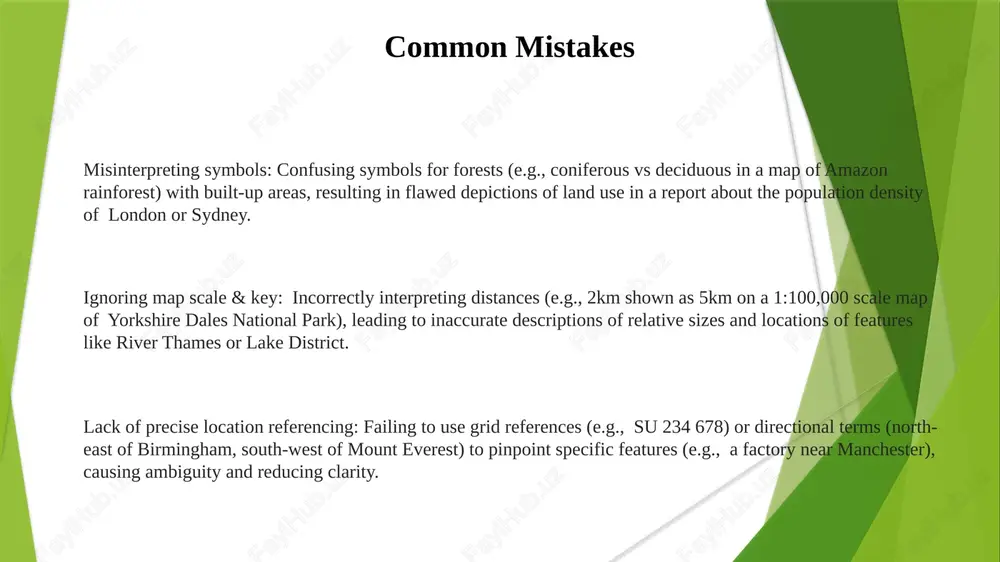
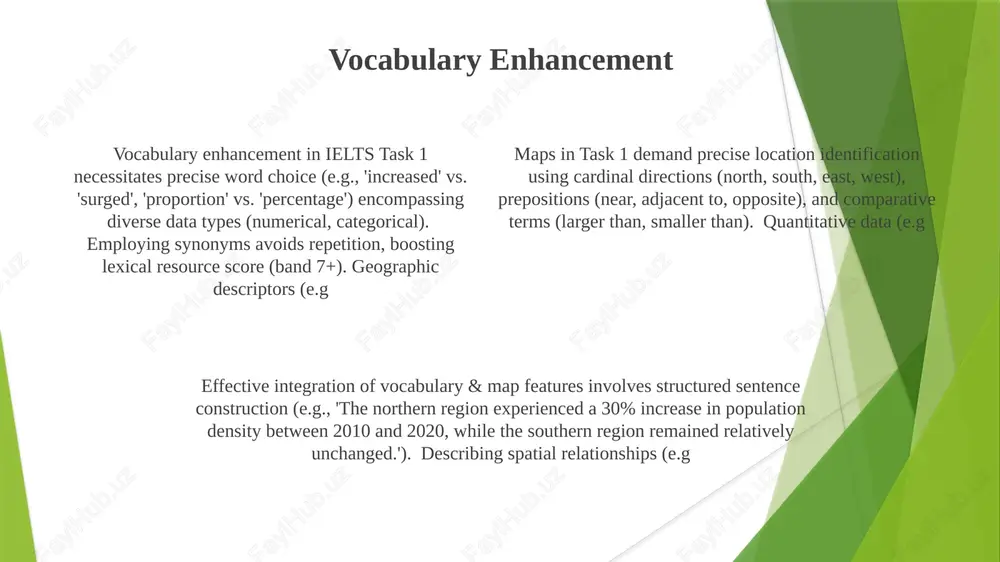
powerpoint presentation maps in writing task 1 _rasulova_ 1. successful chart description strategies 2. map types & their features, 3. data interpretation & key skills, plan: misinterpreting symbols: confusing symbols for forests (e.g., coniferous vs deciduous in a map of amazon rainforest) with built-up areas, resulting in flawed depictions of land use in a report about the population density of london or sydney. ignoring map scale & key: incorrectly interpreting distances (e.g., 2km shown as 5km on a 1:100,000 scale map of yorkshire dales national park), leading to inaccurate descriptions of relative sizes and locations of features like river thames or lake district. lack of precise location referencing: failing to use grid references (e.g., su 234 678) or directional terms (north-east of birmingham, south-west of mount everest) to pinpoint specific features (e.g., a factory near manchester), causing ambiguity and reducing clarity. common mistakes vocabulary enhancement vocabulary enhancement in ielts task …
2 / 16
ine), tables, and graphs, extracting key features (trends, comparisons, highest/lowest values), and presenting findings concisely. specific data points (e.g map interpretation demands identifying locations (cities like tokyo, new york), regions (e.g., the northeast of a country), geographical features (rivers, mountains), and analyzing spatial distributions (population density, resource allocation). precise place names and quantifiable data (e.g practice exercises practice exercises focusing on map interpretation (e.g analyzing maps necessitates specific vocabulary (e.g., "adjacent to," "northwest of," "surrounded by") and precise numerical descriptions (e.g., a 25% decrease in area, an increase of 5000 residents) location words data presentation on maps (e.g., population density, 100 people per sq km, rainfall, 1500 mm annually, temperature, 25°c average, agricultural yields, 10 tons per hectare) requires careful description of distribution patterns across specified areas, using grid references or distances. maps often depict geographical features (mountains, 2000m peaks, valleys, rivers, 50km stretches of coastline) and human-made structures (roads, …
3 / 16
zones in london, population density of tokyo). quantify changes using percentages or numerical values (e.g., a 30% increase in housing) 2. map comparisons necessitate detailed descriptions of spatial distributions. note the scale and orientation (e.g., 1:50,000 scale map shows a 2km expansion of the port in shanghai) key features key features: 3 main map sections showcasing 1980, 1990, and 2000. significant changes in residential (30% increase) and commercial (15%) zones noted between 1980 and 2000, impacting the area around springfield rd & oakville data presentation: quantitative data (hectares, percentages, kilometers squared) presented clearly. visual comparison facilitates easy identification of changes. locations (springfield, oakville, highway 17) are clearly labelled. clear use of legends & scale for accurate interpretation. map comparisons: illustrates the spatial distribution shifts over 2 decades within springfield. shows growth of residential areas in the north-east (approx. 5km²) & a decrease in agricultural land (25%) in the south-west writing …
4 / 16
simple for maps' current state; past simple for changes) and accurate prepositions (e.g., 'to the north of', 'adjacent to'). numerical data (percentages, lengths, areas) needs correct units (km², meters) maps: visual information demands accurate description. include cardinal directions (north, south, east, west) and relative positions (e.g., 'north-west corner'). quantify features with numerical values (e.g., '20km long river'). specify map types (topographical, thematic). mention scale if provided. information synthesis: combine textual and visual data. focus on key features (e.g., 'highest peak at 1500m'). structure logically (overall description, key features, changes). use comparative language ('larger than', 'smaller than'). location names must be correct and consistent throughout. trend identification maps illustrate geographical distributions; analyze density (high population in mumbai vs. low in rural areas), clustering (businesses concentrated in central london), and spatial relationships (proximity of factories to resources in the ruhr valley, germany) identifying trends requires analyzing data visualizations like line graphs (showing …

Хотите читать дальше?

Скачайте все 16 страниц бесплатно через Telegram.

Скачать полный файл

О "maps in writing task 1"

powerpoint presentation maps in writing task 1 _rasulova_ 1. successful chart description strategies 2. map types & their features, 3. data interpretation & key skills, plan: misinterpreting symbols: confusing symbols for forests (e.g., coniferous vs deciduous in a map of amazon rainforest) with built-up areas, resulting in flawed depictions of land use in a report about the population density of london or sydney. ignoring map scale & key: incorrectly interpreting distances (e.g., 2km shown as 5km on a 1:100,000 scale map of yorkshire dales national park), leading to inaccurate descriptions of relative sizes and locations of features like river thames or lake district. lack of precise location referencing: failing to use grid references (e.g., su 234 678) or directional terms …

Этот файл содержит 16 стр. в формате PPTX (74,9 КБ). Чтобы скачать "maps in writing task 1", нажмите кнопку Telegram слева.
Теги: maps in writing task 1 PPTX 16 стр. Бесплатная загрузка Telegram