comparative typology of sentence structures in english and uzbek

PDF 4 pages 213.3 KB Free download

Page preview (4 pages)

Scroll down 👇
1 / 4
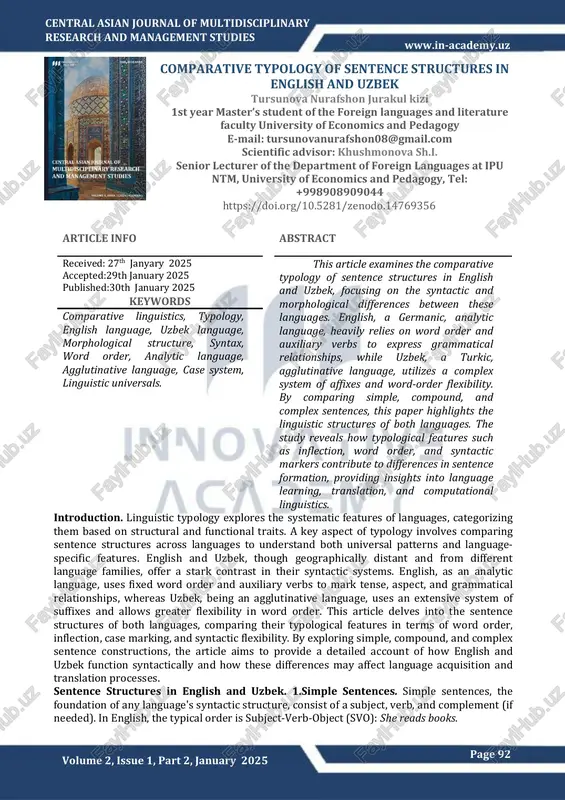
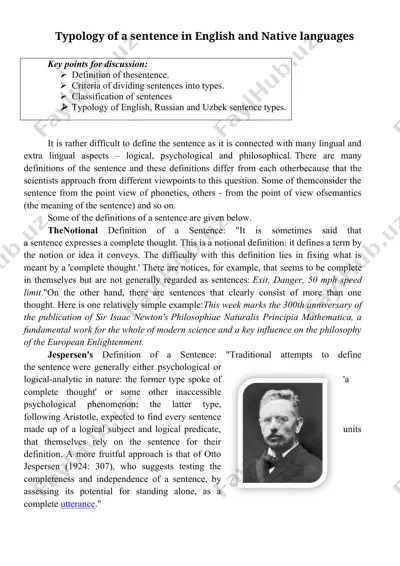
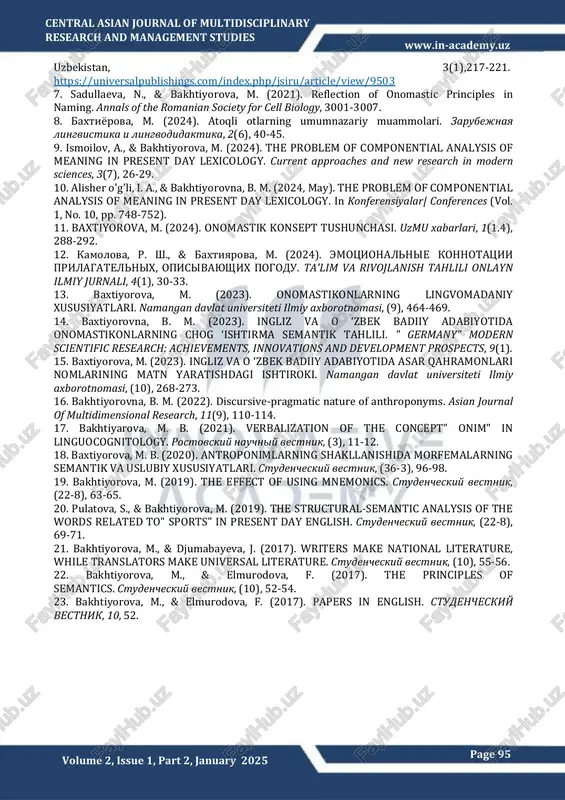
page 92 central asian journal of multidisciplinary research andmanagement studies volume 2, issue 1, part 2, january 2025 www.in-academy.uz comparative typology of sentence structures in english and uzbek tursunova nurafshon jurakul kizi 1st year master’s student of the foreign languages and literature faculty university of economics and pedagogy e-mail: tursunovanurafshon08@gmail.com scientific advisor: khushmonova sh.i. senior lecturer of the department of foreign languages at ipu ntm, university of economics and pedagogy, tel: +998908909044 https://doi.org/10.5281/zenodo.14769356 introduction. linguistic typology explores the systematic features of languages, categorizing them based on structural and functional traits. a key aspect of typology involves comparing sentence structures across languages to understand both universal patterns and language- specific features. english and uzbek, though geographically distant and from different language families, offer a stark contrast in their syntactic systems. english, as an analytic language, uses fixed word order and auxiliary verbs to mark tense, aspect, and grammatical relationships, whereas uzbek, …
2 / 4
received: 27th janyary 2025 accepted:29th january 2025 published:30th january 2025 this article examines the comparative typology of sentence structures in english and uzbek, focusing on the syntactic and morphological differences between these languages. english, a germanic, analytic language, heavily relies on word order and auxiliary verbs to express grammatical relationships, while uzbek, a turkic, agglutinative language, utilizes a complex system of affixes and word-order flexibility. by comparing simple, compound, and complex sentences, this paper highlights the linguistic structures of both languages. the study reveals how typological features such as inflection, word order, and syntactic markers contribute to differences in sentence formation, providing insights into language learning, translation, and computational linguistics. keywords comparative linguistics, typology, english language, uzbek language, morphological structure, syntax, word order, analytic language, agglutinative language, case system, linguistic universals. page 93 central asian journal of multidisciplinary research andmanagement studies volume 2, issue 1, part 2, january 2025 www.in-academy.uz …
3 / 4
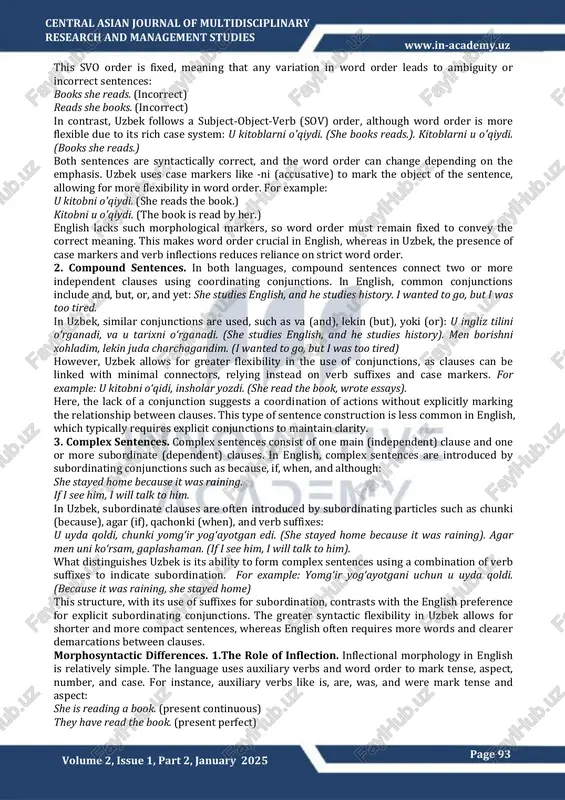
this makes word order crucial in english, whereas in uzbek, the presence of case markers and verb inflections reduces reliance on strict word order. 2. compound sentences. in both languages, compound sentences connect two or more independent clauses using coordinating conjunctions. in english, common conjunctions include and, but, or, and yet: she studies english, and he studies history. i wanted to go, but i was too tired. in uzbek, similar conjunctions are used, such as va (and), lekin (but), yoki (or): u ingliz tilini o‘rganadi, va u tarixni o‘rganadi. (she studies english, and he studies history). men borishni xohladim, lekin juda charchagandim. (i wanted to go, but i was too tired) however, uzbek allows for greater flexibility in the use of conjunctions, as clauses can be linked with minimal connectors, relying instead on verb suffixes and case markers. for example: u kitobni o‘qidi, insholar yozdi. (she read the book, wrote …
4 / 4
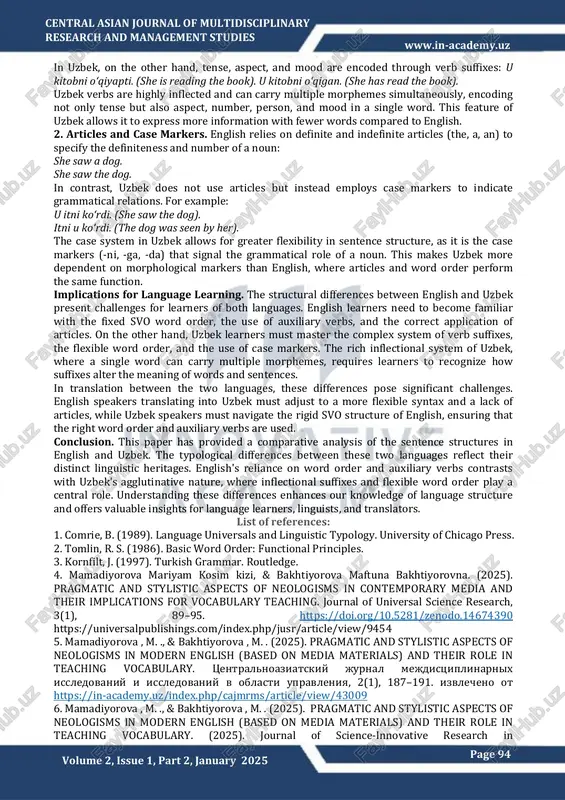
tgani uchun u uyda qoldi. (because it was raining, she stayed home) this structure, with its use of suffixes for subordination, contrasts with the english preference for explicit subordinating conjunctions. the greater syntactic flexibility in uzbek allows for shorter and more compact sentences, whereas english often requires more words and clearer demarcations between clauses. morphosyntactic differences. 1.the role of inflection. inflectional morphology in english is relatively simple. the language uses auxiliary verbs and word order to mark tense, aspect, number, and case. for instance, auxiliary verbs like is, are, was, and were mark tense and aspect: she is reading a book. (present continuous) they have read the book. (present perfect) page 94 central asian journal of multidisciplinary research andmanagement studies volume 2, issue 1, part 2, january 2025 www.in-academy.uz in uzbek, on the other hand, tense, aspect, and mood are encoded through verb suffixes: u kitobni o‘qiyapti. (she is reading …

Want to read more?

Download all 4 pages for free via Telegram.

Download full file

About "comparative typology of sentence structures in english and uzbek"

page 92 central asian journal of multidisciplinary research andmanagement studies volume 2, issue 1, part 2, january 2025 www.in-academy.uz comparative typology of sentence structures in english and uzbek tursunova nurafshon jurakul kizi 1st year master’s student of the foreign languages and literature faculty university of economics and pedagogy e-mail: tursunovanurafshon08@gmail.com scientific advisor: khushmonova sh.i. senior lecturer of the department of foreign languages at ipu ntm, university of economics and pedagogy, tel: +998908909044 https://doi.org/10.5281/zenodo.14769356 introduction. linguistic typology explores the systematic features of languages, categorizing them based on structural and functional traits. a key aspect of typology involves comparing sentence structures acro...

This file contains 4 pages in PDF format (213.3 KB). To download "comparative typology of sentence structures in english and uzbek", click the Telegram button on the left.
Tags: comparative typology of sentenc… PDF 4 pages Free download Telegram