comparative typology of grammar forms and meanings of verb tenses

DOCX 7 sahifa 24,3 KB Bepul yuklash

Sahifa ko'rinishi (5 sahifa)

Pastga aylantiring 👇
1 / 7
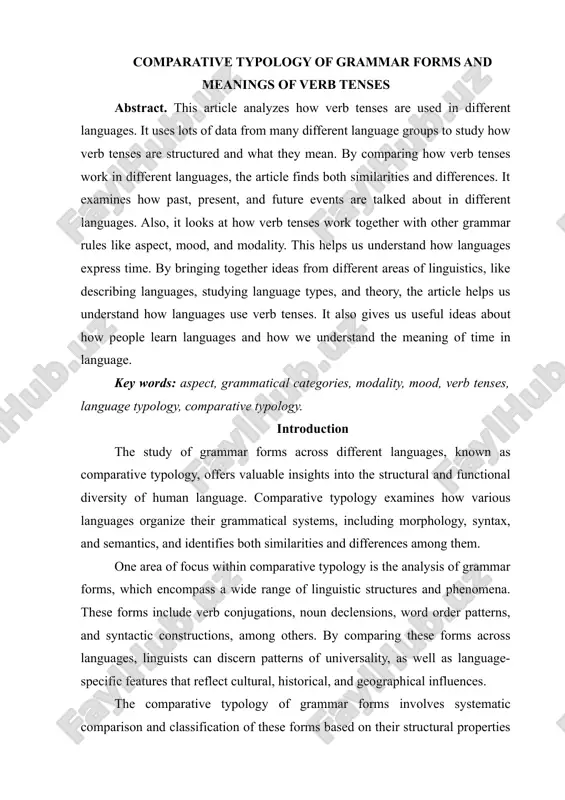
comparative typology of grammar forms and meanings of verb tenses abstract. this article analyzes how verb tenses are used in different languages. it uses lots of data from many different language groups to study how verb tenses are structured and what they mean. by comparing how verb tenses work in different languages, the article finds both similarities and differences. it examines how past, present, and future events are talked about in different languages. also, it looks at how verb tenses work together with other grammar rules like aspect, mood, and modality. this helps us understand how languages express time. by bringing together ideas from different areas of linguistics, like describing languages, studying language types, and theory, the article helps us understand how languages use verb tenses. it also gives us useful ideas about how people learn languages and how we understand the meaning of time in language. key words: aspect, …
2 / 7
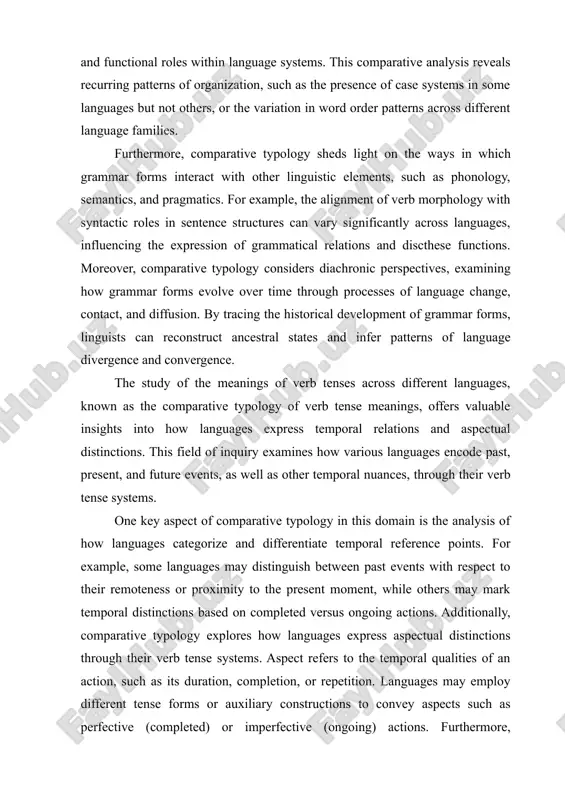
sed on their structural properties and functional roles within language systems. this comparative analysis reveals recurring patterns of organization, such as the presence of case systems in some languages but not others, or the variation in word order patterns across different language families. furthermore, comparative typology sheds light on the ways in which grammar forms interact with other linguistic elements, such as phonology, semantics, and pragmatics. for example, the alignment of verb morphology with syntactic roles in sentence structures can vary significantly across languages, influencing the expression of grammatical relations and discthese functions. moreover, comparative typology considers diachronic perspectives, examining how grammar forms evolve over time through processes of language change, contact, and diffusion. by tracing the historical development of grammar forms, linguists can reconstruct ancestral states and infer patterns of language divergence and convergence. the study of the meanings of verb tenses across different languages, known as the comparative …
3 / 7
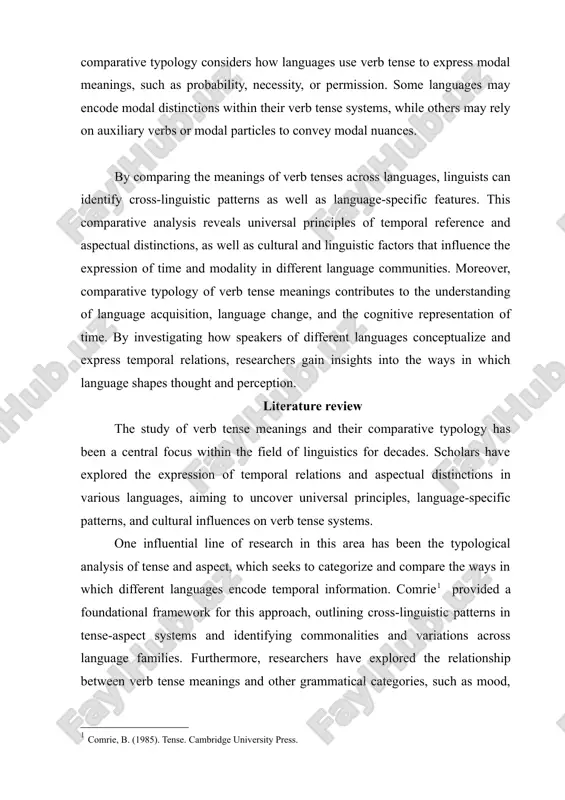
loy different tense forms or auxiliary constructions to convey aspects such as perfective (completed) or imperfective (ongoing) actions. furthermore, comparative typology considers how languages use verb tense to express modal meanings, such as probability, necessity, or permission. some languages may encode modal distinctions within their verb tense systems, while others may rely on auxiliary verbs or modal particles to convey modal nuances. by comparing the meanings of verb tenses across languages, linguists can identify cross-linguistic patterns as well as language-specific features. this comparative analysis reveals universal principles of temporal reference and aspectual distinctions, as well as cultural and linguistic factors that influence the expression of time and modality in different language communities. moreover, comparative typology of verb tense meanings contributes to the understanding of language acquisition, language change, and the cognitive representation of time. by investigating how speakers of different languages conceptualize and express temporal relations, researchers gain insights into …
4 / 7
have explored the relationship between verb tense meanings and other grammatical categories, such as mood, modality, and evidentiality. smith[footnoteref:2] demonstrated how tense-aspect systems interact with modal markers to convey nuanced meanings of obligation, permission, and likelihood in different languages. similarly, palmer[footnoteref:3] examined the encoding of evidentiality within verb tense systems, illustrating how languages mark the sthece of information and the speaker's epistemic stance towards reported events. additionally, studies in language acquisition and psycholinguistics have investigated how speakers of different languages perceive and interpret verb tense meanings. bohnemeyer and pederson [footnoteref:4]conducted cross-linguistic experiments to explore how speakers categorize events temporally and conceptually, revealing both universal tendencies and language-specific biases in temporal cognition. [1: comrie, b. (1985). tense. cambridge university press.] [2: smith, c. (1997). the interaction of tense-aspect systems with modal markers. in a. brown (ed.), perspectives on grammar typology (pp. 45-68). oxford university press.] [3: palmer, f. r. (2001). mood …
5 / 7
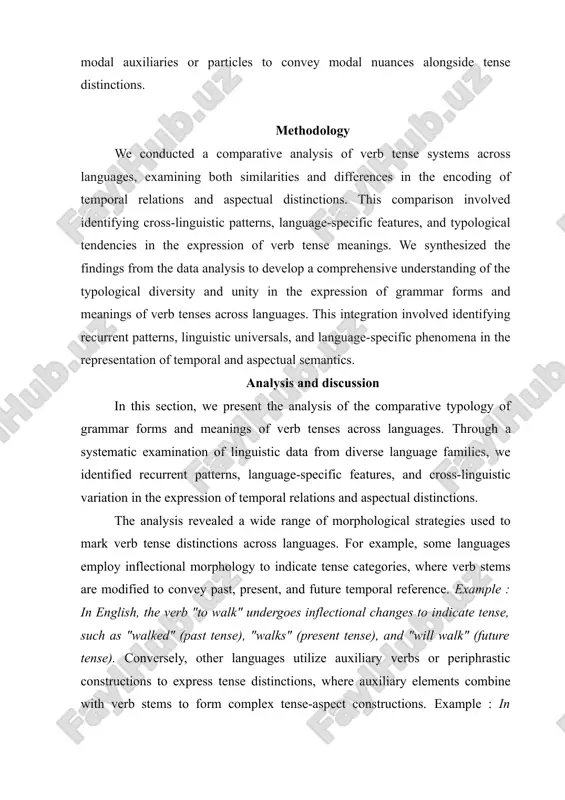
een verb tense meanings and other grammatical categories, such as aspect, mood, and modality, varied considerably across languages. while some languages exhibit a high degree of integration between tense and aspect markers, others maintain a more modular or layered system of verbal inflection. similarly, the expression of modal meanings within verb tense systems showed significant cross-linguistic variation, with some languages employing dedicated modal auxiliaries or particles to convey modal nuances alongside tense distinctions. methodology we conducted a comparative analysis of verb tense systems across languages, examining both similarities and differences in the encoding of temporal relations and aspectual distinctions. this comparison involved identifying cross-linguistic patterns, language-specific features, and typological tendencies in the expression of verb tense meanings. we synthesized the findings from the data analysis to develop a comprehensive understanding of the typological diversity and unity in the expression of grammar forms and meanings of verb tenses across languages. this …

Ko'proq o'qimoqchimisiz?

Barcha 7 sahifani Telegram orqali bepul yuklab oling.

To'liq faylni yuklab olish

"comparative typology of grammar forms and meanings of verb tenses" haqida

comparative typology of grammar forms and meanings of verb tenses abstract. this article analyzes how verb tenses are used in different languages. it uses lots of data from many different language groups to study how verb tenses are structured and what they mean. by comparing how verb tenses work in different languages, the article finds both similarities and differences. it examines how past, present, and future events are talked about in different languages. also, it looks at how verb tenses work together with other grammar rules like aspect, mood, and modality. this helps us understand how languages express time. by bringing together ideas from different areas of linguistics, like describing languages, studying language types, and theory, the article helps us …

Bu fayl DOCX formatida 7 sahifadan iborat (24,3 KB). "comparative typology of grammar forms and meanings of verb tenses"ni yuklab olish uchun chap tomondagi Telegram tugmasini bosing.
Teglar: comparative typology of grammar… DOCX 7 sahifa Bepul yuklash Telegram