music in the foreign language classroom: how and why?

PDF 9 стр. 802,2 КБ Бесплатная загрузка

Предварительный просмотр (5 стр.)

Прокрутите вниз 👇
1 / 9
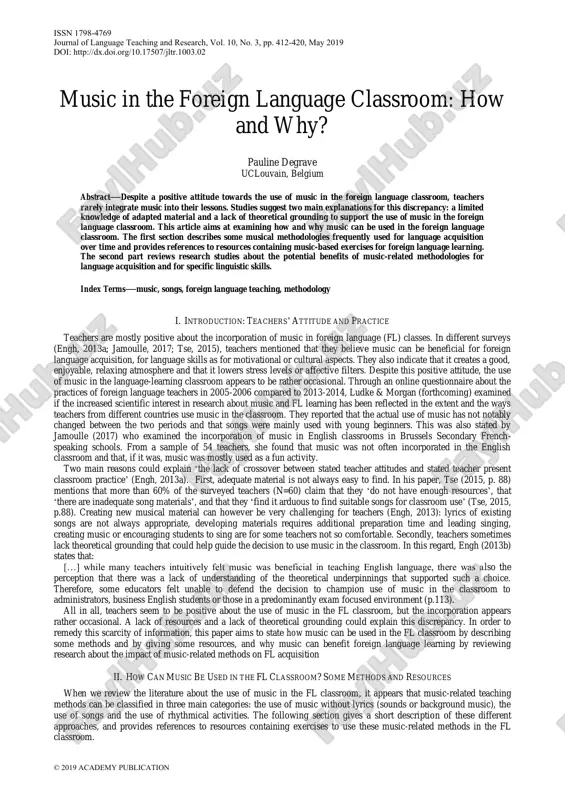
jltr1003.pdf music in the foreign language classroom: how and why? pauline degrave uclouvain, belgium abstract—despite a positive attitude towards the use of music in the foreign language classroom, teachers rarely integrate music into their lessons. studies suggest two main explanations for this discrepancy: a limited knowledge of adapted material and a lack of theoretical grounding to support the use of music in the foreign language classroom. this article aims at examining how and why music can be used in the foreign language classroom. the first section describes some musical methodologies frequently used for language acquisition over time and provides references to resources containing music-based exercises for foreign language learning. the second part reviews research studies about the potential benefits of music-related methodologies for language acquisition and for specific linguistic skills. index terms—music, songs, foreign language teaching, methodology i. introduction: teachers’ attitude and practice teachers are mostly positive about the incorporation …
2 / 9
ween the two periods and that songs were mainly used with young beginners. this was also stated by jamoulle (2017) who examined the incorporation of music in english classrooms in brussels secondary french- speaking schools. from a sample of 54 teachers, she found that music was not often incorporated in the english classroom and that, if it was, music was mostly used as a fun activity. two main reasons could explain ‘the lack of crossover between stated teacher attitudes and stated teacher present classroom practice’ (engh, 2013a). first, adequate material is not always easy to find. in his paper, tse (2015, p. 88) mentions that more than 60% of the surveyed teachers (n=60) claim that they ‘do not have enough resources’, that ‘there are inadequate song materials’, and that they ‘find it arduous to find suitable songs for classroom use’ (tse, 2015, p.88). creating new musical material can however be …
3 / 9
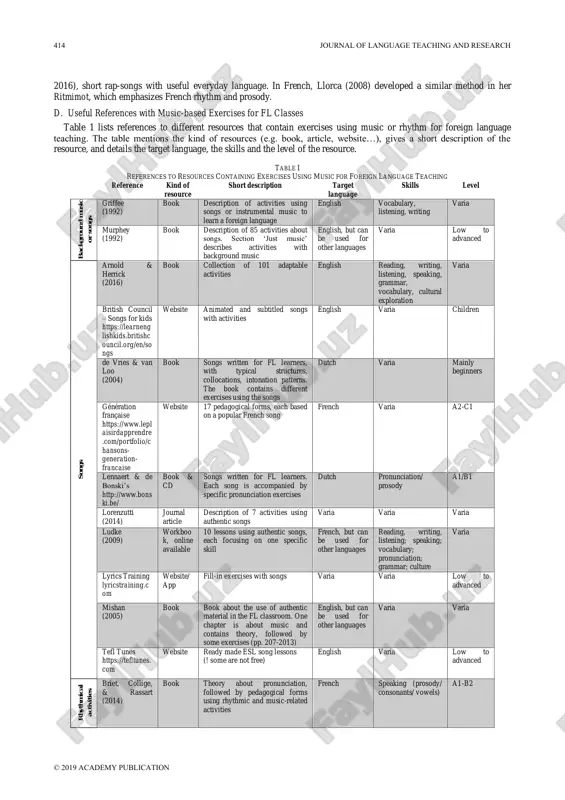
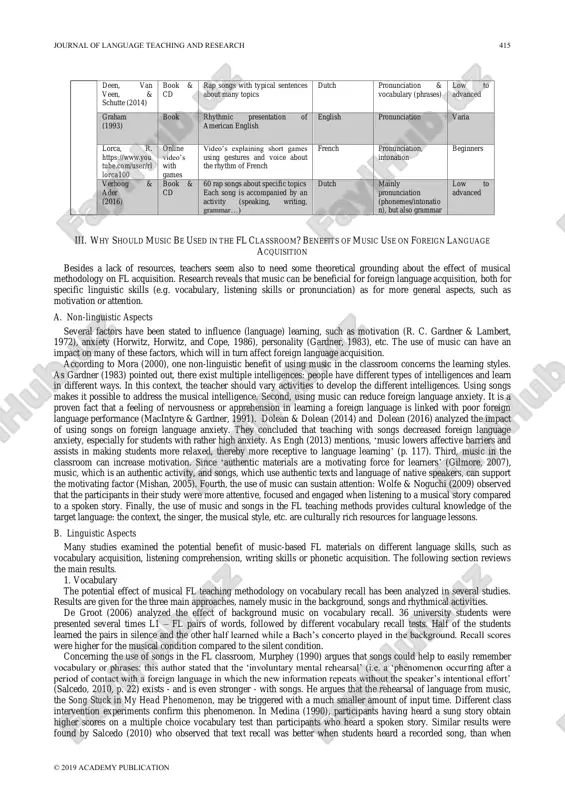
order to remedy this scarcity of information, this paper aims to state how music can be used in the fl classroom by describing some methods and by giving some resources, and why music can benefit foreign language learning by reviewing research about the impact of music-related methods on fl acquisition ii. how can music be used in the fl classroom? some methods and resources when we review the literature about the use of music in the fl classroom, it appears that music-related teaching methods can be classified in three main categories: the use of music without lyrics (sounds or background music), the use of songs and the use of rhythmical activities. the following section gives a short description of these different approaches, and provides references to resources containing exercises to use these music-related methods in the fl classroom. issn 1798-4769 journal of language teaching and research, vol. 10, no. 3, …
4 / 9
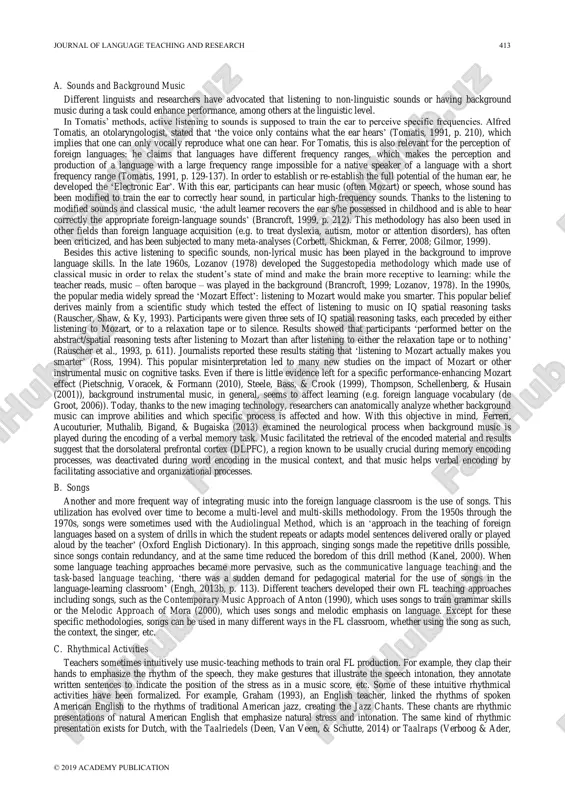
ticipants can hear music (often mozart) or speech, whose sound has been modified to train the ear to correctly hear sound, in particular high-frequency sounds. thanks to the listening to modified sounds and classical music, ‘the adult learner recovers the ear s/he possessed in childhood and is able to hear correctly the appropriate foreign-language sounds’ (brancroft, 1999, p. 212). this methodology has also been used in other fields than foreign language acquisition (e.g. to treat dyslexia, autism, motor or attention disorders), has often been criticized, and has been subjected to many meta-analyses (corbett, shickman, & ferrer, 2008; gilmor, 1999). besides this active listening to specific sounds, non-lyrical music has been played in the background to improve language skills. in the late 1960s, lozanov (1978) developed the suggestopedia methodology which made use of classical music in order to relax the student’s state of mind and make the brain more receptive to …
5 / 9
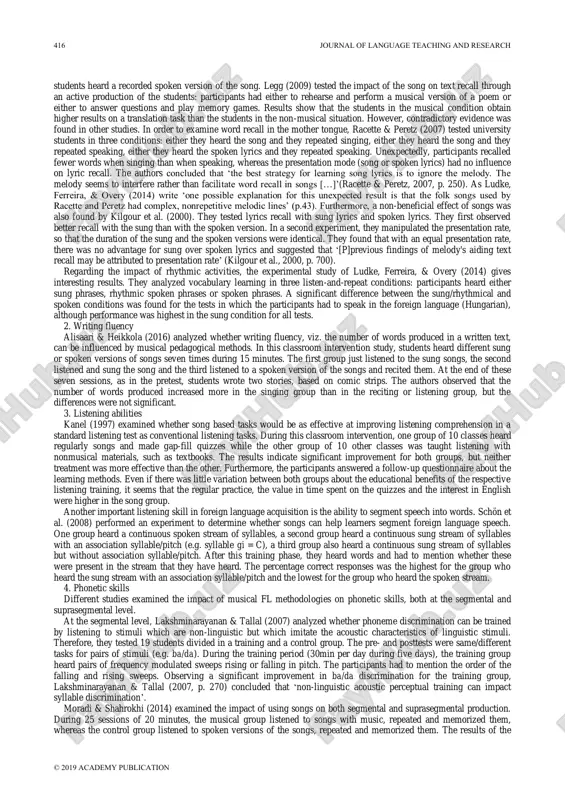
ittle evidence left for a specific performance-enhancing mozart effect (pietschnig, voracek, & formann (2010), steele, bass, & crook (1999), thompson, schellenberg, & husain (2001)), background instrumental music, in general, seems to affect learning (e.g. foreign language vocabulary (de groot, 2006)). today, thanks to the new imaging technology, researchers can anatomically analyze whether background music can improve abilities and which specific process is affected and how. with this objective in mind, ferreri, aucouturier, muthalib, bigand, & bugaiska (2013) examined the neurological process when background music is played during the encoding of a verbal memory task. music facilitated the retrieval of the encoded material and results suggest that the dorsolateral prefrontal cortex (dlpfc), a region known to be usually crucial during memory encoding processes, was deactivated during word encoding in the musical context, and that music helps verbal encoding by facilitating associative and organizational processes. b. songs another and more frequent way …

Хотите читать дальше?

Скачайте все 9 страниц бесплатно через Telegram.

Скачать полный файл

О "music in the foreign language classroom: how and why?"

jltr1003.pdf music in the foreign language classroom: how and why? pauline degrave uclouvain, belgium abstract—despite a positive attitude towards the use of music in the foreign language classroom, teachers rarely integrate music into their lessons. studies suggest two main explanations for this discrepancy: a limited knowledge of adapted material and a lack of theoretical grounding to support the use of music in the foreign language classroom. this article aims at examining how and why music can be used in the foreign language classroom. the first section describes some musical methodologies frequently used for language acquisition over time and provides references to resources containing music-based exercises for foreign language learning. the second part reviews research studies about ...

Этот файл содержит 9 стр. в формате PDF (802,2 КБ). Чтобы скачать "music in the foreign language classroom: how and why?", нажмите кнопку Telegram слева.
Теги: music in the foreign language c… PDF 9 стр. Бесплатная загрузка Telegram