student-centred teaching
Sahifa ko'rinishi (5 sahifa)
Pastga aylantiring 👇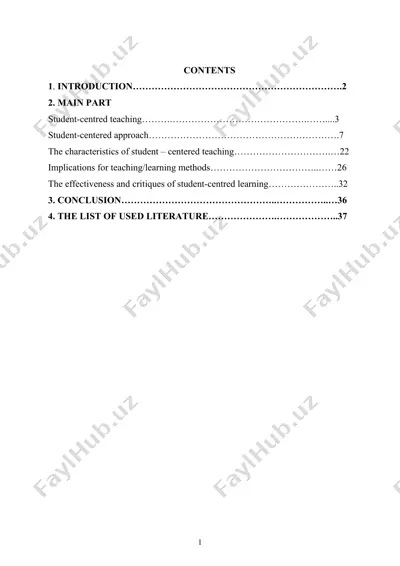
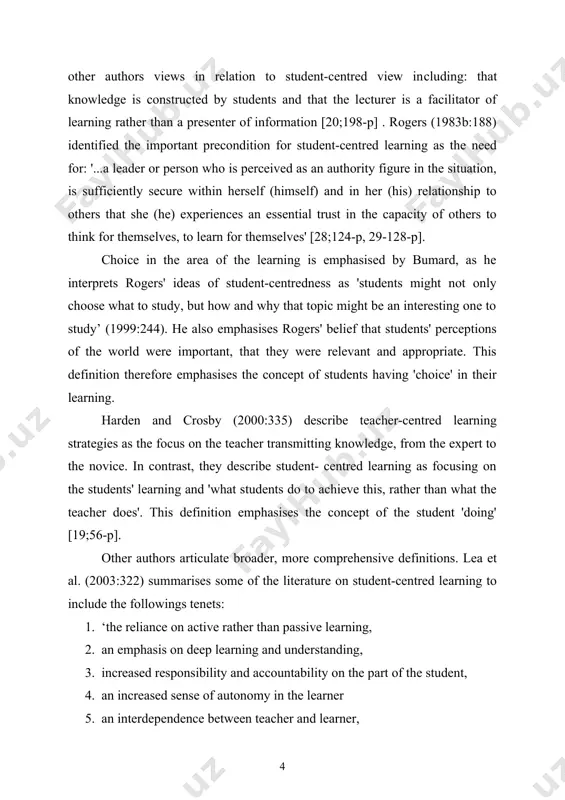
![and students leam to collaborate and communicate with one another. we can define the main principles of student-centered learning as: о the learner has full responsibility for her/his learning; о involvement and participation are necessary for learning; о the relationship between learners is more equal, promoting growth and development; the teacher becomes a facilitator and resource person; the learner sees himself differently as a result of the learning experience. main part student-centred teaching the term student-centred learning (scl) is widely used in the teaching and learning literature. many terms have been linked with student-centred learning, such as flexible learning (taylor 2000), experiential learning (burnard 1999), self-directed learning and therefore the slightly overused term 'student-centred learning' can mean different things to different people [10;154-p]. in addition, in practice it is also described by a range of terms and this has led to confusion surrounding its implementation [33;48-p]. the concept of student-centred …](/media/previews/pages/preview_a9lUMJB.webp "student-centred teaching - 2-sahifa")
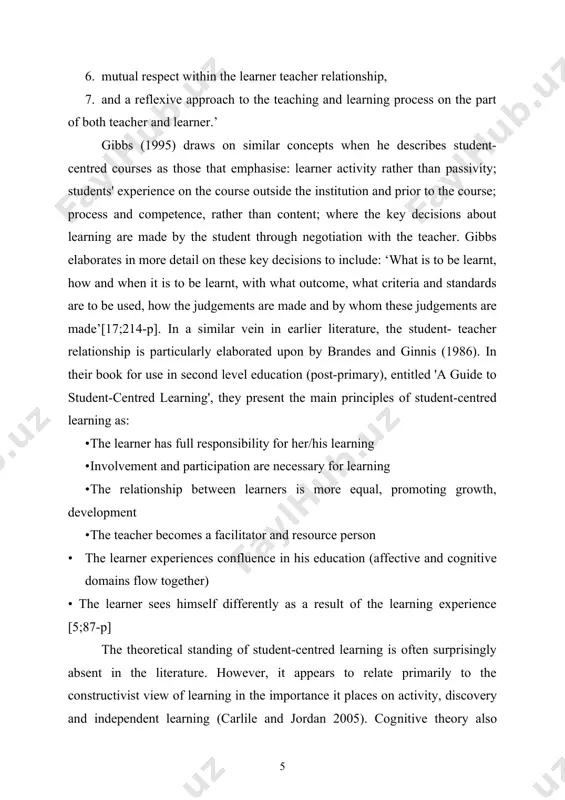
![ghted that this was linked with the process of development or 'readiness', i.e. the child will learn when he/she is ready [25;124-p,10;205-p, 31-28-p]. kember (1997) described two broad orientations in teaching: the teacher centred/content oriented conception and the student centred/learning oriented conceptions. in a very useful breakdown of these orientations he supports many other authors views in relation to student-centred view including: that knowledge is constructed by students and that the lecturer is a facilitator of learning rather than a presenter of information [20;198-p] . rogers (1983b:188) identified the important precondition for student-centred learning as the need for: '...a leader or person who is perceived as an authority figure in the situation, is sufficiently secure within herself (himself) and in her (his) relationship to others that she (he) experiences an essential trust in the capacity of others to think for themselves, to learn for themselves' [28;124-p, 29-128-p]. choice in the …](/media/previews/pages/preview_dSDm57K.webp "student-centred teaching - 3-sahifa")
Ko'proq o'qimoqchimisiz?
Barcha 40 sahifani Telegram orqali bepul yuklab oling.
To'liq faylni yuklab olish"student-centred teaching" haqida
contents 1. introduction………………………………………………………….2 2. main part student-centred teaching……….…………………………………….……....3 student-centered approach…………………………………………………….7 the characteristics of student – centered teaching………………………….…22 implications for teaching/learning methods……………………………..……26 the effectiveness and critiques of student-centred learning…………………..32 3. conclusion…………………………………………..……………..…36 4. the list of used literature………………….………………..37 introduction student-centered approach includes the idea that students have choice in what to study and how to study. student-centered learning is focused on the student’s needs, abilities, interests, and learning styles with the teacher as a facilitator of learning. teachers provide the way for students to access the material, so students can easier...
Bu fayl DOC formatida 40 sahifadan iborat (201,0 KB). "student-centred teaching"ni yuklab olish uchun chap tomondagi Telegram tugmasini bosing.
 DOCX
DOCX
 DOCX
DOCX
 DOC
DOC
 DOC
DOC
 DOCX
DOCX
 DOCX
DOCX
 DOCX
DOCX
 DOCX
DOCX
 DOC
DOC
 DOC
DOC
 DOCX
DOCX
 DOCX
DOCX