sequence tones in english

DOC 231,0 KB Bepul yuklash

Sahifa ko'rinishi (5 sahifa)

Pastga aylantiring 👇
1
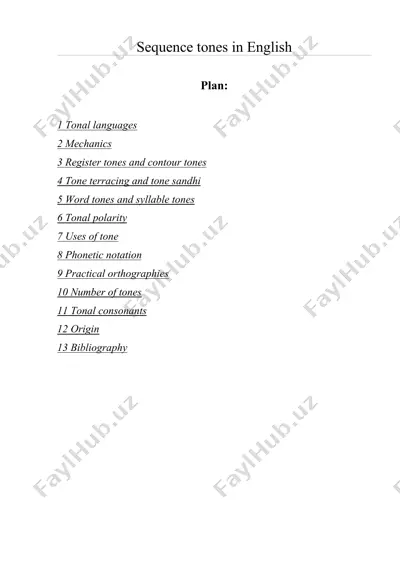
1411364827_59205.doc sequence tones in english plan: 1 tonal languages 2 mechanics 3 register tones and contour tones 4 tone terracing and tone sandhi 5 word tones and syllable tones 6 tonal polarity 7 uses of tone 8 phonetic notation 9 practical orthographies 10 number of tones 11 tonal consonants 12 origin 13 bibliography tone is the use of pitch in language to distinguish lexical or grammatical meaning—that is, to distinguish orinflect words. all verbal languages use pitch to express emotional and other paralinguistic information, and to convey emphasis, contrast, and other such features in what is called intonation, but not all languages use tones to distinguish words or their inflections, analogously to consonants and vowels. such tonal phonemesare sometimes called tonemes. in the most widely-spoken tonal language, mandarin chinese, tones are distinguished by their shape (contour) and pitch range (or register). most syllables carry their own tone and many words …
2
is debate over the definition of pitch accent, and whether a coherent definition is even possible. tonal languages most languages of sub-saharan africa are tonal, notably excepting swahili in the east, and wolof andfulani in the west. the chadic, omotic, and to some extent cushitic branches of afroasiatic are tonal—the omotic languages heavily so—though their sister families of semitic, berber, and egyptian are not. there are numerous tonal languages in east asia and south east asia, including all the chinese languages(though some such as shanghainese are only marginally tonal), vietnamese, thai, and lao. some east asian languages, such as burmese, korean[citation needed], and japanese have simpler tone systems, which are sometimes called 'register' or 'pitch accent' systems. however, some languages in the region are not tonal at all, including mongolian, khmer, and malay. of the tibetan languages, central tibetan (including the dialect of the capital lhasa) and amdo tibetan are …
3
se are strongly tonal (an exception being shanghainese, where the system has collapsed to only a two-way contrast at the word level with some initial consonants, and no contrast at all with others); while some of the tibetan languages, including the standard languages of lhasa and bhutan and burmese, are more marginally tonal. however, nepal bhasa, the original language of kathmandu, is non-tonal, as are several tibetan dialects and many other tibeto-burman languages. · in the austro-asiatic family, vietnamese and its closest relatives are strongly tonal. other languages of this family, such as mon, khmer, and the munda languages, are non-tonal. · the entire tai-kadai family, spoken mainly in china, vietnam, thailand, and laos, is strongly tonal. · the entire hmong–mien family is strongly tonal. · many afroasiatic languages in the chadic, cushitic and omotic families have register-tone systems, such as chadic hausa. many of the omotic tone systems are …
4
e contour systems. these are perhaps the most complex tone systems in north america. · the tanoan languages. · scattered languages of the amazon basin, usually with rather simple register-tone systems. · scattered languages of new guinea, usually with rather simple register-tone systems. · a few indo-european languages, namely ancient greek, swedish, norwegian, limburgish, lithuanian, the west south slavic languages (slovene and serbo-croatian), vedic sanskrit, and punjabi have limited word-tone systems which are sometimes called pitch accent or "tonal accents". generally there can only be at most one tonic syllable per word of 2-5 different registers, as well as additional distinctive and non-distinctive pre- and post-tonic lengths. · some european-based creole languages, such as saramaccan and papiamentu, have tone from their african substratum languages. the vast majority of austronesian languages are non-tonal, but a small number, for example ma'ya (which also has lexical stress) have developed tone, and also the …
5
ing similar appears to be the case with ket. the most thoroughly tonal language is the 19th-century constructed language solresol, which consists ofonly tone. mechanics most languages use pitch as intonation to convey prosody and pragmatics, but this does not make them tonal languages. in tonal languages, each syllable has an inherent pitch contour, and thus minimal pairs exist between syllables with the same segmental features but different tones. here is a minimal tone set from mandarin chinese, which has five tones, here transcribed by diacritics over the vowels: the tone contours of standard chinese. in the convention for chinese, 1 is low and 5 is high. the corresponding tone letters are˥ ˧˥ ˨˩˦ ˥˩. 1. a high level tone: /á/ (pinyin ⟨ā⟩) 2. a tone starting with mid pitch and rising to a high pitch: /ǎ/ (pinyin ⟨á⟩) 3. a low tone which dips briefly before, if there is …

Ko'proq o'qimoqchimisiz?

Faylni Telegram orqali bepul yuklab oling.

To'liq faylni yuklab olish

"sequence tones in english" haqida

1411364827_59205.doc sequence tones in english plan: 1 tonal languages 2 mechanics 3 register tones and contour tones 4 tone terracing and tone sandhi 5 word tones and syllable tones 6 tonal polarity 7 uses of tone 8 phonetic notation 9 practical orthographies 10 number of tones 11 tonal consonants 12 origin 13 bibliography tone is the use of pitch in language to distinguish lexical or grammatical meaning—that is, to distinguish orinflect words. all verbal languages use pitch to express emotional and other paralinguistic information, and to convey emphasis, contrast, and other such features in what is called intonation, but not all languages use tones to distinguish words or their inflections, analogously to consonants and vowels. such tonal phonemesare sometimes called …

DOC format, 231,0 KB. "sequence tones in english"ni yuklab olish uchun chap tomondagi Telegram tugmasini bosing.

Teglar: sequence tones in english DOC Bepul yuklash Telegram