diphthong
Sahifa ko'rinishi (5 sahifa)
Pastga aylantiring 👇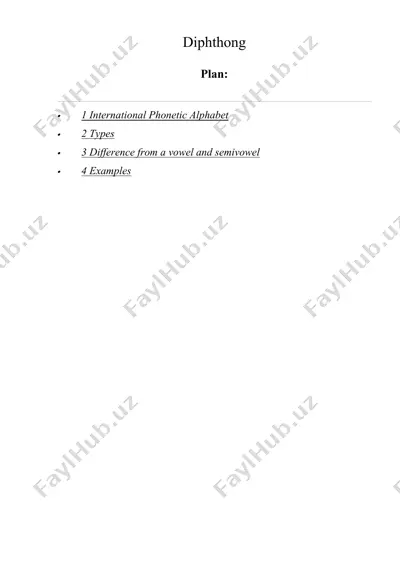
![wel with less prominence, like [aɪ̯] in eye, while rising (or ascending) diphthongs begin with a less prominent semivowel and end with a more prominent full vowel, similar to the [ja] in yard. (note that "falling" and "rising" in this context do not refer to vowel height; the terms "opening" and "closing" are used instead. see below.) the less prominent component in the diphthong may also be transcribed as an approximant, thus [aj]in eye and [ja] in yard. however, when the diphthong is analysed as a single phoneme, both elements are often transcribed with vowel letters (/aɪ̯/, /ɪ̯a/). note also that semivowels and approximants are not equivalent in all treatments, and in the english and italian languages, among others, many phoneticians do not consider rising combinations to be diphthongs, but rather sequences of approximant and vowel. there are many languages (such as romanian) that contrast one or more rising diphthongs …](/media/previews/pages/preview_3h4ySsf.webp "diphthong - 2-sahifa")
![e central one, such as [ɪə̯], [ɛə̯], and [ʊə̯] inreceived pronunciation or [iə̯] and [uə̯] in irish. many centering diphthongs are also opening diphthongs ([iə̯], [uə̯]). diphthongs may contrast in how far they open or close. for example, samoan contrasts low-to-mid with low-to-high diphthongs: · ’ai [ʔai̯] 'probably' · ’ae [ʔae̯] 'but' · ’auro [ʔau̯ɾo] 'gold' · ao [ao̯] 'a cloud' length languages differ in the length of diphthongs, measured in terms of morae. in languages with phonemically short and long vowels, diphthongs typically behave like long vowels, and are pronounced with a similar length.[citation needed] in languages with only one phonemic length for pure vowels, however, diphthongs may be behave like pure vowels.[citation needed] for example, in icelandic, both monophthongs and diphthongs are pronounced long before single consonants and short before most consonant clusters. some languages contrast short and long diphthongs. in some languages, such as old english, these …](/media/previews/pages/preview_6gLccXC.webp "diphthong - 3-sahifa")
![ways clear. the english word yes, for example, consists of a palatal glide followed by a monophthong rather than a rising diphthong. in addition, while the segmental elements must be different in diphthongs so that [ii̯], when it occurs in a language, does not contrast with [iː]though it is possible for languages to contrast [ij] and [iː] examples germanic languages english see also: ipa chart for english dialects all english diphthongs are falling, apart from /juː/, which can be analyzed as [i̯uː]. in words coming from middle english, most cases of the modern english diphthongs [aɪ̯, oʊ̯, eɪ̯, aʊ̯] originate from the middle english long monophthongs [iː, ɔː, aː, uː] through the great vowel shift, although some cases of [oʊ̯, eɪ̯] originate from the middle english diphthongs [ɔu̯, aɪ̯]. standard english diphthongs rp (british) australian american ga canadian low [əʊ̯] [əʉ̯] [oʊ̯] loud [aʊ̯] [æɔ̯] [aʊ̯] [aʊ̯] lout [əʊ̯][t2 1] …](/media/previews/pages/preview_88LI1sC.webp "diphthong - 4-sahifa")
![hthongs of dutch netherlandic belgian zeis [ɛɪ̯] ui [œʏ̯] zout [ʌʊ̯] [ɔʊ̯] beet[t1 1] [eɪ̯] [eː] neus[t1 1] [øʏ̯] [øː] boot[t1 1] [oʊ̯] [oː] 1. ^ a b c [eɪ̯], [øʏ̯], and [oʊ̯] are normally pronounced as closing diphthongs except before [ɾ] in the same word, in which case they are centering diphthongs: [eə̯], [øə̯], and [oə̯]. in many dialects, they are monophthongized (see verhoeven & van bael (2002) for more information). the dialect of hamont (in limburg) has five centring diphthongs and contrasts long and short forms of [ɛɪ̯], [œʏ̯], [ɔʊ̯], and [ɑʊ̯]. german standard german phonemic diphthongs in german: · /aɪ̯/ as in ei ‘egg’ · /aʊ̯/ as in maus ‘mouse’ · /ɔʏ̯/ as in neu ‘new’ in the varieties of german that vocalize the /r/ in the syllable coda, other diphthongal combinations may occur. these are only phonetic diphthongs, not phonemic diphthongs, since the vocalic pronunciation [ɐ̯] …](/media/previews/pages/preview_r2miKJs.webp "diphthong - 5-sahifa")
"diphthong" haqida
1411371609_59220.doc diphthong plan: · 1 international phonetic alphabet · 2 types · 3 difference from a vowel and semivowel · 4 examples a diphthong ( /ˈdɪfθɒŋ/ or /ˈdɪpθɒŋ/; greek: δίφθογγος, diphthongos, literally "two sounds" or "two tones"), also known as a gliding vowel, refers to two adjacent vowel sounds occurring within the same syllable. technically, a diphthong is a vowel with two different targets: that is, the tongue moves during the pronunciation of the vowel. in most dialects of english, the wordseye, hay, boy, low, and cow contain diphthongs. diphthongs contrast with monophthongs, where the tongue doesn't move and only one vowel sound is heard in a syllable. where two adjacent vowel sounds occur in different syllables—for example, in the …
DOC format, 330,0 KB. "diphthong"ni yuklab olish uchun chap tomondagi Telegram tugmasini bosing.
 DOCX
DOCX
 DOC
DOC
 DOC
DOC
 DOCX
DOCX
 DOCX
DOCX
 DOCX
DOCX
 DOC
DOC
 PPT
PPT
 DOCX
DOCX
 DOCX
DOCX
 DOC
DOC
 DOC
DOC