lecture 4: affixation and conversion

DOCX 21 pages 43.0 KB Free download

Page preview (5 pages)

Scroll down 👇
1 / 21
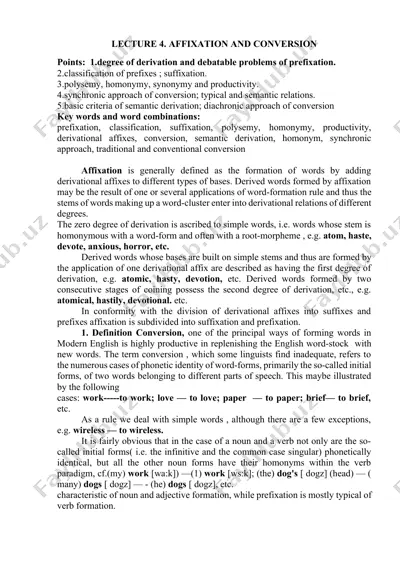
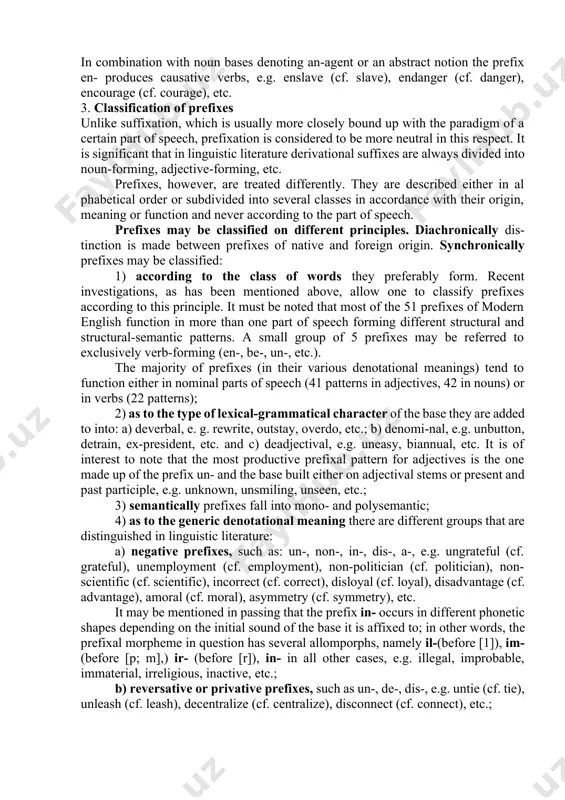
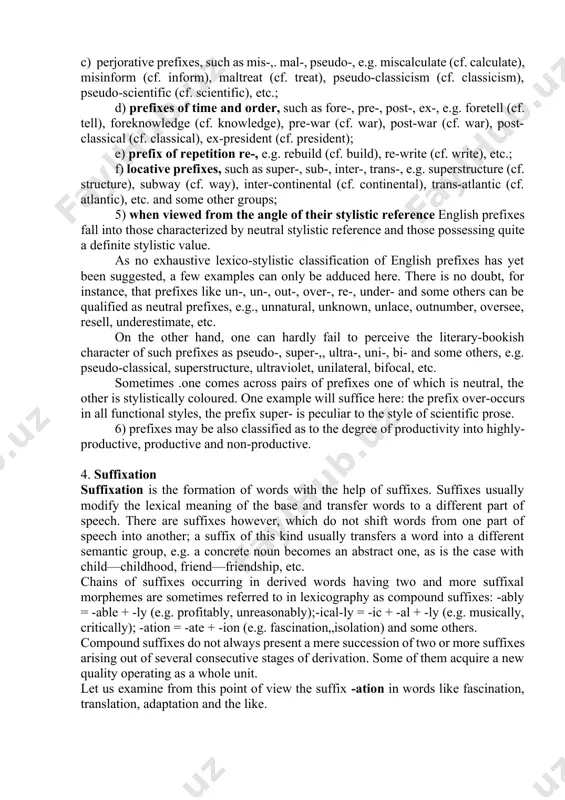
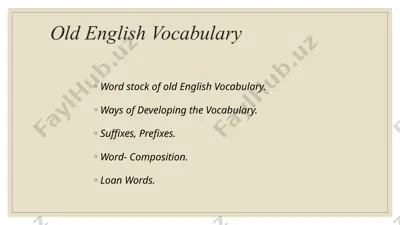
lecture 4. affixation and conversion points: 1.degree of derivation and debatable problems of prefixation. 2.classification of prefixes ; suffixation. 3.polysemy, homonymy, synonymy and productivity. 4.synchronic approach of conversion; typical and semantic relations. 5.basic criteria of semantic derivation; diachronic approach of conversion key words and word combinations: prefixation, classification, suffixation, polysemy, homonymy, productivity, derivational affixes, conversion, semantic derivation, homonym, synchronic approach, traditional and conventional conversion affixation is generally defined as the formation of words by adding derivational affixes to different types of bases. derived words formed by affixation may be the result of one or several applications of word-formation rule and thus the stems of words making up a word-cluster enter into derivational relations of different degrees. the zero degree of derivation is ascribed to simple words, i.e. words whose stem is homonymous with a word-form and often with a root-morpheme , e.g. atom, haste, devote, anxious, horror, etc. derived words …
2 / 21
ted by the following cases: work-----to work; love — to love; paper — to paper; brief— to brief, etc. as a rule we deal with simple words , although there are a few exceptions, e.g. wireless — to wireless. it is fairly obvious that in the case of a noun and a verb not only are the so-called initial forms( i.e. the infinitive and the common case singular) phonetically identical, but all the other noun forms have their homonyms within the verb paradigm, cf.(my) work [wa:k]) —(1) work [ws:k]; (the) dog's [ dogz] (head) — ( many) dogs [ dogz] — - (he) dogs [ dogz], etc. characteristic of noun and adjective formation, while prefixation is mostly typical of verb formation. the distinction also rests on the role different types of meaning play in the semantic structure of the suffix and the prefix. the part-of-speech meaning has a much greater …
3 / 21
osition (or compounding). the greater semantic independence of prefixes as compared with suffixes led the linguists to identify prefixes with the first component part of a compound word. at present the majority of scholars treat prefixation as an integral part of word-derivation regarding prefixes as derivational affixes which differ essentially both from root-morphemes and non-derivational prepositive morphemes. opinion sometimes differs concerning the interpretation of the functional status of certain individual groups of morphemes which commonly occur as first component parts of words. h. marchand, for instance, analyses words like to overdo, to underestimate as compound verbs, the first components of which are locative particles, not prefixes. in a similar way he interprets words like income, onlooker, outhouse qualifying them as compounds with locative particles as first, elements. there are about 51 prefixes in the system of modern english word-formation. according to the available word-counts of prefixal derivatives the greatest number …
4 / 21
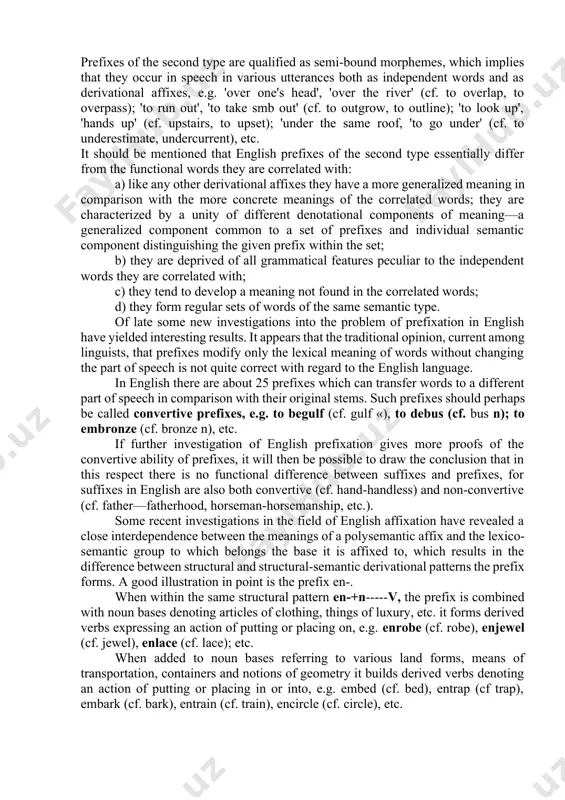
as semi-bound morphemes, which implies that they occur in speech in various utterances both as independent words and as derivational affixes, e.g. 'over one's head', 'over the river' (cf. to overlap, to overpass); 'to run out', 'to take smb out' (cf. to outgrow, to outline); 'to look up', 'hands up' (cf. upstairs, to upset); 'under the same roof, 'to go under' (cf. to underestimate, undercurrent), etc. it should be mentioned that english prefixes of the second type essentially differ from the functional words they are correlated with: a) like any other derivational affixes they have a more generalized meaning in comparison with the more concrete meanings of the correlated words; they are characterized by a unity of different denotational components of meaning—a generalized component common to a set of prefixes and individual semantic component distinguishing the given prefix within the set; b) they are deprived of all grammatical features peculiar …
5 / 21
n english are also both convertive (cf. hand-handless) and non-convertive (cf. father—fatherhood, horseman-horsemanship, etc.). some recent investigations in the field of english affixation have revealed a close interdependence between the meanings of a polysemantic affix and the lexico-semantic group to which belongs the base it is affixed to, which results in the difference between structural and structural-semantic derivational patterns the prefix forms. a good illustration in point is the prefix en-. when within the same structural pattern en-+n-----v, the prefix is combined with noun bases denoting articles of clothing, things of luxury, etc. it forms derived verbs expressing an action of putting or placing on, e.g. enrobe (cf. robe), enjewel (cf. jewel), enlace (cf. lace); etc. when added to noun bases referring to various land forms, means of transportation, containers and notions of geometry it builds derived verbs denoting an action of putting or placing in or into, e.g. embed …

Want to read more?

Download all 21 pages for free via Telegram.

Download full file

About "lecture 4: affixation and conversion"

lecture 4. affixation and conversion points: 1.degree of derivation and debatable problems of prefixation. 2.classification of prefixes ; suffixation. 3.polysemy, homonymy, synonymy and productivity. 4.synchronic approach of conversion; typical and semantic relations. 5.basic criteria of semantic derivation; diachronic approach of conversion key words and word combinations: prefixation, classification, suffixation, polysemy, homonymy, productivity, derivational affixes, conversion, semantic derivation, homonym, synchronic approach, traditional and conventional conversion affixation is generally defined as the formation of words by adding derivational affixes to different types of bases. derived words formed by affixation may be the result of one or several applications of word-formation ru...

This file contains 21 pages in DOCX format (43.0 KB). To download "lecture 4: affixation and conversion", click the Telegram button on the left.

Tags: lecture 4: affixation and conve… DOCX 21 pages Free download Telegram