conditional sentences: understanding the basics

DOCX 51 pages 48.2 KB Free download

Page preview (5 pages)

Scroll down 👇
1 / 51
theme: corditionals 1: (zero, first, second). the deer and his image. plan: 1. corditionals 1: (zero, first, second). 2. the deer and his image. prototypical conditional sentences in english are those of the form "if x, then y". the clause x is referred to as the antecedent (or protasis), while the clause y is called the consequent (or apodosis). a conditional is understood as expressing its consequent under the temporary hypothetical assumption of its antecedent. conditional sentences can take numerous forms. the consequent can precede the "if"-clause and the word "if" itself may be omitted or replaced with a different complementizer. the consequent can be a declarative, an interrogative, or an imperative. special tense morphology can be used to form a counterfactual conditional. some linguists have argued that other superficially distinct grammatical structures such as wish reports have the same underlying structure as conditionals. conditionals are one of the most …
2 / 51
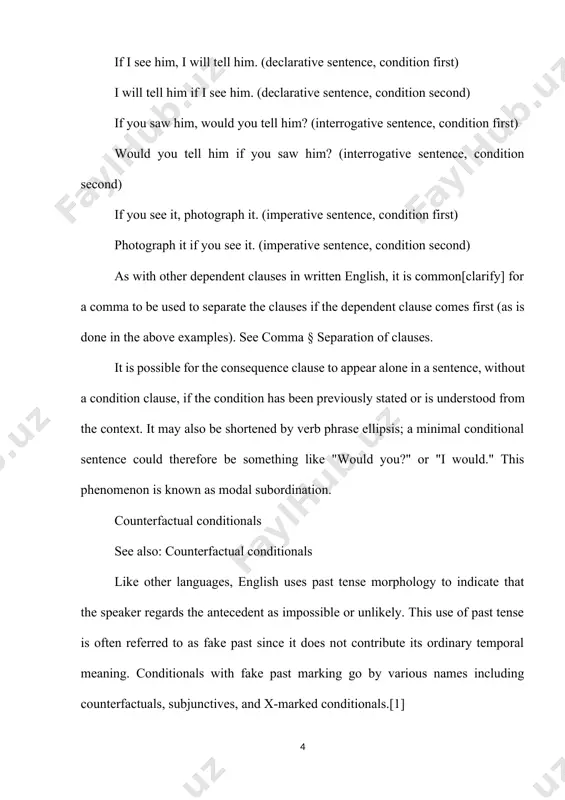
rogative sentence, condition second) if you see it, photograph it. (imperative sentence, condition first) photograph it if you see it. (imperative sentence, condition second) as with other dependent clauses in written english, it is common[clarify] for a comma to be used to separate the clauses if the dependent clause comes first (as is done in the above examples). see comma § separation of clauses. it is possible for the consequence clause to appear alone in a sentence, without a condition clause, if the condition has been previously stated or is understood from the context. it may also be shortened by verb phrase ellipsis; a minimal conditional sentence could therefore be something like "would you?" or "i would." this phenomenon is known as modal subordination. counterfactual conditionals see also: counterfactual conditionals like other languages, english uses past tense morphology to indicate that the speaker regards the antecedent as impossible or unlikely. …
3 / 51
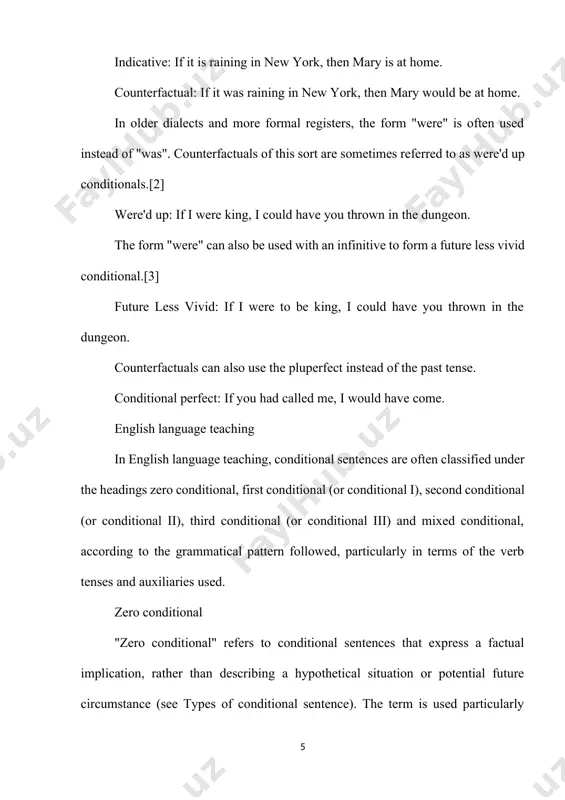
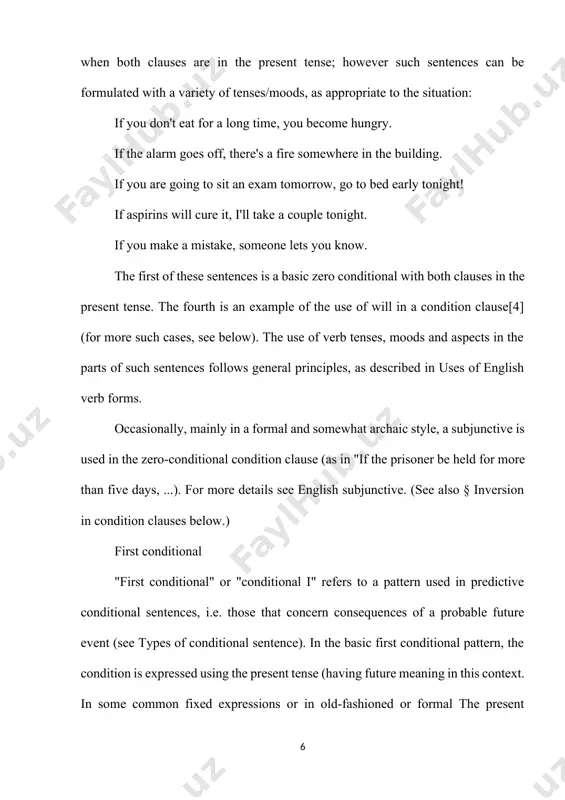
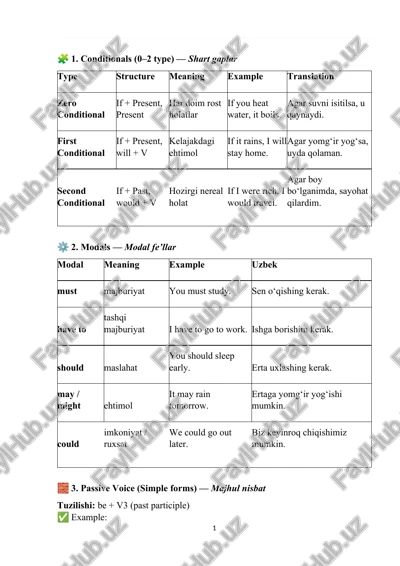
n classified under the headings zero conditional, first conditional (or conditional i), second conditional (or conditional ii), third conditional (or conditional iii) and mixed conditional, according to the grammatical pattern followed, particularly in terms of the verb tenses and auxiliaries used. zero conditional "zero conditional" refers to conditional sentences that express a factual implication, rather than describing a hypothetical situation or potential future circumstance (see types of conditional sentence). the term is used particularly when both clauses are in the present tense; however such sentences can be formulated with a variety of tenses/moods, as appropriate to the situation: if you don't eat for a long time, you become hungry. if the alarm goes off, there's a fire somewhere in the building. if you are going to sit an exam tomorrow, go to bed early tonight! if aspirins will cure it, i'll take a couple tonight. if you make a mistake, …
4 / 51
n old-fashioned or formal the present subjunctive is occasionally found. for example:if need be, we'll rent a car. see use of the present subjunctive), and the consequence using the future construction with will (or shall): if you make a mistake, someone will let you know. if he asks me, i will/shall consider his proposal carefully. the use of present tense in dependent clauses with future time reference is not confined to condition clauses; it also occurs in various temporal and relative clauses (as soon as he arrives; take the first train that comes; etc.), as described under uses of english verb forms § dependent clauses. the present tense used in the condition clause may take the form of the simple present as in the above examples, or the present progressive, present perfect or present perfect progressive as appropriate (according to general principles for uses of english verb forms): if he …
5 / 51
. in colloquial english, an imperative may be used with the meaning of a condition clause, as in "go eastwards a mile and you'll see it" (meaning "if you go eastwards a mile, you will see it"). although the consequence in first conditional sentences is usually expressed using the will (or shall) future (usually the simple future, though future progressive, future perfect and future perfect progressive are used as appropriate), other variations are also possible – it may take the form of an imperative, it may use another modal verb that can have future meaning, or it may be expressed as a deduction about present or past time (consequent on a possible future event): if it rains this afternoon, come round to my place! (imperative) if it rains this afternoon, we can/could/should/may/might find somewhere to shelter. (other modals) if it rains this afternoon, then yesterday's weather forecast was wrong. (deduction …

Want to read more?

Download all 51 pages for free via Telegram.

Download full file

About "conditional sentences: understanding the basics"

theme: corditionals 1: (zero, first, second). the deer and his image. plan: 1. corditionals 1: (zero, first, second). 2. the deer and his image. prototypical conditional sentences in english are those of the form "if x, then y". the clause x is referred to as the antecedent (or protasis), while the clause y is called the consequent (or apodosis). a conditional is understood as expressing its consequent under the temporary hypothetical assumption of its antecedent. conditional sentences can take numerous forms. the consequent can precede the "if"-clause and the word "if" itself may be omitted or replaced with a different complementizer. the consequent can be a declarative, an interrogative, or an imperative. special tense morphology can be used to form …

This file contains 51 pages in DOCX format (48.2 KB). To download "conditional sentences: understanding the basics", click the Telegram button on the left.

Tags: conditional sentences: understa… DOCX 51 pages Free download Telegram