lexis

PDF 5 pages 7.2 MB Free download

Page preview (5 pages)

Scroll down 👇
1 / 5
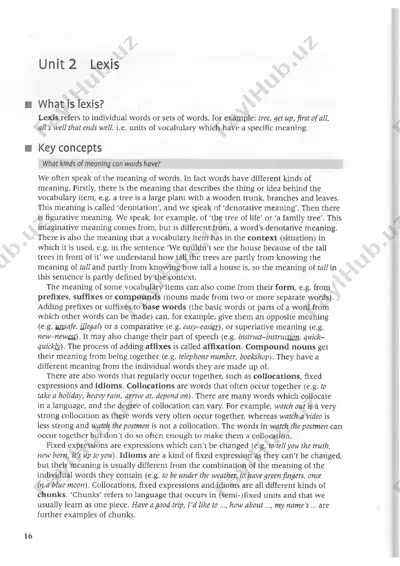
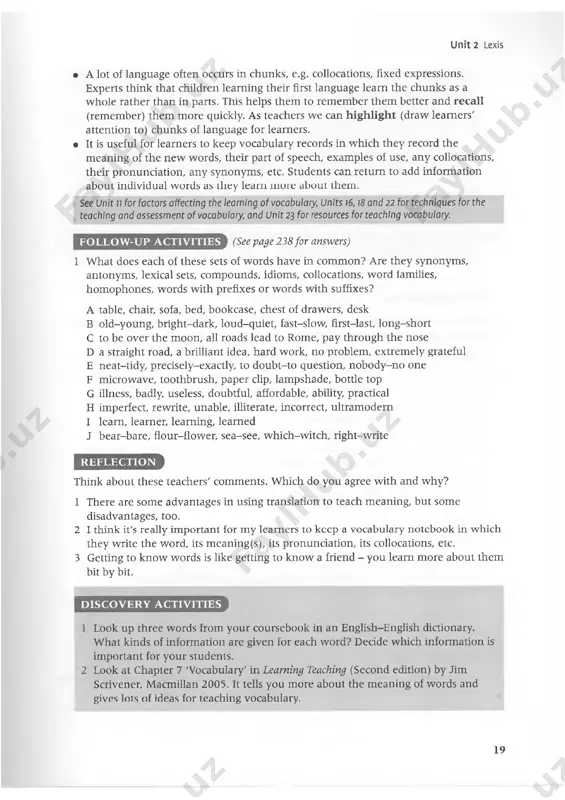
the tkt teaching knowledge test.modules 1,2 and 3 (4).pdf unit 2 lexis what is lexis? lexis refers to individual words or sets of words, for example: tree, get up, first of all, all’s well that ends well, i.e. units of vocabulary which have a specific meaning, key concepts what kinds of meaning can words have? we often speak of the m eaning of words. in fact words have different kinds of meaning. firstly, there is the m eaning tha t describes the thing or idea behind the vocabulary item, e.g. a tree is a large plant w ith a w ooden trunk, branches and leaves. this m eaning is called 'denotation ', and we speak of 'denotative m eaning'. then there is figurative meaning. we speak, for example, of 'the tree of life' or 'a family tree'. this imaginative m eaning comes from, bu t is different from, a w …
2 / 5
ds that regularly occur together, such as collocations, fixed expressions and id iom s. c ollocations are words that often occur together (e.g. to take a holiday, heavy rain, arrive at, depend on). there are m any words w hich collocate in a language, and the degree of collocation can vary. for example, watch out is a very strong collocation as these words very often occur together, w hereas watch a video is less strong and watch the postmen is no t a collocation. the words in watch the postmen can occur together bu t d on 't do so often enough to m ake them a collocation. fixed expressions are expressions w hich can 't be changed (e.g. to tell you the truth, new born, it's up to you). id iom s are a kind of fixed expression as they can 't be changed, bu t their m eaning …
3 / 5
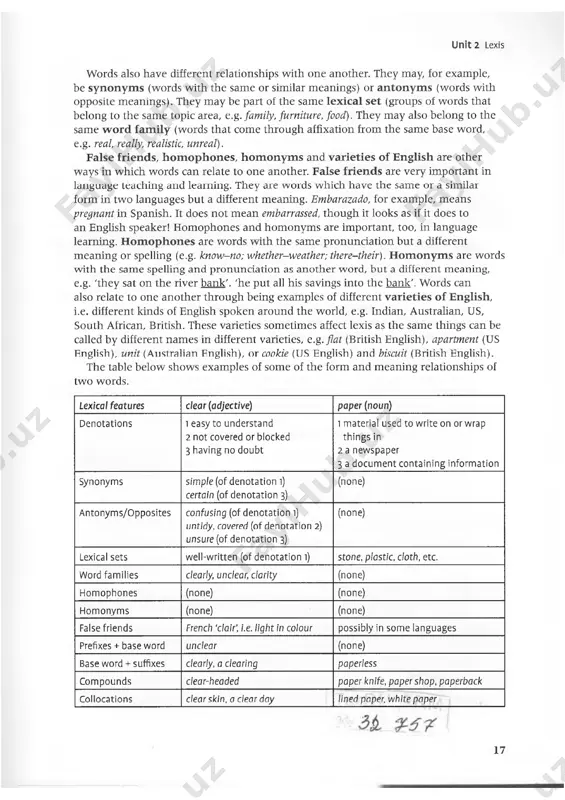
ent m eaning. embarazado, for example, means pregnant in spanish. it does not m ean embarrassed, though it looks as if it does to an english speaker! h om ophones and hom onym s are im portant, too, in language learning. h om o ph o nes are words w ith the same pronunciation bu t a different m eaning or spelling (e.g. know-no; whether-weather; there-their). h om on ym s are words w ith the same spelling and pronunciation as another word, bu t a different meaning, e.g. 'they sat on the river bank ', 'he pu t all his savings into the bank '. words can also relate to one another th rough being examples of different varieties o f english, i.e. different kinds of english spoken around the world, e.g. indian, australian, us, south african, british. these varieties sometimes affect lexis as the same things can be …
4 / 5
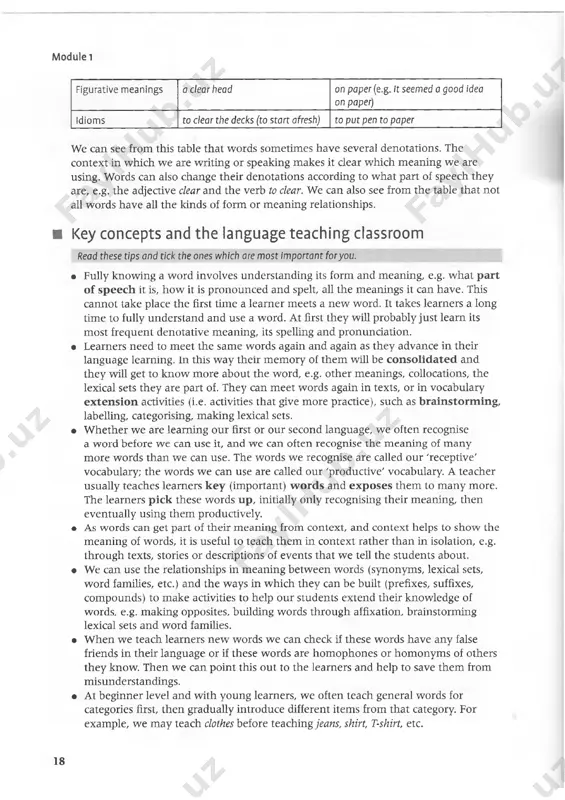
per (e.g. it seemed a good idea on paper) idioms to clear the decks (to start afresh) to put pen to paper we can see from this table that words sometimes have several denotations. the context in w hich w e are w riting or speaking makes it clear w hich m eaning we are using. words can also change their denotations according to w hat part of speech they are, e.g. the adjective clear and the verb to clear. we can also see from the table th at no t all words have all the kinds of form or m eaning relationships. key concepts and the language teaching classroom read these tips and tick the ones which are most important for you. о fully knowing a w ord involves understanding its form and m eaning, e.g. w hat part o f sp eech it is, how it is pronounced …
5 / 5
hen eventually using them productively. • as words can get part of their m eaning from context, and context helps to show the m eaning of words, it is useful to teach them in context ra ther th an in isolation, e.g. th rough texts, stories or descriptions of events tha t we tell the students about. • we can use the relationships in m eaning betw een words (synonyms, lexical sets, w ord families, etc.) and the ways in w hich they can be built (prefixes, suffixes, compounds) to m ake activities to help ou r students extend their knowledge of words, e.g. m aking opposites, building words through affixation, brainstorming lexical sets and w ord families. • w hen we teach learners new words we can check if these words have any false friends in their language or if these words are hom ophones or hom onym s …

Want to read more?

Download all 5 pages for free via Telegram.

Download full file

About "lexis"

the tkt teaching knowledge test.modules 1,2 and 3 (4).pdf unit 2 lexis what is lexis? lexis refers to individual words or sets of words, for example: tree, get up, first of all, all’s well that ends well, i.e. units of vocabulary which have a specific meaning, key concepts what kinds of meaning can words have? we often speak of the m eaning of words. in fact words have different kinds of meaning. firstly, there is the m eaning tha t describes the thing or idea behind the vocabulary item, e.g. a tree is a large plant w ith a w ooden trunk, branches and leaves. this m eaning is called 'denotation ', and we speak of 'denotative m eaning'. then …

This file contains 5 pages in PDF format (7.2 MB). To download "lexis", click the Telegram button on the left.
Tags: lexis PDF 5 pages Free download Telegram