teaching english as an international language

PPT 25 sahifa 890,0 KB Bepul yuklash

Sahifa ko'rinishi (5 sahifa)

Pastga aylantiring 👇


1 / 25
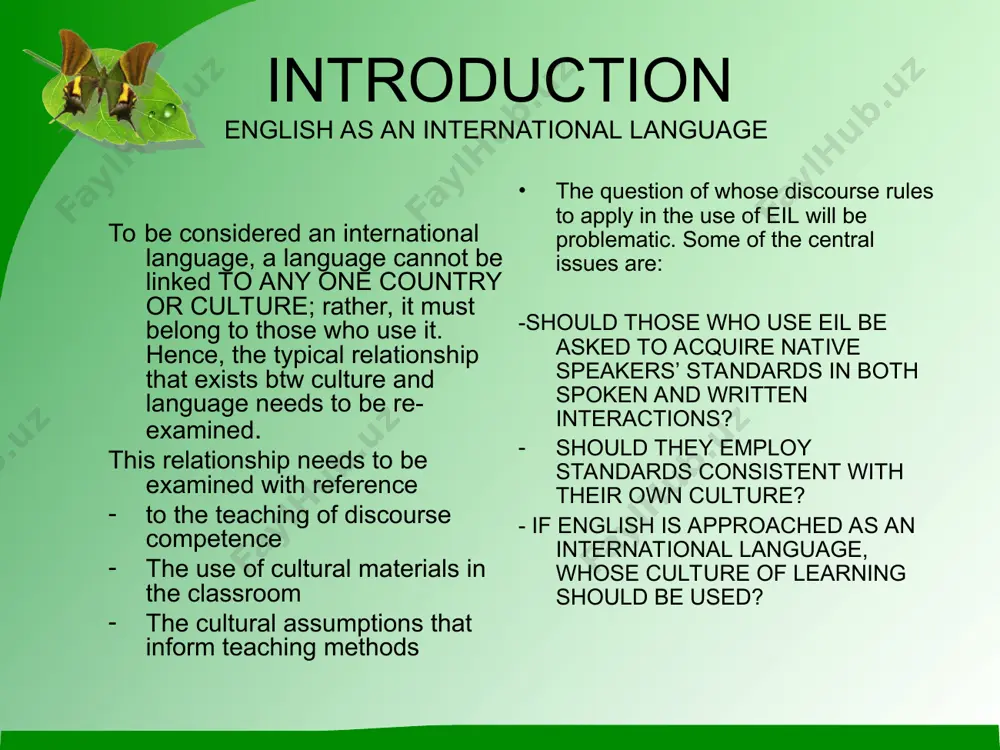
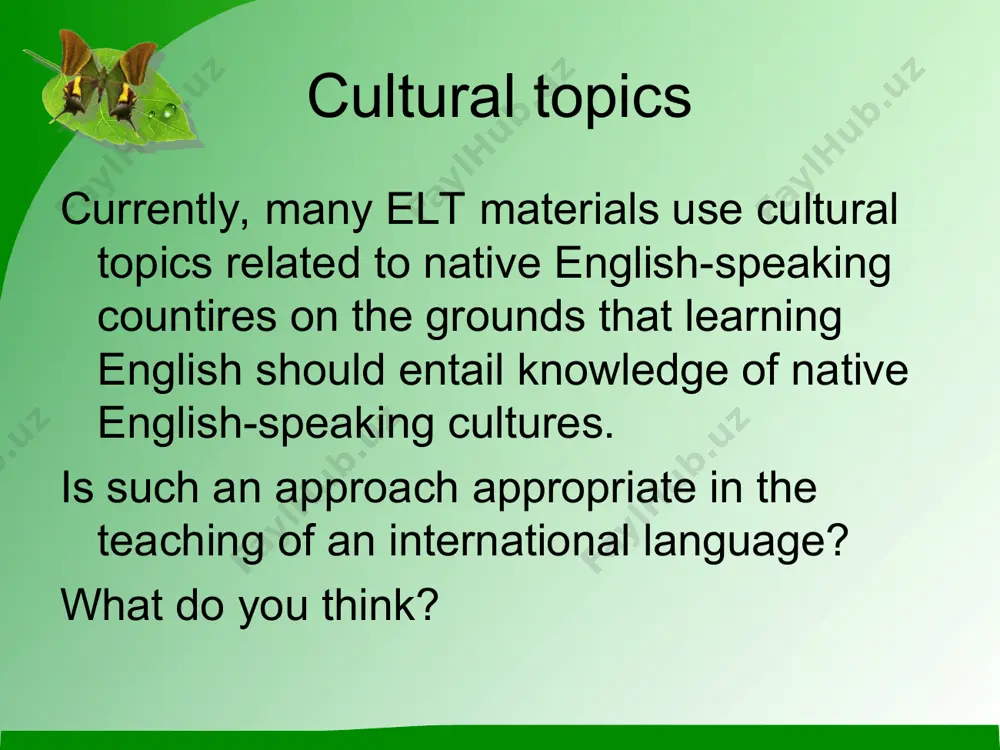
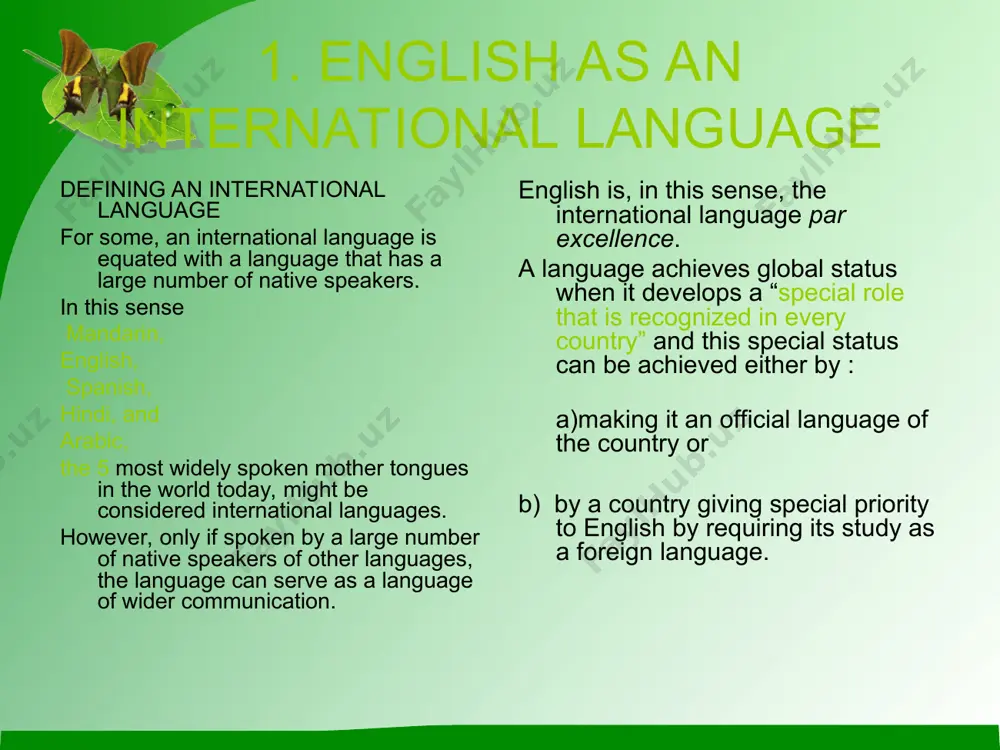
english as an international language english as an international language sandra lee mckay: teaching english as an international language introduction english as an international language to be considered an international language, a language cannot be linked to any one country or culture; rather, it must belong to those who use it. hence, the typical relationship that exists btw culture and language needs to be re-examined. this relationship needs to be examined with reference to the teaching of discourse competence the use of cultural materials in the classroom the cultural assumptions that inform teaching methods the question of whose discourse rules to apply in the use of eil will be problematic. some of the central issues are: -should those who use eil be asked to acquire native speakers’ standards in both spoken and written interactions? should they employ standards consistent with their own culture? - if english is approached as an …
2 / 25
ecial status can be achieved either by : a)making it an official language of the country or b) by a country giving special priority to english by requiring its study as a foreign language. crystal (1997): some countries that give special status to english: american samoa antigua and barbuda australia bahamas bangladesh barbados belize bermuda bhutan botswana british virgin islands brunei canada dominica fiji ghana gibraltar grenada hong kong india ireland jamaica kenya liberia malawi malaysia malta marshall islands mauritius micronesia namibia nepal new zealand pakistan philippines puerto rico …and more: rwanda st luca seychelles sierra leone singapore solomon islands south africa sri lanka tanzania tonga trinidad and tobago tuvalu uganda united kingdom uk island (channel is, man) united states us virgin islands western samoa (now samoa) zambia zimbabwe total population: 2,024,614,00 usage estimate: l1 337,407,300 l2 235,351,300 categorisationa of countires in which english is used: (kachru) inner circle l1 …
3 / 25
native speakers of that language the ownership of an international language becomes “de-nationalized” the educational goal of learning it is to enable learners to communicate their ideas and culture to others english as an international language as an international language, e is used both in a global sense for international communication btw countries and in a local sense as a languge of wider communication within multilingual societies. the use of e is no longer connected to the culture of inner circle countires. in a local sense, e becomes embedded in the culture of the country in which it is used. in a global sense, one of tis primaary functions is to enable speakers to share with others their ideas and culture. finally… …an international language spreads not by speakers of that language migrating to other areas but rather by many individuals acquiring the language. reasons for the spread of english …
4 / 25
icant factor in the continued growth of e today – urban migration. the most rapid urbanization today is taking place in the developing world where in asia alone bw 1994 and 2025 there is likely to be an increase of more tha 20% in the urban population. urban areas are typically the focus for linguistic change. they are also important points for language contact and diversity, and they encourage the growth of a middle class who become consumers of the global material culture. urbanisation has importan effects on language demography. new languages emerge, others change, some are lost; new patterns of english uses will arise among second-language speakers. 3 more reasons for the spread of english – past and present a) in the past colonialism, speaker migration, and new technology 19th and 20th century british and american coloialism and the migration of english-speaking individuals to other areas briatin becoming the …
5 / 25
any individuals learn e because they want access to such things as scientific and technological information global economic trade, and higher education. many concerns are raised in relation to the negative economic repercussions of the spread of english. one of the primry concerns in this regard is the strong relationship btw economic wealth and proficiency in the language, and the role that language education policy and practices play in promoting this. tollefson (1991)… …notes that, because e is typically acquired in school context, this situation can lead to significant social inequalities. as he puts it, those people who cannot afford schooling, who do not have time to attend school, who attend substandard programmes, or who otherwise do not have access to effective formal education may be unable to learn e well enough to obtain jobs and to participate in decision-making systems that use e. because education is a major concern …

Ko'proq o'qimoqchimisiz?

Barcha 25 sahifani Telegram orqali bepul yuklab oling.

To'liq faylni yuklab olish

"teaching english as an international language" haqida

english as an international language english as an international language sandra lee mckay: teaching english as an international language introduction english as an international language to be considered an international language, a language cannot be linked to any one country or culture; rather, it must belong to those who use it. hence, the typical relationship that exists btw culture and language needs to be re-examined. this relationship needs to be examined with reference to the teaching of discourse competence the use of cultural materials in the classroom the cultural assumptions that inform teaching methods the question of whose discourse rules to apply in the use of eil will be problematic. some of the central issues are: -should those who use …

Bu fayl PPT formatida 25 sahifadan iborat (890,0 KB). "teaching english as an international language"ni yuklab olish uchun chap tomondagi Telegram tugmasini bosing.
Teglar: teaching english as an internat… PPT 25 sahifa Bepul yuklash Telegram