cognitive factors in language learning

PPTX 10 sahifa 1,2 MB Bepul yuklash

Sahifa ko'rinishi (5 sahifa)

Pastga aylantiring 👇


1 / 10
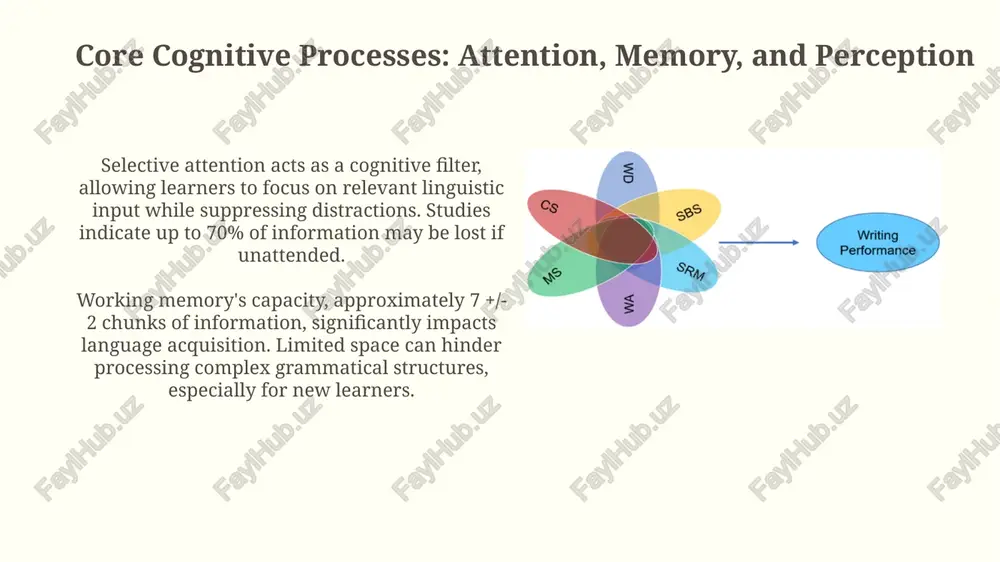
powerpoint presentation republic of uzbekistan ministry of higher education, science and innovation presentation theme: cognitive factors in language learning prepared by: 1. cognitive foundations of language learning 2. key cognitive processes and language acquisition 3. applications and implications for language education plan: introduction: the cognitive landscape of language learning cognitive language learning involves intricate mental processes, including attention, memory, and perception, shaping how individuals acquire and process linguistic input, impacting proficiency levels. working memory capacity, a core executive function, significantly impacts language acquisition. learners with a larger capacity can handle more complex syntactic structures and vocabulary acquisition, with approximately 7+/- 2 chunks. core cognitive processes: attention, memory, and perception selective attention acts as a cognitive filter, allowing learners to focus on relevant linguistic input while suppressing distractions. studies indicate up to 70% of information may be lost if unattended. working memory's capacity, approximately 7 +/- 2 chunks of information, significantly …
2 / 10
ained effort and strategy adoption. metacognition, like self-monitoring comprehension, enables learners to assess their understanding with 85% accuracy, improving self-regulation and strategy adjustment using techniques. cognitive load, transfer, and interference in language learning high cognitive load, especially with unfamiliar grammar or vocabulary, can hinder learning. reducing extraneous load by 25% improves processing new linguistic information effectively. positive transfer occurs when similarities between l1 and l2 facilitate learning; negative transfer, or interference, arises when differing linguistic structures cause errors in l2 pronunciation. individual differences and neurological aspects of language learning neurological studies show varying gray matter volume in broca's and wernicke's areas correlates with language proficiency, highlighting individual brain structure differences linked to l2 learning aptitude. executive functions, such as inhibition control and cognitive shifting, show varying activation levels across individuals, influencing the ability to manage interference from l1 while processing l2. implications for pedagogy and assessment: fostering cognitive growth teachers …
3 / 10
cognitive factors in language learning - Page 3
4 / 10
cognitive factors in language learning - Page 4
5 / 10
cognitive factors in language learning - Page 5

Ko'proq o'qimoqchimisiz?

Barcha 10 sahifani Telegram orqali bepul yuklab oling.

To'liq faylni yuklab olish

"cognitive factors in language learning" haqida

powerpoint presentation republic of uzbekistan ministry of higher education, science and innovation presentation theme: cognitive factors in language learning prepared by: 1. cognitive foundations of language learning 2. key cognitive processes and language acquisition 3. applications and implications for language education plan: introduction: the cognitive landscape of language learning cognitive language learning involves intricate mental processes, including attention, memory, and perception, shaping how individuals acquire and process linguistic input, impacting proficiency levels. working memory capacity, a core executive function, significantly impacts language acquisition. learners with a larger capacity can handle more complex syntactic structures and vocabulary acquisition, with a...

Bu fayl PPTX formatida 10 sahifadan iborat (1,2 MB). "cognitive factors in language learning"ni yuklab olish uchun chap tomondagi Telegram tugmasini bosing.

Teglar: cognitive factors in language l… PPTX 10 sahifa Bepul yuklash Telegram