problems of lexcology

PPTX 17 pages 400.0 KB Free download

Page preview (5 pages)

Scroll down 👇
1 / 17
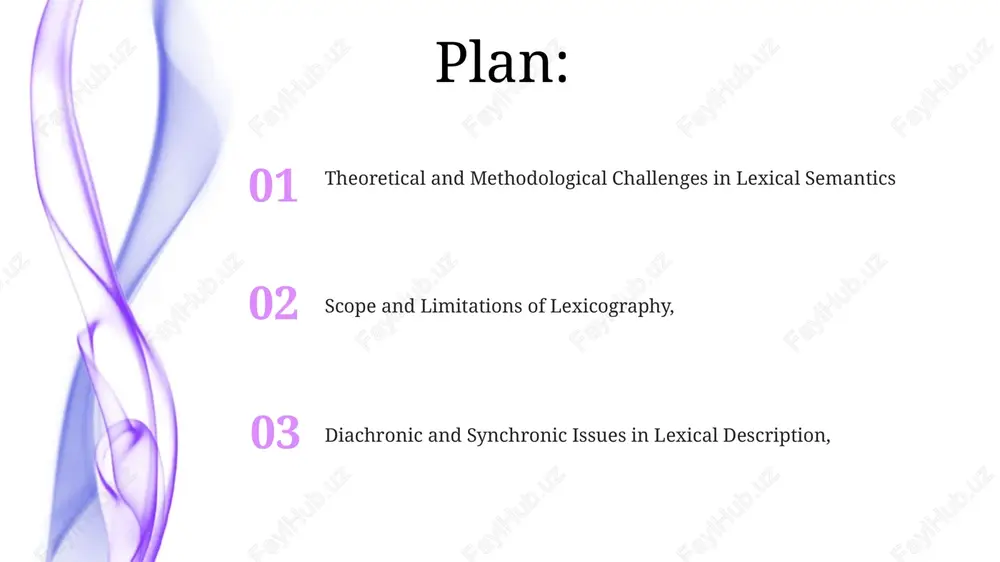
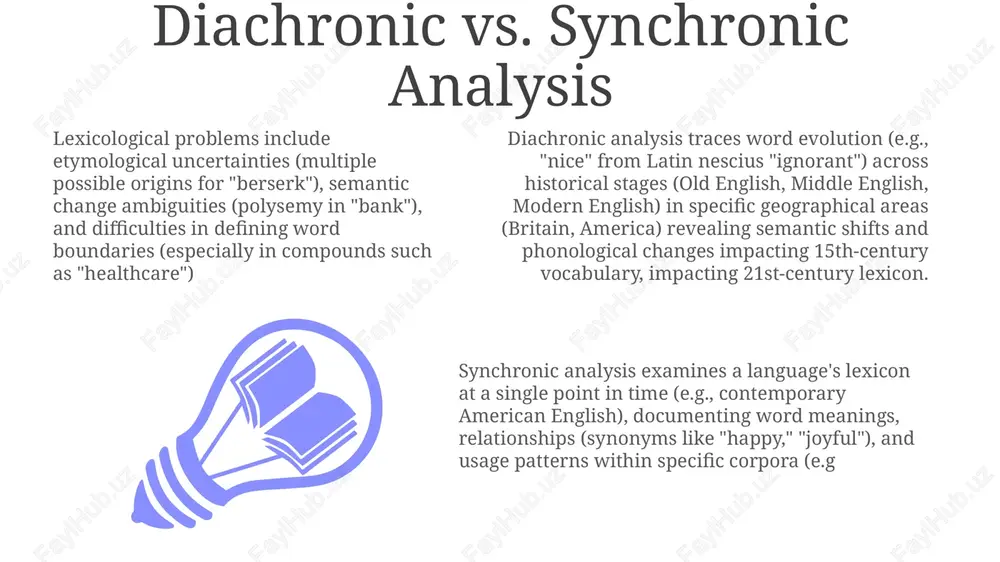
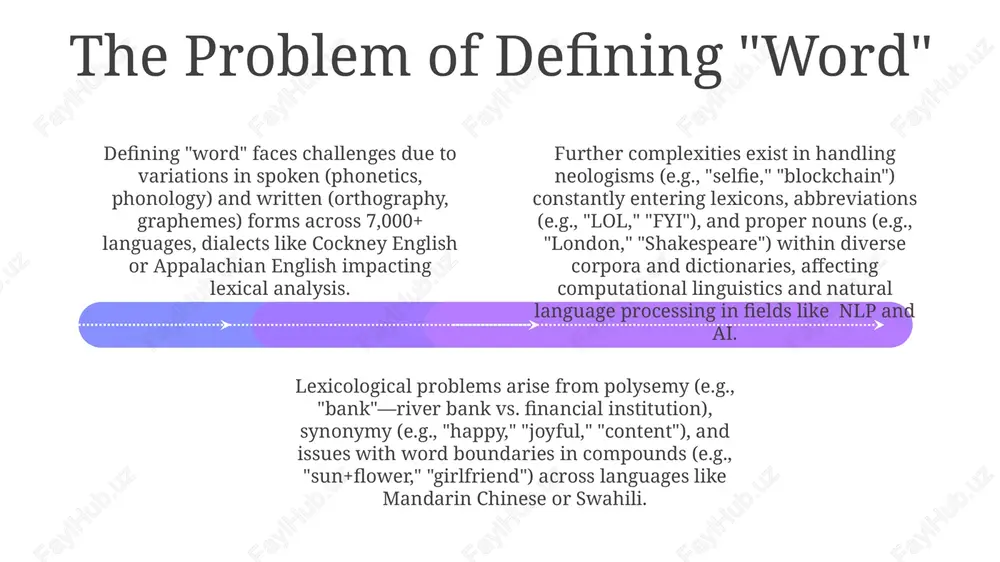
powerpoint presentation problems of lexcology .... 01 theoretical and methodological challenges in lexical semantics 02 scope and limitations of lexicography, 03 diachronic and synchronic issues in lexical description, plan: diachronic vs. synchronic analysis diachronic analysis traces word evolution (e.g., "nice" from latin nescius "ignorant") across historical stages (old english, middle english, modern english) in specific geographical areas (britain, america) revealing semantic shifts and phonological changes impacting 15th-century vocabulary, impacting 21st-century lexicon. lexicological problems include etymological uncertainties (multiple possible origins for "berserk"), semantic change ambiguities (polysemy in "bank"), and difficulties in defining word boundaries (especially in compounds such as "healthcare") synchronic analysis examines a language's lexicon at a single point in time (e.g., contemporary american english), documenting word meanings, relationships (synonyms like "happy," "joyful"), and usage patterns within specific corpora (e.g the problem of defining "word" defining "word" faces challenges due to variations in spoken (phonetics, phonology) and written (orthography, graphemes) …
2 / 17
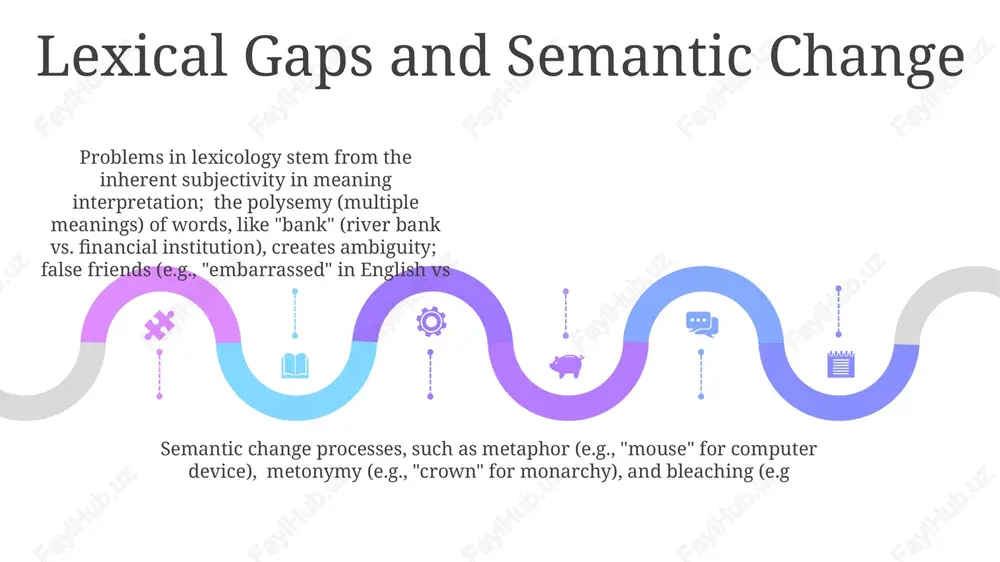
ch as metaphor (e.g., "mouse" for computer device), metonymy (e.g., "crown" for monarchy), and bleaching (e.g problems in lexicology stem from the inherent subjectivity in meaning interpretation; the polysemy (multiple meanings) of words, like "bank" (river bank vs. financial institution), creates ambiguity; false friends (e.g., "embarrassed" in english vs corpus linguistics and lexical data lexical ambiguity poses significant challenges; polysemous words (e.g., "bank"—financial vs. riverbank) require computational techniques (word sense disambiguation algorithms) for accurate analysis within corpora building robust lexical databases (e.g., wordnet, framenet) requires addressing issues like synonymy, antonymy, and hyponymy. evaluating the accuracy of these resources against empirical corpus data is crucial corpus linguistics, employing vast digital text collections (e.g., the british national corpus, coca), reveals patterns in word usage (e.g., collocations like "strong coffee," frequency distributions of "happy" vs. "joyful" in different geographical locations—american english vs. british english— impacting lexical studies representing lexical knowledge developing comprehensive lexical …
3 / 17
xical meaning. novel evaluation strategies, incorporating human judgment and tasks reflecting real-world applications (e.g lexical knowledge acquisition from unstructured data (e.g computational lexico-semantic resource construction faces challenges like polysemy disambiguation (e.g., "bank" – financial vs. river) requiring advanced nlp techniques and large, multilingual corpora (e.g., the opensubtitles2018 corpus containing 1.6b sentences from 60+ languages). data sparsity, especially for low-resource languages (e.g the impact of language contact language contact in the 19th-century american southwest resulted in significant lexical borrowing between spanish (e.g., ranchero, vaquero) and various indigenous languages like navajo and apache, impacting vocabulary related to livestock, landscape, and social structures across arizona, new mexico, and california the impact of colonial english on the lexicon of indigenous australian languages resulted in massive lexical loss and semantic shifts (e.g., the appropriation of words relating to kinship systems, flora, and fauna) lexical clashes between english and french in canada created unique challenges for …
4 / 17
financial institution) having multiple related meanings, causing lexical ambiguity in contexts like "he deposited money in the bank" (2 meanings, 2 locations: river/financial). this contrasts with homonymy, where two words (e.g dealing with neologisms and obsolescence computational lexicology struggles with neologism influx (e.g., internet slang from 4chan, twitter, reddit); obsolescence involves removing outdated terms (e.g., "videocassette recorder" -vcr) from corpora & dictionaries while preserving historical context (oed, merriam-webster's archives); geographic variations in vocabulary (e.g., "soda" vs lexical databases (wordnet, framenet) need constant updating to accommodate new words and phrases (e.g the problem of synonymy and antonymy lexicographical challenges arise from polysemy (one word, multiple meanings, e.g., "bank"—river bank vs. financial institution) and homonymy (different words with same spelling/pronunciation, e.g., "bat"—flying mammal vs. baseball bat) antonymy involves exploring gradable antonyms (e.g., "hot" and "cold" on a temperature scale), complementary antonyms (e.g., "alive" and "dead"), and relational antonyms (e.g., "parent" and "child" …
5 / 17
big'/'large'), impacting semantic networks & thesauruses like wordnet lexicology's scope encompasses word formation processes (derivation, compounding) in english, encompassing approximately 200,000+ lexical items, but excludes detailed phonetic/phonological analysis and sociolinguistic variation across dialects like cockney or appalachian english dealing with idioms and collocations 01 02 03 2. idiom comprehension requires recognizing non-compositional meanings (e.g., "break a leg" in us theater), demanding extensive exposure to authentic language use from diverse sources (e.g., novels, films, conversations from london, new york, sydney). statistical analysis of large text corpora (e.g 3. the polysemy of words (e.g., "bank" – river bank, financial institution) complicates lexical choice, particularly within specific domains (e.g., legal terminology). 30+ common errors in using idioms and collocations are documented in various esl/efl textbooks (e.g., oxford learner's dictionaries) 1. lexical ambiguity poses significant challenges (e.g., "kick the bucket," "spill the beans") in 25+ languages, necessitating deep understanding of cultural contexts (e.g., british …

Want to read more?

Download all 17 pages for free via Telegram.

Download full file

About "problems of lexcology"

powerpoint presentation problems of lexcology .... 01 theoretical and methodological challenges in lexical semantics 02 scope and limitations of lexicography, 03 diachronic and synchronic issues in lexical description, plan: diachronic vs. synchronic analysis diachronic analysis traces word evolution (e.g., "nice" from latin nescius "ignorant") across historical stages (old english, middle english, modern english) in specific geographical areas (britain, america) revealing semantic shifts and phonological changes impacting 15th-century vocabulary, impacting 21st-century lexicon. lexicological problems include etymological uncertainties (multiple possible origins for "berserk"), semantic change ambiguities (polysemy in "bank"), and difficulties in defining word boundaries (especially in com...

This file contains 17 pages in PPTX format (400.0 KB). To download "problems of lexcology", click the Telegram button on the left.
Tags: problems of lexcology PPTX 17 pages Free download Telegram