typology of morphological level of english and native languages

PPTX 21 sahifa 3,2 MB Bepul yuklash

Sahifa ko'rinishi (5 sahifa)

Pastga aylantiring 👇
1 / 21
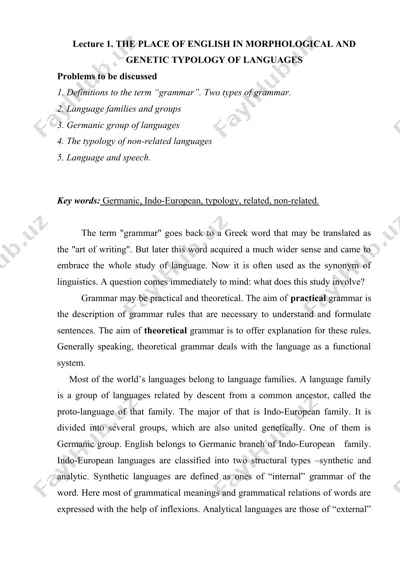
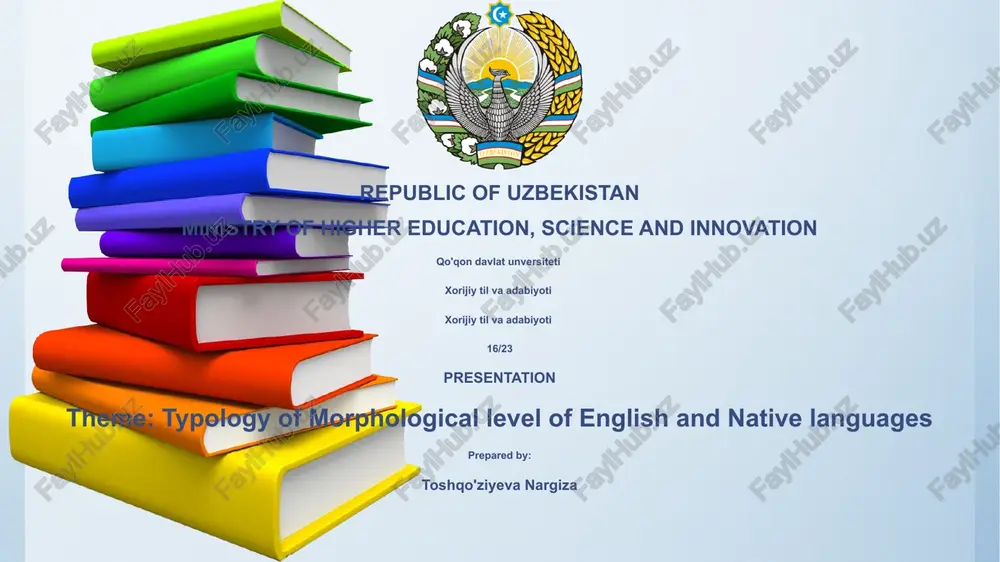
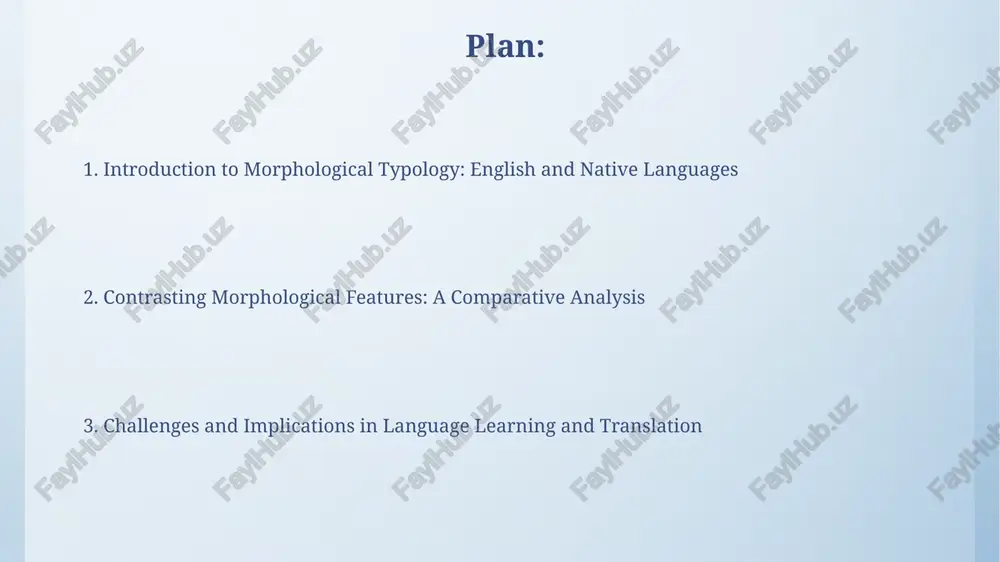
powerpoint presentation republic of uzbekistan ministry of higher education, science and innovation qo'qon davlat unversiteti xorijiy til va adabiyoti xorijiy til va adabiyoti 16/23 presentation theme: typology of morphological level of english and native languages prepared by: toshqo'ziyeva nargiza 1. introduction to morphological typology: english and native languages 2. contrasting morphological features: a comparative analysis 3. challenges and implications in language learning and translation plan: introduction: morphology and language typology morphology studies the internal structure of words, focusing on morphemes, the smallest meaningful units. this involves analyzing how words are formed using processes like affixation and compounding, revealing language-specific patterns. language typology classifies languages based on structural similarities, including morphological features. categorizing languages as isolating, agglutinative, fusional, or polysynthetic provides insights into their word formation strategies. isolating (analytic) languages: english vs. native examples english, while not purely isolating, features analytic tendencies using separate words like 'do' in questions. around 70% …
2 / 21
allenges in segmentation fusional languages pose challenges, as single morphemes often encode multiple grammatical categories (e.g., gender, number, case) simultaneously, making segmentation a complex 3-step process. identifying morpheme boundaries is difficult because the phonological form of a fusional morpheme can change depending on the surrounding sounds, creating 2 ambiguous segmentation options. polysynthetic languages: complex word formation polysynthetic languages, like chukchi, exhibit high morpheme-per-word ratios, often exceeding 5 or 6, encoding multiple grammatical functions within single complex words. in polysynthetic languages, a single word may function as an entire sentence, incorporating the verb root, subject, object, and adverbial modifiers, resembling a concise 1-word phrase. morphological richness: a comparative analysis english, with a low morpheme-per-word ratio averaging around 1.6, relies more on analytical strategies compared to highly synthetic languages like turkish which shows richer morphology. agglutinative languages, like finnish, have a high morpheme-per-word ratio; affixes are clearly separable, each expressing a single …
3 / 21
toward the proposition. for example, the subjunctive shows hypothetical actions via verb conjugations. derivational morphology: word formation processes affixation is a core process; adding prefixes like "un-" (reversal) or suffixes like "-ness" (state) to a base form creates new words, shifting meaning or part of speech, exemplified by "unhappy" or "happiness." conversion, also known as zero derivation, involves changing a word's grammatical category without morphological change; the noun "email" becoming the verb "to email" showcases this word formation process's efficiency. inflectional morphology: grammatical categories inflectional morphology in english indicates grammatical relations through eight primary categories, such as number (singular vs. plural) and tense (past, present, future), without altering the word's core meaning. case, a grammatical category marking a word's function in a sentence, is reduced in english but evident in pronouns (e.g., "i" vs. "me"); many languages utilize 6+ cases extensively. morphological alignment: nominative-accusative vs. ergative-absolutive nominative-accusative languages, like english, …
4 / 21
itially. thank you for your attention image4.png image5.png image6.jpg image7.jpg image8.jpg image9.jpg image10.jpg image11.jpg image12.jpg image13.jpg image14.jpg image15.jpg image16.jpg image17.jpg image3.jpeg
5 / 21
typology of morphological level of english and native languages - Page 5

Ko'proq o'qimoqchimisiz?

Barcha 21 sahifani Telegram orqali bepul yuklab oling.

To'liq faylni yuklab olish

"typology of morphological level of english and native languages" haqida

powerpoint presentation republic of uzbekistan ministry of higher education, science and innovation qo'qon davlat unversiteti xorijiy til va adabiyoti xorijiy til va adabiyoti 16/23 presentation theme: typology of morphological level of english and native languages prepared by: toshqo'ziyeva nargiza 1. introduction to morphological typology: english and native languages 2. contrasting morphological features: a comparative analysis 3. challenges and implications in language learning and translation plan: introduction: morphology and language typology morphology studies the internal structure of words, focusing on morphemes, the smallest meaningful units. this involves analyzing how words are formed using processes like affixation and compounding, revealing language-specific patterns. langua...

Bu fayl PPTX formatida 21 sahifadan iborat (3,2 MB). "typology of morphological level of english and native languages"ni yuklab olish uchun chap tomondagi Telegram tugmasini bosing.
Teglar: typology of morphological level… PPTX 21 sahifa Bepul yuklash Telegram