phonetics vs. phonology: understanding the sounds behind the language
Sahifa ko'rinishi (5 sahifa)
Pastga aylantiring 👇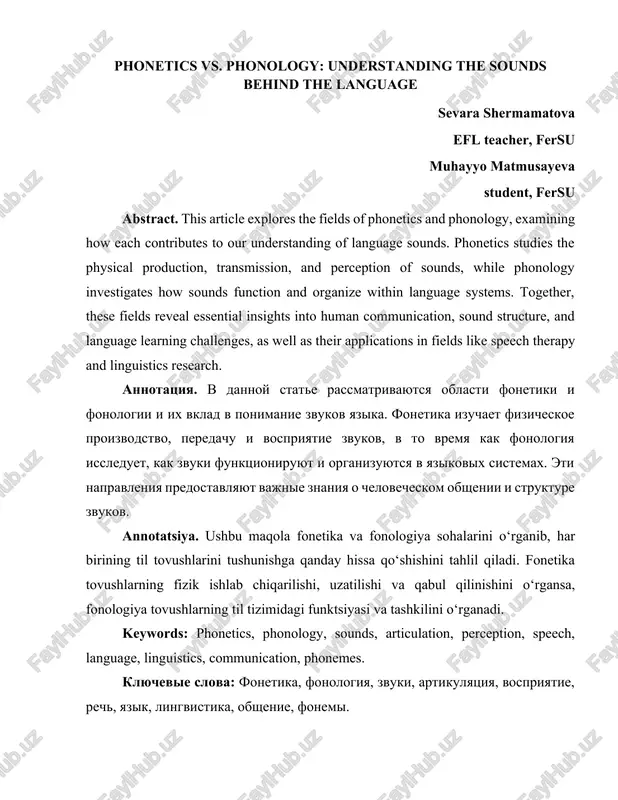
![al properties of sounds, phonology delves into how sounds function and are organized within languages [1,p.]. phonetics focuses on the articulation, acoustics, and auditory processing of sounds. for example, articulatory phonetics categorizes sounds by where and how they are produced in the vocal tract [2,p.]. it examines all sounds that human speech can produce, offering tools to describe them precisely. acoustic phonetics, meanwhile, measures the sound waves produced by speech, analyzing frequency, pitch, and duration to understand how sounds transmit. auditory phonetics studies how listeners perceive sounds, contributing to areas such as hearing science and speech therapy [3,p.]. in contrast, phonology is concerned with sounds’ roles within specific languages. phonology identifies the meaningful units, or phonemes, in languages, revealing how these units can alter meaning. for instance, in english, replacing /p/ with /b/ changes "pat" to "bat," altering the word’s meaning, while in some languages, these sounds may be treated …](/media/previews/pages/p2_232786.webp "phonetics vs. phonology: understanding the sounds behind the language - 2-sahifa")
![ed by directing air through a narrow opening in the teeth. acoustic phonetics examines sound waves’ properties, such as their frequency and amplitude, to understand how sounds travel through the air and are heard by the listener. researchers use spectrograms to visualize these properties, analyzing sound patterns for applications in fields like speech technology and phonetic transcription [3,p.]. auditory phonetics focuses on how sounds are perceived and processed by the brain. the study of auditory phonetics has provided insights into why certain sounds, such as tones in tonal languages, can be challenging for non-native speakers. research shows that the brain’s auditory system is conditioned to recognize native language sounds, creating barriers for learning foreign sounds that do not exist in the learner's native language [4,p.]. phonology, unlike phonetics, is concerned with the abstract and functional aspects of sounds. it examines phonemes, the smallest sound units that can differentiate words in …](/media/previews/pages/p3_232786.webp "phonetics vs. phonology: understanding the sounds behind the language - 3-sahifa")

Ko'proq o'qimoqchimisiz?
Barcha 5 sahifani Telegram orqali bepul yuklab oling.
To'liq faylni yuklab olish"phonetics vs. phonology: understanding the sounds behind the language" haqida
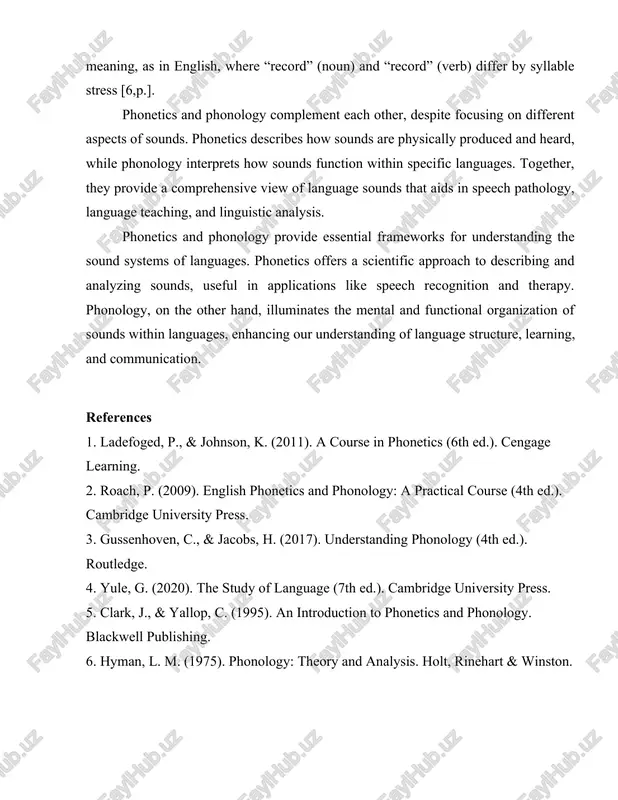
phonetics vs. phonology: understanding the sounds behind the language sevara shermamatova efl teacher, fersu muhayyo matmusayeva student, fersu abstract. this article explores the fields of phonetics and phonology, examining how each contributes to our understanding of language sounds. phonetics studies the physical production, transmission, and perception of sounds, while phonology investigates how sounds function and organize within language systems. together, these fields reveal essential insights into human communication, sound structure, and language learning challenges, as well as their applications in fields like speech therapy and linguistics research. annotatsiya. v dannoy state rassmatrivayutsya oblasti fonetiki i fonologii i ix vklad v ponimanie zvukov yazika. fonetika izuchaet ...
Bu fayl DOCX formatida 5 sahifadan iborat (17,6 KB). "phonetics vs. phonology: understanding the sounds behind the language"ni yuklab olish uchun chap tomondagi Telegram tugmasini bosing.
 PPTX
PPTX
 DOCX
DOCX
 PPTX
PPTX
 PPTX
PPTX
 DOCX
DOCX
 DOC
DOC
 PPTX
PPTX
 DOCX
DOCX
 DOC
DOC
 DOCX
DOCX
 DOCX
DOCX
 DOCX
DOCX