various forms of business

DOCX 10 pages 16.9 KB Free download

Page preview (5 pages)

Scroll down 👇
1 / 10
republic of uzbekistan ministry of higher education, science and innovation mustaqil ish theme: various forms of business prepared by: abdunabiyev abduvali introduction 1. sole proprietorships and partnerships 2. corporations: c-corps, s-corps, and llcs 3. other business structures and considerations conclusion references introduction to business forms business forms, such as sole proprietorships, offer simple structures with minimal setup, often requiring fewer than 5 key regulatory compliances compared to larger entities. limited liability companies (llcs) blend partnership flexibility with corporate liability protection, shielding personal assets from business debts, offering a hybrid structure around 7 specific clauses. corporations, like c-corps, are distinct legal entities, offering perpetual existence and potential for raising capital through stock sales, which often need over 10 documented requirements. sole proprietorship: simplicity and liability a major drawback is unlimited liability; the owner's personal assets are at risk for business debts, unlike in an llc where liability is typically limited to …
2 / 10
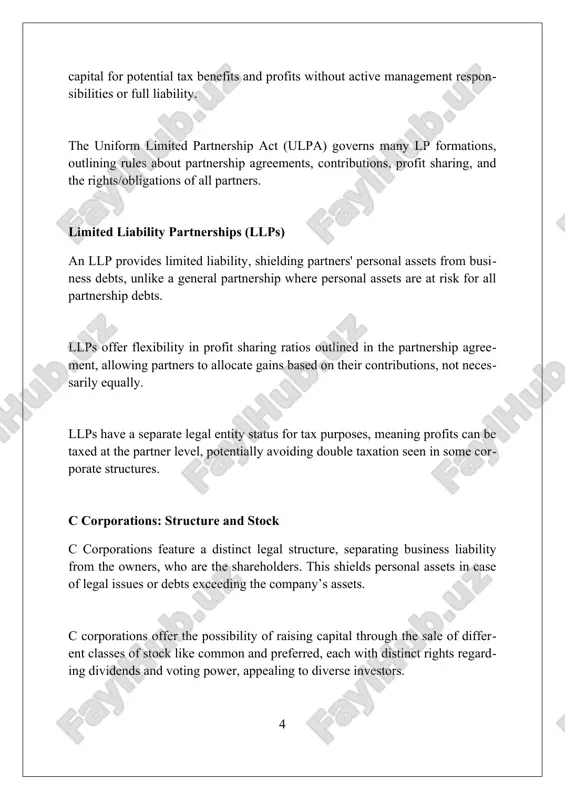
0, ensuring fair distribution based on capital contributions, skills, and agreed-upon responsibilities. limited partnerships (lps) limited partnerships require at least one general partner who manages daily operations and bears personal liability for all business debts, unlike limited partners with passive roles. lps are useful for ventures like real estate, where limited partners can invest capital for potential tax benefits and profits without active management responsibilities or full liability. the uniform limited partnership act (ulpa) governs many lp formations, outlining rules about partnership agreements, contributions, profit sharing, and the rights/obligations of all partners. limited liability partnerships (llps) an llp provides limited liability, shielding partners' personal assets from business debts, unlike a general partnership where personal assets are at risk for all partnership debts. llps offer flexibility in profit sharing ratios outlined in the partnership agreement, allowing partners to allocate gains based on their contributions, not necessarily equally. llps have a separate …
3 / 10
taxation s corporations utilize pass-through taxation, meaning profits and losses are reported on the owner's individual income tax return (form 1040), avoiding corporate income tax rates. shareholders in an s corp pay income tax at their individual rate on the company's profits, with form k-1 detailing their share of income, losses, deductions, and credits from the business. pass-through taxation with an s corp allows owners to pay only self-employment taxes on wages, and not on profits earned that are distributed as dividends to the owners. limited liability companies (llcs): flexibility and protection llcs offer pass-through taxation, meaning profits and losses are reported on the owner's personal income taxes at their individual rate, avoiding double taxation like in c corporations. operating agreements in llcs outline the ownership structure, member responsibilities, and profit/loss distribution, providing crucial internal governance and dispute resolution mechanisms. llcs shield personal assets from business debts and lawsuits, providing …
4 / 10
this. they rely on diverse funding sources, including individual donations, corporate sponsorships, and government grants; in 2022, charitable giving in the us reached $499.33 billion showing massive support. non-profits operate under the governance of a board of directors or trustees; these individuals are responsible for overseeing the organization's activities and ensuring adherence to its stated purpose. cooperatives (co-ops) cooperatives operate on the one-member, one-vote principle, ensuring democratic control, regardless of individual investment size, diverging from standard shareholder models with voting power based on the quantity of shares held. distributing surplus revenue, also known as profits, back to members based on their usage of the cooperative's services or products, rather than solely on capital investment, is a key feature of co-op economics. cooperatives can be structured across various sectors, ranging from agricultural co-ops supporting farmers to consumer co-ops providing goods and services at reasonable prices through collective bargaining power. franchises franchise …
5 / 10
es, potentially simpler than c-corp taxation. think long-term fundraising: corporations, specifically c-corps, can issue stock, attracting investors; sole proprietorships lack this ability, hindering major capital infusions. conclusion: the future of business structures decentralized autonomous organizations (daos) could redefine business ownership, allowing for collective decision-making via blockchain technology and smart contracts, potentially replacing traditional hierarchies. expect an increased emphasis on b corporations and benefit llcs, driven by consumer demand for socially responsible businesses, showcasing a shift towards profit and positive impact metrics. hybrid models combining elements from various structures like cooperatives and franchises, will gain traction, providing greater flexibility and adaptability in response to evolving market dynamics and regulation. conclusion choosing the right business form is crucial. it impacts liability, taxation, and administrative burden. carefully weigh options like sole proprietorships, partnerships, llcs, and corporations before deciding. references here are 7 references about various forms of business: 1. jennings, m. m. (2017). …

Want to read more?

Download all 10 pages for free via Telegram.

Download full file

About "various forms of business"

republic of uzbekistan ministry of higher education, science and innovation mustaqil ish theme: various forms of business prepared by: abdunabiyev abduvali introduction 1. sole proprietorships and partnerships 2. corporations: c-corps, s-corps, and llcs 3. other business structures and considerations conclusion references introduction to business forms business forms, such as sole proprietorships, offer simple structures with minimal setup, often requiring fewer than 5 key regulatory compliances compared to larger entities. limited liability companies (llcs) blend partnership flexibility with corporate liability protection, shielding personal assets from business debts, offering a hybrid structure around 7 specific clauses. corporations, like c-corps, are distinct legal entities, offering ...

This file contains 10 pages in DOCX format (16.9 KB). To download "various forms of business", click the Telegram button on the left.
Tags: various forms of business DOCX 10 pages Free download Telegram