tools for teaching foreign languages in the continuous education system

DOC 32 pages 176.5 KB Free download

Page preview (5 pages)

Scroll down 👇
1 / 32
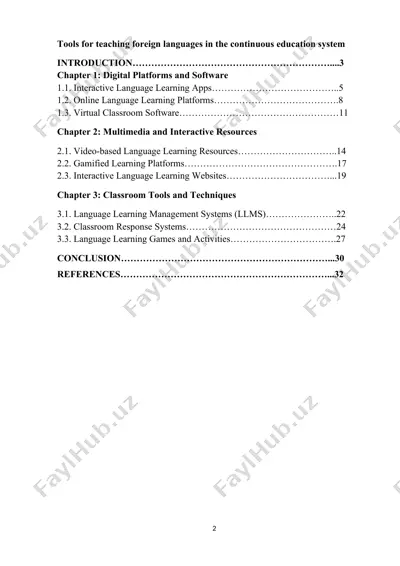
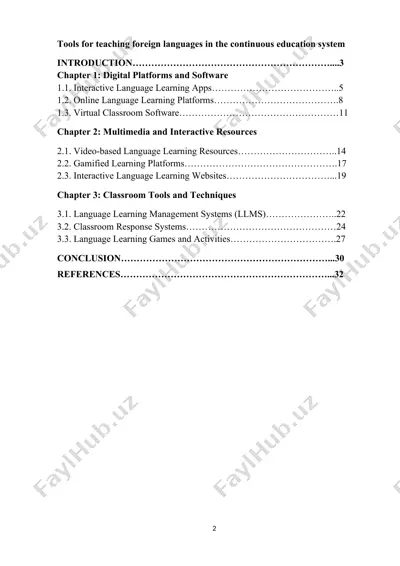
tools for teaching foreign languages in the continuous education system introduction………………………………………………………....3 chapter 1: digital platforms and software 1.1. interactive language learning apps…………………………………..5 1.2. online language learning platforms………………………………….8 1.3. virtual classroom software……………………………………………11 chapter 2: multimedia and interactive resources 2.1. video-based language learning resources…………………………..14 2.2. gamified learning platforms………………………………………….17 2.3. interactive language learning websites……………………………...19 chapter 3: classroom tools and techniques 3.1. language learning management systems (llms)…………………..22 3.2. classroom response systems…………………………………………24 3.3. language learning games and activities…………………………….27 conclusion…………………………………………………………...30 references…………………………………………………………...32 introduction in the realm of education, particularly in the domain of language learning, understanding the relevance of coursework is paramount. it serves as the foundational pillar upon which the entire educational edifice stands. as we delve into the intricacies of language education, it becomes imperative to grasp the significance of coursework, the purpose of scientific research, the tasks inherent in the theme, and the theoretical underpinnings that guide our exploration. through this introductory discourse, we …
2 / 32
linguistic proficiency but also instills critical thinking, problem-solving, and communication skills essential for navigating today's globalized world. the purpose of scientific research: scientific research in language education is imbued with a twofold purpose: to elucidate existing paradigms and to pave the way for innovative methodologies. through rigorous inquiry and empirical investigation, researchers unravel the intricacies of language acquisition, pedagogical strategies, and learner psychology. moreover, scientific research serves as the bedrock upon which evidence-based practices are built, guiding educators in the design and implementation of effective teaching methodologies. by interrogating existing assumptions and pushing the boundaries of knowledge, scientific research propels the field of language education forward, ensuring its relevance and efficacy in an ever-evolving landscape. the tasks of the theme: within the context of teaching foreign languages in the continuous education system, the theme encompasses a myriad of tasks aimed at fostering comprehensive language proficiency and cultural literacy. these tasks …
3 / 32
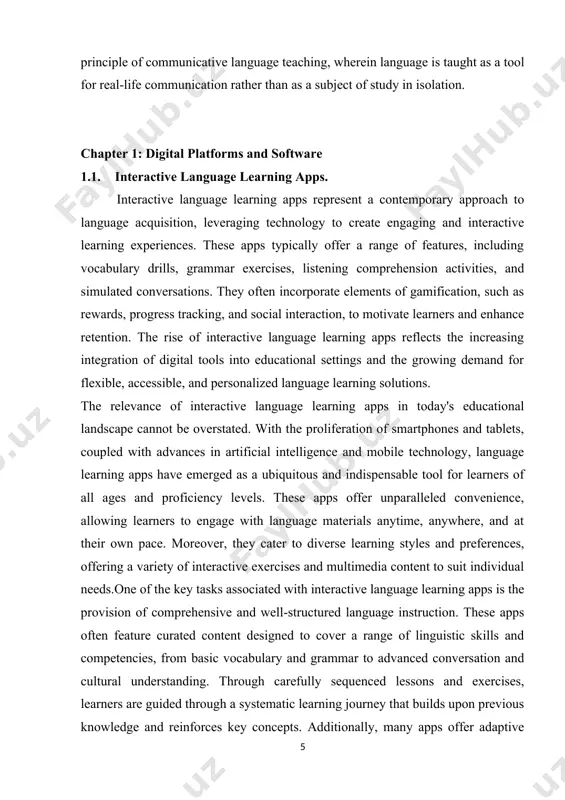
and cultural studies, the course paper seeks to provide a comprehensive understanding of language learning processes and instructional methodologies. key theoretical perspectives include communicative language teaching, socio-cultural theory, cognitive psychology, and task-based learning, among others. these theoretical underpinnings serve as the scaffolding upon which empirical investigations are conducted, guiding the interpretation of findings and the formulation of pedagogical recommendations. the methodological framework: embedded within the continuous education system is a methodological framework designed to optimize the teaching and learning of foreign languages. this framework encompasses a diverse array of pedagogical approaches, instructional strategies, and assessment techniques tailored to meet the diverse needs of learners. central to this framework is the principle of communicative language teaching, wherein language is taught as a tool for real-life communication rather than as a subject of study in isolation. chapter 1: digital platforms and software 1.1. interactive language learning apps. interactive language learning apps represent …
4 / 32
ith advances in artificial intelligence and mobile technology, language learning apps have emerged as a ubiquitous and indispensable tool for learners of all ages and proficiency levels. these apps offer unparalleled convenience, allowing learners to engage with language materials anytime, anywhere, and at their own pace. moreover, they cater to diverse learning styles and preferences, offering a variety of interactive exercises and multimedia content to suit individual needs.one of the key tasks associated with interactive language learning apps is the provision of comprehensive and well-structured language instruction. these apps often feature curated content designed to cover a range of linguistic skills and competencies, from basic vocabulary and grammar to advanced conversation and cultural understanding. through carefully sequenced lessons and exercises, learners are guided through a systematic learning journey that builds upon previous knowledge and reinforces key concepts. additionally, many apps offer adaptive learning algorithms that personalize the learning experience based …
5 / 32
nd technological backgrounds. methodologically, interactive language learning apps draw upon a combination of theories and approaches from language acquisition research, cognitive psychology, and instructional design. these apps often employ principles of spaced repetition, retrieval practice, and feedback mechanisms to optimize learning outcomes and retention. by leveraging multimedia elements such as audio recordings, images, and videos, they provide multimodal input that appeals to different learning modalities and enhances comprehension. moreover, many apps incorporate social learning features, such as forums, chatrooms, and language exchange platforms, to foster peer interaction, collaboration, and motivation. in addition to their instructional role, interactive language learning apps also serve as assessment tools, allowing learners to gauge their progress and proficiency levels. through quizzes, quizzes, and performance tracking features, learners can monitor their learning trajectory, identify areas of weakness, and set goals for improvement. some apps also offer proficiency tests and certifications, providing learners with tangible evidence of …

Want to read more?

Download all 32 pages for free via Telegram.

Download full file

About "tools for teaching foreign languages in the continuous education system"

tools for teaching foreign languages in the continuous education system introduction………………………………………………………....3 chapter 1: digital platforms and software 1.1. interactive language learning apps…………………………………..5 1.2. online language learning platforms………………………………….8 1.3. virtual classroom software……………………………………………11 chapter 2: multimedia and interactive resources 2.1. video-based language learning resources…………………………..14 2.2. gamified learning platforms………………………………………….17 2.3. interactive language learning websites……………………………...19 chapter 3: classroom tools and techniques 3.1. language learning management systems (llms)…………………..22 3.2. classroom response systems…………………………………………24 3.3. language learning games and activities…………………………….27 conclusion…………………………………………………………...30 references……………………...

This file contains 32 pages in DOC format (176.5 KB). To download "tools for teaching foreign languages in the continuous education system", click the Telegram button on the left.
Tags: tools for teaching foreign lang… DOC 32 pages Free download Telegram