types of adverbs and their problems
Предварительный просмотр (5 стр.)
Прокрутите вниз 👇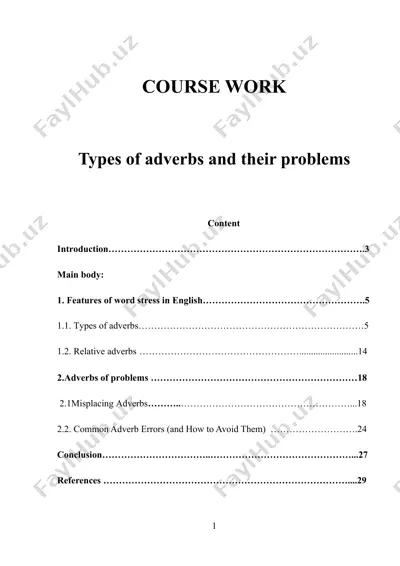
![, preposition, or sentence. an adverb is a word, often an expression that generally modifies a verb, adjective, another adverb, determiner, clause, preposition, or sentence. the topic of the title is far from exhausted for research, although the main parameters of this first word of the work of art are indicated.[footnoteref:1] adverbs typically express manner, place, time, frequency, degree, level of certainty, etc., answering questions such as how, when, where, to what extent etc. [1: arnold, i.v. the importance of a strong position for the interpretation of an artistic text / i.v. arnold. – moscow, 1978 - p. 24 - 27] · jane sang loudly (loudly modifies the verb sang-manner of singing) · she left it here (here modifies the verb phrase left it- indicating place) · i worked hard yesterday (yesterday modifies the verb worked-time) · they often make mistakes (often modifies the verb phrase make mistakes-frequency) · he …](/media/previews/pages/preview_Ml3erPg.webp "types of adverbs and their problems - Страница 3")
![ent is happening. they can be recognized by asking the question ‘how often’. examples of adverbs of frequency: seldom, rarely, never, often, weekly, monthly, yearly, annually, usually, sometimes, occasionally, constantly, frequently, etc. .[footnoteref:2] [2: kulibina, n.v. literary text in linguodidactic understanding / n.v. kulibina. – m.: higher. school, 2001. -356 p.] · adverbs of degree: these adverbs are used to indicate how intense an action of quality is. examples of adverbs of degree: too, extremely, much, more, most, little, less, incredibly, totally, greatly, hardly, deeply, very, barely, etc. · conjunctive adverbs: these adverbs are seen to act like a conjunction to link two sentences together. they connect two or more sentences. examples of conjunctive adverbs: however, nevertheless, meanwhile, therefore, instead, likewise, notably, subsequently, rather, namely, on the other hand, incidentally, in addition to, etc. there are many uses of tense. in english grammar, we use present tense to talk about …](/media/previews/pages/preview_AGoR6Vw.webp "types of adverbs and their problems - Страница 4")
![-stative verbs are used in the simple present tense when a person is telling a story or writing a narrative.however, we do often use both stative and non-stative verbs in the simple present tense to state facts because they are true right now as in dogs bark or i play basketball. 2. we use simple present tense to refer to an action or situation that happens regularly.for example, jessica attends her classes, tells us that she is regular in attending classes. .[footnoteref:4]something to keep in mind is that if a sentence is describing a temporary action or state that will continue into the future, we do not use a simple present tense verb. for example, the sentences my dog is getting fat or i am eating chips, are not using a verb in the simple present tense. instead, these sentences use verb phrases that are in a verb tense known …](/media/previews/pages/preview_TdxsDmE.webp "types of adverbs and their problems - Страница 5")
О "types of adverbs and their problems"
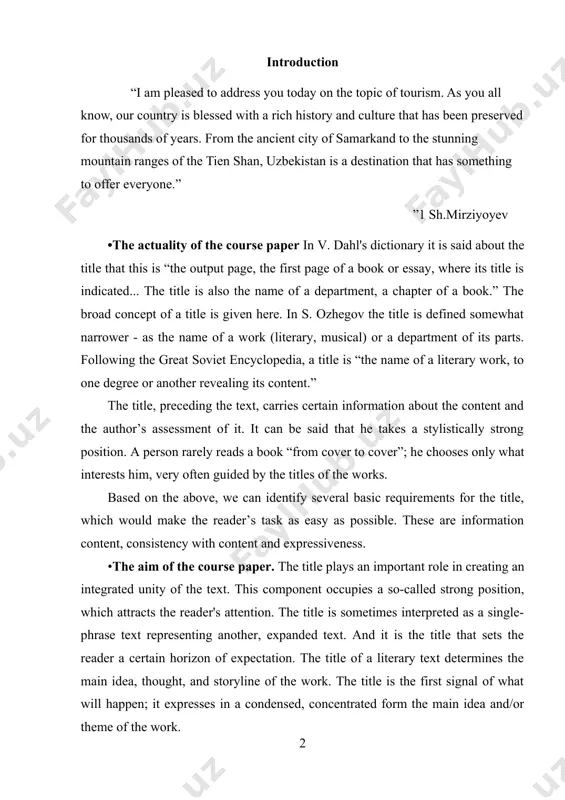
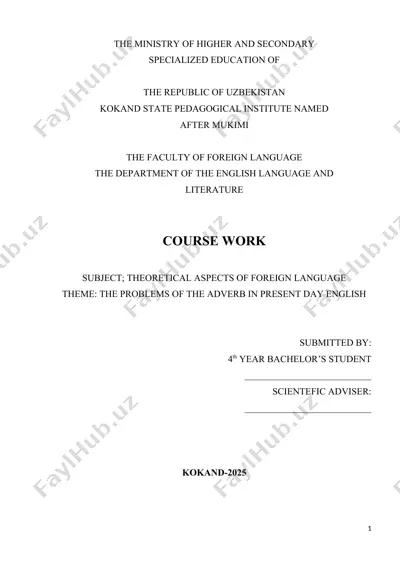
course work types of adverbs and their problems content introduction……………………………………………………………………….3 main body: 1. features of word stress in english…………………………………………….5 1.1. types of adverbs………………………………………………………………5 1.2. relative adverbs …………………………………………….........................14 2.adverbs of problems …………………………………………………………18 2.1misplacing adverbs………..………………………………………………...18 2.2. common adverb errors (and how to avoid them) ……………………….24 conclusion……………………………..………………………………………...27 references ……………………………………………………………………....29 introduction “i am pleased to address you today on the topic of tourism. as you all know, our country is blessed with a rich history and culture that has been preserved for thousands of years. from the ancient city of samarkand to the stunning mountain ranges of the tien ...
Этот файл содержит 29 стр. в формате DOCX (68,7 КБ). Чтобы скачать "types of adverbs and their problems", нажмите кнопку Telegram слева.
 DOC
DOC
 DOCX
DOCX
 DOCX
DOCX
 DOCX
DOCX
 DOCX
DOCX
 DOCX
DOCX
 DOC
DOC
 DOCX
DOCX
 DOC
DOC
 DOCX
DOCX
 DOCX
DOCX
 DOCX
DOCX