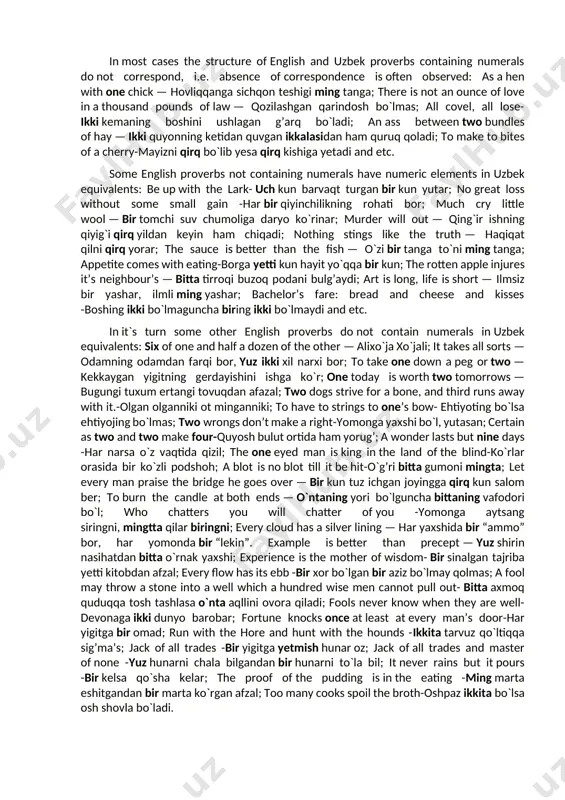
english proverbs with numeral component and their uzbek equivalents
Предварительный просмотр (4 стр.)
Прокрутите вниз 👇![english proverbs with numeral component and their uzbek equivalents pardayeva zulayho toshtemirovna termez state university uzbekistan e-mail: pardaeva93@bk.ru a proverb (from latin: proverbium) is a simple and concrete saying popularly known and repeated, which expresses a truth, based on common sense or the practical experience of humanity. they are often metaphorical. a proverb that describes a basic rule of conduct may also be known as a maxim. if a proverb is distinguished by particularly good phrasing, it may be known as an aphorism [4]. proverbs are often studied as a unit of paremiology. paremiology (from greek παροιμία — paroimía, “proverb”) and can be dated back as far as aristotle. paremiography, on the other hand, is the collection of proverbs. a prominent proverb scholar in the united states is wolfgang mieder. he has written or edited over 50 books on the subject, edits the journal proverbium (journal), has written innumerable articles …](/media/previews/pages/preview_JFfSzPV.webp "english proverbs with numeral component and their uzbek equivalents - Страница 1")
![ern of loan-words — many loan-proverbs appear besides the indigenous ones. a considerable part ot them can be traced back to the classical literature of the region’s past, in europe the greco-roman classics, and in the far east to the sanskrit and korean classics. local proverbs — in a cultural region often internal differences appear, the classics (e.g. the bible or the confucian analects) are not equally regarded as a source of proverbs in every language. geographical vicinity gives also rise to another set of common local proverbs. these considerations are illustrated in several european and far-eastern languages, as english and korean [ 2, p. 153]. proverbs are often borrowed across lines of language, religion, and even time. for example, a proverb of the approximate form “no flies enter a mouth that is shut” is currently found in spain, ethiopia, and many countries in between. it is embraced as a …](/media/previews/pages/preview_coXPSy7.webp "english proverbs with numeral component and their uzbek equivalents - Страница 2")

О "english proverbs with numeral component and their uzbek equivalents"
english proverbs with numeral component and their uzbek equivalents pardayeva zulayho toshtemirovna termez state university uzbekistan e-mail: pardaeva93@bk.ru a proverb (from latin: proverbium) is a simple and concrete saying popularly known and repeated, which expresses a truth, based on common sense or the practical experience of humanity. they are often metaphorical. a proverb that describes a basic rule of conduct may also be known as a maxim. if a proverb is distinguished by particularly good phrasing, it may be known as an aphorism [4]. proverbs are often studied as a unit of paremiology. paremiology (from greek παροιμία — paroimía, “proverb”) and can be dated back as far as aristotle. paremiography, on the other hand, is the collection of proverbs. a …
Этот файл содержит 4 стр. в формате DOCX (20,1 КБ). Чтобы скачать "english proverbs with numeral component and their uzbek equivalents", нажмите кнопку Telegram слева.
 DOCX
DOCX
 DOC
DOC
 DOCX
DOCX
 DOC
DOC
 DOCX
DOCX
 DOC
DOC
 DOCX
DOCX
 DOCX
DOCX
 DOCX
DOCX
 DOCX
DOCX
 DOCX
DOCX
 DOC
DOC