introduction to literature

PPT 61 sahifa 1,5 MB Bepul yuklash

Sahifa ko'rinishi (5 sahifa)

Pastga aylantiring 👇
1 / 61
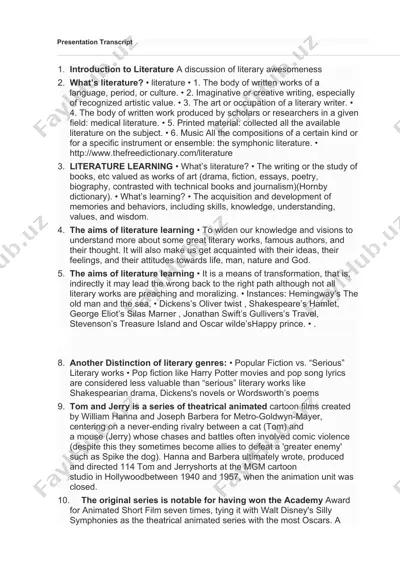
introduction to literature introduction to literature why do we read? information fun but is all fiction literature? literature is concerned with the content and the form, in other words not only the story but the way it is written. what is literature? literature: a body of written works. the name is often applied to those imaginative works of poetry and prose distinguished by the intentions of their authors and the excellence of their execution. (encyclopedia britannica, micropedia) literature: the collective writings proper to any language or nations. the term literature is site of ideological conflict; it may refer to those canonical works in the genres, ie., traditional works considered to be artistic or it may also refer to the total sum of writings, including letters, memoirs, comics, historical writings, etc. (adapted from the cambridge encyclopedia) or literature: an intimate experience of an author carefully expressed in concrete images through the …
2 / 61
a (2001) modern literary theory: a reader (4th ed), london, arnold literature all writing in prose and poetry having permanent value, excellent format, an imaginative or critical characteristic, and heightened emotional effect. literature literature is referred to as the entirety of written expression, with the restriction that not every written document can be categorized as literature in the more exact sense of the word. (klarer p.1) literature etymologically: the latin word “litteratura” is derived from “littera” (letter), which is the smallest element of alphabetical writing. the word text is related to “textile” and can be translated as “fabric”: just as single threads form a fabric, so words and sentences form a meaningful and coherent text. literature literature or text as cultural and historical phenomena and to investigate the conditions of their production and reception. pre historic painting in the cave wall the beginning of literature not only pictorial but acoustic …
3 / 61
looked up at any time. methods of literary and textual criticism are, therefore, frequently applied to the cinema and acoustic media. computer hypertexts and networks/ the internet are the latest hybrids of the textual and various media  writing is linked to sounds, pictures or even video clips within an interdependent network. the written medium is obviously the main concern in the study of literature or texts  the stage, painting, film, music or even computer networks. genre a genre is a french word meaning “type” or “kind” of literature. genre the genres of literature we will study are poetry, drama, fiction (short story, non-fiction, and novel) and film. prose and poetry prose and poetry are two kinds of writing formats in standard american english. prose prose is straight writing in paragraph form (e.g. newspaper, novels, magazines). poetry poetry is a particular arrangement of words on a page for heightened …
4 / 61
ack of the huge lorry. although the sun was pouring its inferno down on them without any respite, the breeze that they felt because of the lorry’s speed lessened the intensity of the heat. abu qais had climbed up on top with marwan, and they sat side by side on the edge of the tank. they had drawn lots, and it was assad’s turn to sit beside the driver----------- modern fiction novels & short stories verisimilitude: realistic (life-like) presentation of events real (human characters) minute details not reality but an illusion of reality modern fiction is the genre of the middle class. the industrial revolution created the middle class and the novel became the new form of literature which represented the difficulties encountering middle class people. history, biography/autobiography & fiction history: an objective presentation of reality biography/autobiography: a subjective presentation of reality. fiction: an illusion of reality. elements of fiction …
5 / 61
me, mine, we, us, our) - the narrator is the main character who tells his/her own story. point of view ii. third person point of view (uses personal pronouns: he, she, it, they, them, etc.) - this narrator is an outside narrator. third person point of view a. third person: objective this narrator is like a news reporter. he tells us the facts only. he cannot enter into the thoughts of the characters. third person point of view b. third person: limited this narrator can see into the mind of only one character. third person point of view c. third person: omniscient this narrator can relate the thoughts of all the characters. objective point of view the objective point of view is the point of view from a distanced, informational perspective, as in a news report. subjective point of view the subjective point of view involves a personal perspective. the …

Ko'proq o'qimoqchimisiz?

Barcha 61 sahifani Telegram orqali bepul yuklab oling.

To'liq faylni yuklab olish

"introduction to literature" haqida

introduction to literature introduction to literature why do we read? information fun but is all fiction literature? literature is concerned with the content and the form, in other words not only the story but the way it is written. what is literature? literature: a body of written works. the name is often applied to those imaginative works of poetry and prose distinguished by the intentions of their authors and the excellence of their execution. (encyclopedia britannica, micropedia) literature: the collective writings proper to any language or nations. the term literature is site of ideological conflict; it may refer to those canonical works in the genres, ie., traditional works considered to be artistic or it may also refer to the total …

Bu fayl PPT formatida 61 sahifadan iborat (1,5 MB). "introduction to literature"ni yuklab olish uchun chap tomondagi Telegram tugmasini bosing.
Teglar: introduction to literature PPT 61 sahifa Bepul yuklash Telegram