future simple

PPTX 10 sahifa 2,1 MB Bepul yuklash

Sahifa ko'rinishi (5 sahifa)

Pastga aylantiring 👇

1 / 10
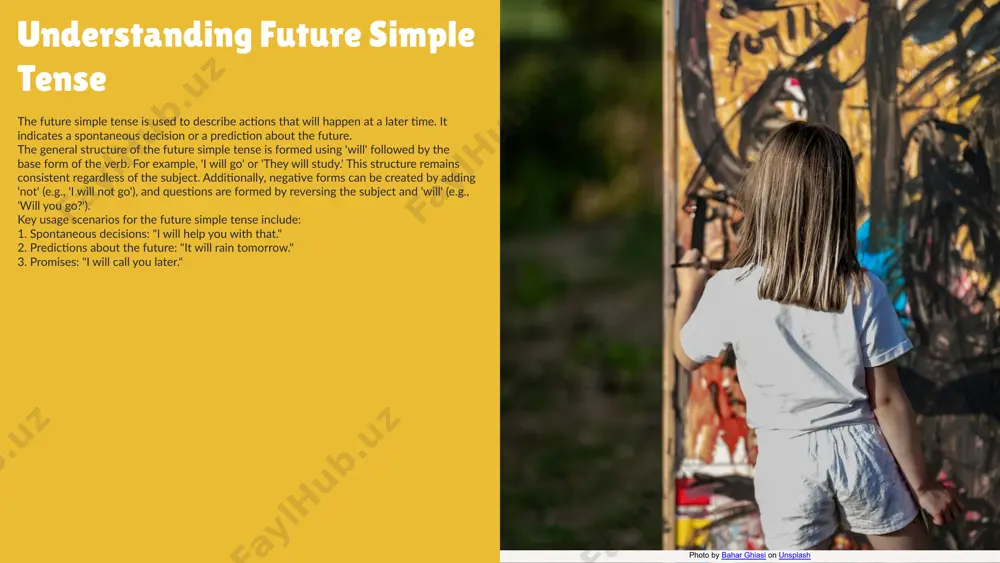
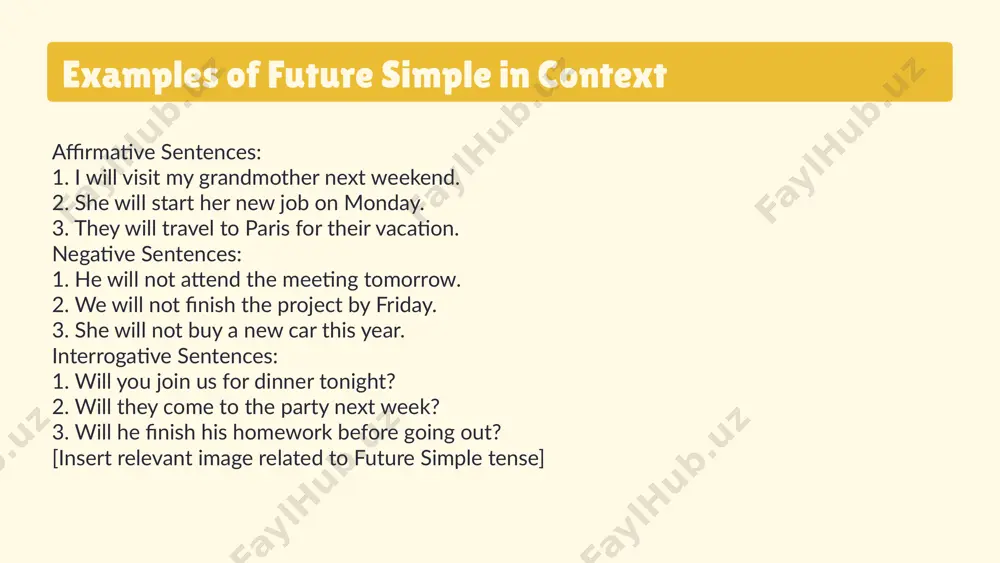
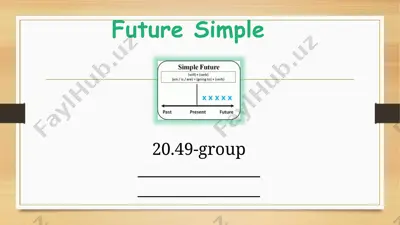
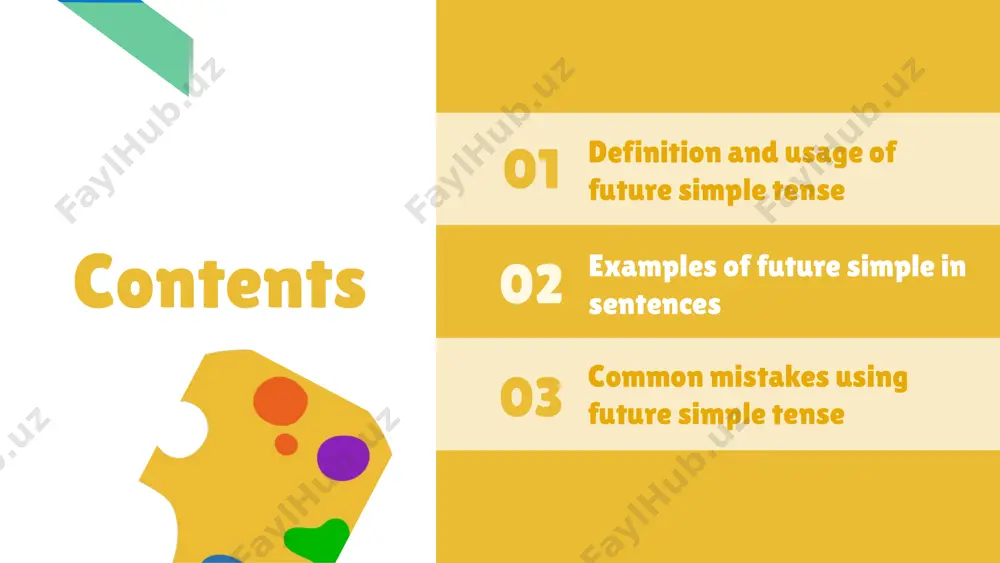
future simple karimova laylo contents definition and usage of future simple tense examples of future simple in sentences common mistakes using future simple tense 01 02 03 understanding future simple tense the future simple tense is used to describe actions that will happen at a later time. it indicates a spontaneous decision or a prediction about the future. the general structure of the future simple tense is formed using 'will' followed by the base form of the verb. for example, 'i will go' or 'they will study.' this structure remains consistent regardless of the subject. additionally, negative forms can be created by adding 'not' (e.g., 'i will not go'), and questions are formed by reversing the subject and 'will' (e.g., 'will you go?'). key usage scenarios for the future simple tense include: 1. spontaneous decisions: "i will help you with that." 2. predictions about the future: "it will rain tomorrow." …
2 / 10
t, 'will start' is the verb, and 'his new job next month' provides the object and timing. 3. "we will visit our grandparents this weekend." - in this case, 'we' is the subject, 'will visit' is the verb, and 'our grandparents this weekend' shows the object and timeframe. 4. "they will go to the concert on friday." - in this example, 'they' is the subject, 'will go' is the verb, and 'to the concert on friday' specifies the object and timing. photo by bahar ghiasi on unsplash subtitle: forming questions and negatives in future simple in the future simple tense, questions are formed by inverting the subject and the auxiliary verb "will." for example, to ask if someone will attend a meeting, you can say, "will you attend the meeting?" negative sentences are formed by adding "not" after "will," as in "i will not go to the party," which indicates …
3 / 10
- correct: "i will go to the park tomorrow." visual representation: infographics can illustrate these mistakes effectively, helping to reinforce the concepts discussed. photo by bahar ghiasi on unsplash common mistakes: - misusing verb forms, e.g., "she will goes to the store" (incorrect) vs. "she will go to the store" (correct). - failing to use the base form of the verb after "will". examples: - incorrect: "i will studies tonight." - correct: "i will study tonight." tips for avoiding mistakes: 1. always use the base form of the verb after "will". 2. double-check subject-verb agreement. 3. familiarize yourself with common time expressions, such as "tomorrow" or "next week". case studies: many learners confuse future forms when describing planned actions versus spontaneous decisions. for example, "i will eat lunch at 1 pm" indicates a plan, while "i’ll get the door" shows a spontaneous decision. summary of key takeaways: - remember to …
4 / 10
1.png image22.png image23.png image24.png
5 / 10
future simple - Page 5

Ko'proq o'qimoqchimisiz?

Barcha 10 sahifani Telegram orqali bepul yuklab oling.

To'liq faylni yuklab olish

"future simple" haqida

future simple karimova laylo contents definition and usage of future simple tense examples of future simple in sentences common mistakes using future simple tense 01 02 03 understanding future simple tense the future simple tense is used to describe actions that will happen at a later time. it indicates a spontaneous decision or a prediction about the future. the general structure of the future simple tense is formed using 'will' followed by the base form of the verb. for example, 'i will go' or 'they will study.' this structure remains consistent regardless of the subject. additionally, negative forms can be created by adding 'not' (e.g., 'i will not go'), and questions are formed by reversing the subject and 'will' (e.g., …

Bu fayl PPTX formatida 10 sahifadan iborat (2,1 MB). "future simple"ni yuklab olish uchun chap tomondagi Telegram tugmasini bosing.
Teglar: future simple PPTX 10 sahifa Bepul yuklash Telegram